

As wastewater utilities across Europe and North America accelerate sewer overflow monitoring, the demand for non-contact, corrosion-resistant radar flow meters is moving beyond conventional water-level measurement.
The reason is practical.
Combined sewer overflow chambers, storm overflow structures, pumping stations and open drainage channels are among the most difficult locations for long-term flow measurement. Hydrogen sulfide, humidity, sludge, floating debris, turbulence and intermittent flow can significantly increase maintenance requirements for submerged instruments.
At the same time, regulators increasingly expect utilities to obtain reliable information about overflow frequency, duration, hydraulic performance and pollution loads.
This is creating a growing market opportunity for non-contact radar flow measurement technology, particularly in countries with mature wastewater infrastructure and strong environmental monitoring requirements.
A New Requirement: From “Overflow Detection” to “Quantified Monitoring”
The revised EU Urban Wastewater Treatment Directive (EU) 2024/3019 places greater emphasis on monitoring storm-water overflows and developing integrated urban wastewater management plans.
Importantly, the Directive does not simply require every CSO above 10,000 population equivalent to install a specific radar flow meter. Instead, it requires representative monitoring of storm-water overflows in relevant agglomerations and requires integrated wastewater management planning where storm-water overflows create environmental or public-health risks.
For wastewater utilities, this changes the engineering question:
“How can an overflow structure generate reliable hydraulic data continuously, while minimizing maintenance in a highly corrosive environment?”
This is where non-contact radar becomes increasingly attractive.
Why Sewer Overflow Structures Are Difficult to Measure
A typical overflow chamber can experience very different hydraulic conditions within the same day.
During dry weather:
- Low flow velocity
- Sediment accumulation
- High humidity
- Hydrogen sulfide exposure
- Biofilm formation
During rainfall:
- Rapidly changing water level
- High flow velocity
- Floating debris
- Turbulence
- Foam
- Surcharging
- Backflow
For a submerged flow meter, these conditions can translate into fouling, mechanical damage, cleaning requirements and difficult maintenance access.
Hydrogen sulfide is particularly important. European wastewater research has documented how H₂S generated in sewer systems can contribute to corrosion and create difficult measurement conditions.
The engineering advantage of radar is therefore straightforward:
Measure the flow without putting the sensing element into the wastewater.
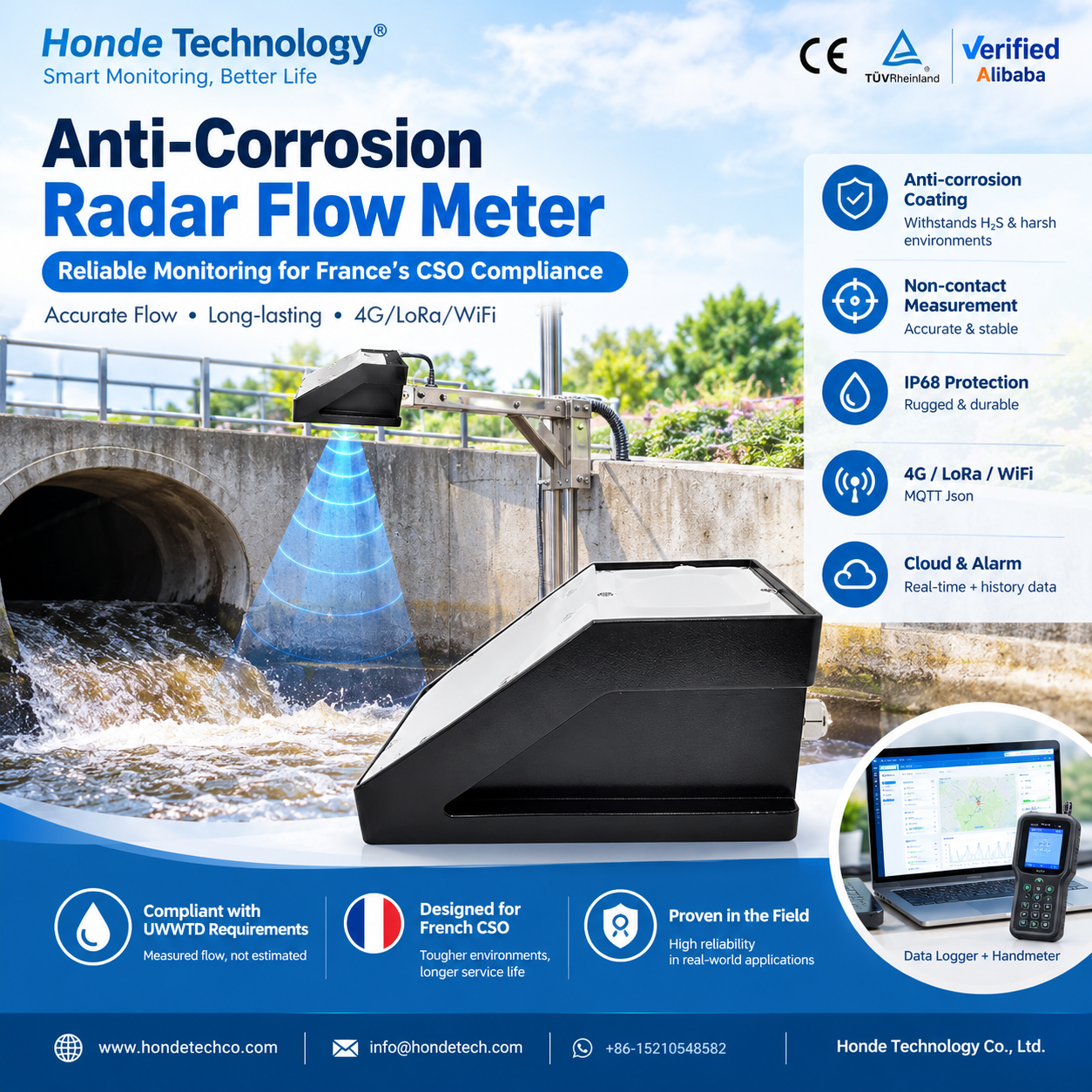
Honde RD-600S-02: 3-in-1 Non-Contact Radar Measurement
The Honde RD-600S-02 combines three important measurements in one installation:
Instead of installing a submerged electromagnetic or mechanical flow sensor directly into the wastewater stream, the radar sensor can be mounted above the channel.
RD-600S-02 Key Specifications
| Parameter | RD-600S-02 |
|---|---|
| Measurement | Velocity + Level + Flow |
| Velocity Range | 0.03–20 m/s |
| Velocity Accuracy | ±0.01 m/s |
| Level Range | Up to 15 m |
| Level Accuracy | ±2 mm |
| Beam Angle | 12° |
| Protection | IP68 |
| Surge Protection | 6,000 V |
| Output | RS485 Modbus-RTU |
| Wireless Options | GPRS / 4G / WiFi / LoRa / LoRaWAN |
| Data Protocol | MQTT / JSON |
| Operating Temperature | −40°C to +70°C |
| Commissioning | Bluetooth 5.2 / Smartphone APP |
| Installation | Non-contact |
For sewer applications, the most important feature is not simply the measurement range.
It is the combination of:
Why Anti-Corrosion Protection Matters
Standard outdoor radar equipment is not necessarily optimized for sewer environments.
A wastewater overflow chamber can expose equipment to:
Honde’s RD-600S-02 uses a hardened black industrial anti-corrosion coating designed to improve the protection of the external sensor structure in aggressive environments.
This makes the configuration particularly relevant to:
- Combined Sewer Overflow Monitoring
- Storm Overflow Monitoring
- Industrial Wastewater Channels
- Coastal Drainage Systems
- Stormwater Overflow Structures
- Open-Channel Monitoring
- Rivers and Canals
- Flood Warning Systems
The important difference:
The sensor does not need to be immersed in wastewater to measure velocity and level.
That can reduce the number of components directly exposed to sewage, sediment and debris.
International Market Demand: Where Is the Opportunity?
The strongest demand opportunity is not necessarily the country with the largest number of rivers.
It is the market where three conditions overlap:
- Large or aging wastewater infrastructure
- Increasing regulatory pressure for overflow monitoring
- Investment in digital water and remote monitoring
Based on regulatory activity, existing monitoring programs, wastewater infrastructure and publicly documented smart-sewer projects, we assess the following markets as high-potential targets.
International Market Opportunity Assessment
| Market | Regulatory Pressure | Sewer Monitoring Investment | Need for Remote Monitoring | Corrosion/Harsh Environment Need | Opportunity |
|---|---|---|---|---|---|
| United Kingdom | ★★★★★ | ★★★★★ | ★★★★★ | ★★★★☆ | Very High |
| France | ★★★★★ | ★★★★☆ | ★★★★★ | ★★★★★ | Very High |
| United States | ★★★★☆ | ★★★★★ | ★★★★★ | ★★★★☆ | Very High |
| Denmark | ★★★★☆ | ★★★★☆ | ★★★★★ | ★★★★☆ | High |
| Netherlands | ★★★★☆ | ★★★★★ | ★★★★★ | ★★★★☆ | High |
| Germany | ★★★★☆ | ★★★★☆ | ★★★★☆ | ★★★★☆ | High |
| Australia | ★★★☆☆ | ★★★★☆ | ★★★★☆ | ★★★★☆ | High |
Note: This is an engineering-market opportunity score based on publicly available regulatory and infrastructure signals, not a published national sales-volume ranking.
The UK Is Already Operating at Scale
The UK provides one of the clearest examples of how sewer overflow monitoring is evolving.
According to the UK government’s 2025 storm-overflow guidance, all storm overflows in England are now fitted with Event Duration Monitors (EDMs). The installation program was completed in December 2023. Since January 2025, water companies have also been required to publish storm-overflow information in near real time.
This creates a much more mature monitoring market than simply installing a level sensor.
Utilities need to know:
- When an overflow starts
- When it stops
- How frequently it occurs
- Where it occurs
- How the system behaves during rainfall
- Whether additional hydraulic intervention is required
The UK also has formal MCERTS requirements for flow monitoring. The Environment Agency specifies performance and management requirements for flow measurement installations, including monitoring of sewage and trade-effluent flows.
Engineering implication:
For Honde and similar suppliers, the UK market is therefore better approached as:
One important commercial point is that RD-600S-02 should not be marketed as MCERTS-certified unless the exact product/system has the required certification. MCERTS certification concerns the monitoring installation and applicable equipment requirements, not simply the fact that a sensor uses radar.
Denmark Shows the Shift Toward Data-Driven Overflow Management
Denmark provides another useful real-world example.
In March 2026, the Danish Environmental Protection Agency published results from the OVERLØB – Data-Driven Solutions for Reducing Environmental Effects of Overflows project.
The project installed:
to measure parameters including:
- Water level
- Water flow
- Temperature
- Substance concentrations
The objective was to obtain better data on the hydraulic and pollutant effects of wastewater-system overflows and use that information to target environmental improvements more accurately.
This is an important market signal.
The requirement is moving from:
to:
That is exactly the type of application in which a 3-in-1 radar system can add value.
The United States Is Also a Significant Market
The United States has a different regulatory framework, but the engineering problem is similar.
The U.S. EPA estimates that approximately 700 communities have combined sewer systems experiencing CSO discharges, concentrated particularly in the Northeast and Great Lakes regions.
EPA also promotes smart sewer systems, real-time monitoring and data infrastructure for CSO management.
For example, EPA documents smart-sewer deployments using distributed sensors, real-time controls and decision-support systems to reduce overflow volumes and improve system management.
This makes the U.S. market particularly interesting for:
- CSO outfall monitoring
- Sewer network flow monitoring
- Pump station monitoring
- Inflow and infiltration studies
- Wet-weather flow measurement
- Real-time sewer control
- Hydraulic model calibration
Where Does an Anti-Corrosion Radar Flow Meter Fit?
The strongest applications are not limited to CSO chambers.
Application Map
| Application | Main Problem | Why Radar Helps |
|---|---|---|
| Combined Sewer Overflow | Corrosion + intermittent flow | Non-contact monitoring |
| Storm Overflow | Rapidly changing flow | Velocity + level measurement |
| Wastewater Pump Station | H₂S + sludge | Sensor above wastewater |
| Open Sewer Channel | Debris + sediment | No submerged moving parts |
| Industrial Wastewater | Corrosive chemicals | Anti-corrosion housing |
| Coastal Drainage | Salt + humidity | Corrosion-resistant design |
| River Monitoring | Flood + debris | Remote non-contact measurement |
| Canal Monitoring | Variable velocity | Continuous velocity measurement |
| Flood Warning | Rapid water-level changes | Radar level + velocity |
| Hydrological Stations | Remote locations | 4G/LoRaWAN communication |
Complete IoT Architecture for Wastewater Flow Monitoring
A radar sensor alone is only the first layer.
For a utility, the real value comes from turning field measurements into usable operational data.
Honde’s solution can be configured around three layers.
Layer 1 — Field Measurement
The RD-600S-02 is installed above the water surface.
It measures: Water Velocity → Water Level → Flow Rate
The non-contact installation helps keep the sensor away from direct contact with wastewater, sludge and floating debris.
For local commissioning and verification, the system can be combined with:
- Handmeter, Data logger with screen
The Handmeter provides portable field measurement, while the Data Logger with Screen allows operators to view local measurement data without relying entirely on the cloud platform.
Layer 2 — Wireless Transmission
For different field conditions, the system can support:
- GPRS / 4G / WiFi / LoRa / LoRaWAN wireless module supports MQTT JSON format
This allows utilities to select the communication method according to site conditions.
Example:
RD-600S-02 ↓ 4G ↓ SCADA / Cloud Platform
RD-600S-02 ↓ LoRaWAN ↓ Gateway ↓ 4G / Ethernet ↓ Cloud Platform
This architecture is particularly useful where hundreds of overflow points must be monitored without installing wired communication at every location.
Layer 3 — Cloud Monitoring
The third layer is data management.
- Cloud server and software with alarm relay system support to see real-time data and historical data.
The platform can be configured to display:
- Real-time velocity
- Real-time water level
- Flow rate
- Cumulative flow
- Overflow status
- Historical trends
- Alarm status
- Communication status
- Measurement records
An alarm relay can also be configured for threshold events.
Water Level Rising ↓ Overflow Threshold Reached ↓ Alarm Relay Activated ↓ 4G / LoRaWAN Data Transmission ↓ Cloud Platform ↓ Operator Notification
This allows the monitoring system to become part of a wider wastewater SCADA or smart-sewer system.
Example: French CSO Monitoring Scenario
France is one of the most relevant European markets because the revised EU wastewater framework is increasing attention on storm-water overflows and integrated urban wastewater management.
A practical deployment could look like this:
Existing CSO structure
A combined sewer carries:
Domestic wastewater + Industrial wastewater + Rainwater
During normal conditions:
Sewer → Treatment Plant
During heavy rainfall:
Sewer capacity exceeded → Overflow structure → Receiving water
The monitoring system is installed above the overflow channel.
Proposed Configuration
| Component | Function |
|---|---|
| RD-600S-02 | Velocity + Level + Flow |
| Anti-corrosion housing/coating | Protection in aggressive environment |
| Data Logger | Local data recording |
| Screen | Local visualization |
| Handmeter | Portable verification |
| 4G | Main remote communication |
| LoRaWAN | Alternative for distributed sites |
| MQTT JSON | Data integration |
| Cloud Software | Real-time + historical data |
| Alarm Relay | Threshold/event alarm |
| SCADA | Utility-level management |
The objective is not merely to produce a sensor reading.
It is to create a continuous chain:
Why Non-Contact Radar Can Reduce Maintenance
The traditional measurement question is often:
For wastewater applications, another question is equally important:
A non-contact radar configuration can reduce exposure to:
This can be particularly valuable at remote overflow structures where maintenance access is expensive or where confined-space entry creates additional safety requirements.
The UK MCERTS EDM guidance explicitly emphasizes that monitoring equipment should be accessible for safe maintenance, inspection and verification, and that the monitoring point should not interfere with cleaning and maintenance of the overflow structure.
High-Conversion Keywords for the International Market
Based on the terminology used by regulators, utilities and the wastewater-monitoring industry, the most commercially useful keywords should focus on application + measurement + technology, rather than simply repeating “water flow sensor.”
Core High-Intent Keywords
| Keyword | Search/Commercial Intent |
|---|---|
| radar flow meter | ★★★★★ |
| radar flow sensor | ★★★★★ |
| non contact flow meter | ★★★★★ |
| wastewater flow meter | ★★★★★ |
| sewer flow meter | ★★★★★ |
| open channel flow meter | ★★★★★ |
| radar water flow meter | ★★★★★ |
| water velocity sensor | ★★★★☆ |
| radar velocity sensor | ★★★★☆ |
| wastewater flow monitoring | ★★★★★ |
| sewer flow monitoring | ★★★★★ |
| stormwater flow monitoring | ★★★★★ |
| CSO flow monitoring | ★★★★★ |
| sewer overflow monitoring | ★★★★★ |
| storm overflow monitoring | ★★★★★ |
| combined sewer overflow monitoring | ★★★★★ |
| wastewater radar sensor | ★★★★☆ |
| non contact radar flow sensor | ★★★★★ |
| 3 in 1 radar flow meter | ★★★★★ |
| water level velocity flow sensor | ★★★★☆ |
High-Value Long-Tail Keywords
- anti corrosion radar flow meter
- corrosion resistant wastewater flow meter
- non contact sewer flow meter
- radar flow meter for wastewater
- radar flow meter for sewer overflow
- radar sensor for combined sewer overflow
- CSO radar flow monitoring
- storm overflow radar sensor
- wastewater radar velocity sensor
- open channel radar flow meter
- remote wastewater flow monitoring
- 4G radar flow meter
- LoRaWAN radar flow meter
- MQTT wastewater monitoring
- IoT sewer flow monitoring
- smart sewer flow monitoring
- radar flow meter for pumping station
- non-contact wastewater flow measurement
The strongest SEO keyword combination:
Anti-Corrosion Non-Contact Radar Flow Meter for Wastewater and Sewer Overflow Monitoring
rather than using a title containing a long chain of unrelated technical keywords.
Market Demand Priority Chart
Based on the regulatory environment, existing overflow-monitoring programs, smart-water investment and the need for remote measurement, the current market opportunity can be visualized as follows:
Relative Market Opportunity for Non-Contact Radar Flow Monitoring
Index = Honde engineering-market opportunity assessment, not official market-size data.
The UK currently stands out because storm-overflow monitoring is already highly developed: all storm overflows in England have EDM systems, and near-real-time publication requirements have been in place since January 2025.
France is particularly interesting for new European infrastructure investment, while Denmark demonstrates how dense sensor networks and data-driven overflow management are being used to improve understanding of environmental impacts.
The United States represents a different but substantial opportunity because of its large installed base of combined sewer systems and established CSO monitoring and smart-sewer programs.
From a Sensor to a Smart Sewer Monitoring System
The next generation of wastewater monitoring will not be defined by one sensor technology.
It will be defined by how effectively field instruments generate reliable data for utility operators.
A modern system can therefore be structured as:
↓
RD-600S-02 Radar
Velocity + Level + Flow
↓
Data Logger + Screen
↓
4G / WiFi / LoRa / LoRaWAN
↓
MQTT / JSON Data
↓
Cloud Server
↓
Real-Time Data + Historical Data
↓
Alarm Relay
↓
Utility / SCADA
This architecture can be adapted from a single remote monitoring point to a distributed network covering dozens or hundreds of locations.
The Real Value Is Not Only Flow Measurement
For wastewater utilities, the value of an anti-corrosion radar flow meter can be summarized in five areas:
01 — Reduce Direct Contact with Wastewater
Non-contact measurement keeps the primary sensing process above the water surface.
02 — Improve Measurement Availability
The system is designed for continuous measurement rather than occasional manual inspection.
03 — Reduce Maintenance Pressure
The radar configuration avoids placing the primary velocity measurement element directly in sludge and wastewater.
04 — Connect Remote Sites
4G, WiFi, LoRa and LoRaWAN enable different communication architectures.
05 — Build a Digital Monitoring Network
Cloud software, MQTT/JSON communication, alarms and historical data turn individual sensors into a distributed monitoring system.
Conclusion: The Market Is Moving from “Overflow Detection” to “Hydraulic Intelligence”
The future of sewer overflow monitoring is not simply about detecting whether a chamber has spilled.
Utilities increasingly need to understand:
- When did the event happen?
- How long did it last?
- How fast was the water moving?
- How much water passed through the structure?
- What happened during rainfall?
- Which overflow structures require investment first?
This is why non-contact radar flow measurement is becoming increasingly relevant to wastewater and stormwater infrastructure.
The regulatory approaches differ between France, the UK, Denmark, the Netherlands, Germany and the United States, but the engineering challenge is remarkably similar: obtain reliable hydraulic information from difficult environments while controlling maintenance and operating costs.
For this application, the combination of anti-corrosion protection, non-contact velocity measurement, water-level measurement, flow calculation and IoT connectivity makes the Honde RD-600S-02 a strong candidate for next-generation wastewater, CSO, storm-overflow and open-channel monitoring projects.
Honde Technology — Smart Monitoring for Water Infrastructure
Honde Technology Co., Ltd.
Product: RD-600S-02 Anti-Corrosion 3-in-1 Radar Flow Meter
Applications:
- Combined Sewer Overflow Monitoring
- Storm Overflow Monitoring
- Wastewater Flow Monitoring
- Pump Station Monitoring
- Open Channel Flow Measurement
- River & Canal Monitoring
- Flood Warning
- Industrial Wastewater Monitoring
Solutions:
- Handmeter, Data Logger with Screen
- GPRS / 4G / WiFi / LoRa / LoRaWAN
- MQTT / JSON Data Transmission
- Cloud Server & Software
- Real-Time Data & Historical Data
- Alarm Relay System
- Remote Monitoring
Post time: Sep-15-2026