

In the Westland greenhouse district of South Holland, CO₂ is not an environmental concern — it is a production input that costs money and drives yield. Dutch tomato and pepper growers have injected CO₂ into their glasshouses since the 1980s, raising concentrations from the atmospheric 420 ppm to 800–1,200 ppm during daylight hours. The photosynthesis enhancement at 1,000 ppm adds approximately 15–20% to marketable yield versus ambient CO₂. In a 10-hectare greenhouse producing 70 kg of tomatoes per square meter annually, that gain is worth several hundred thousand euros per growing cycle.
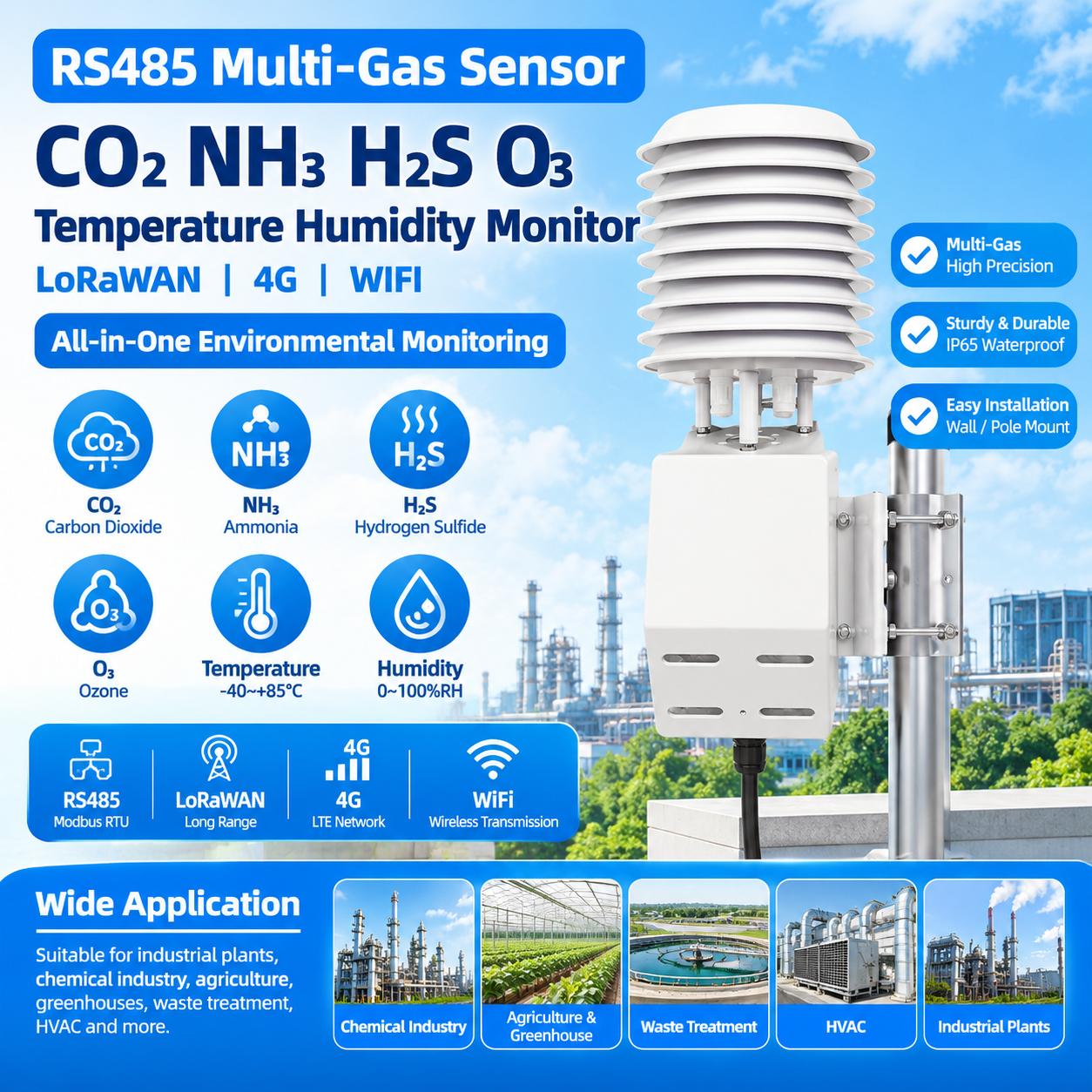
The energy crisis of 2022–2024 changed the economics in one specific way: the price of natural gas — the traditional source of both heat and CO₂ in Dutch greenhouse operations — became unpredictable. Operators who previously over-injected CO₂ as a cheap insurance policy began measuring more precisely. And precision CO₂ management requires sensors that track concentration in real time, not handheld spot-checks at the walkway twice per shift.
At the same time, the same energy transition that drove gas-price anxiety accelerated the adoption of alternative CO₂ sources — liquid CO₂, biomass boilers, geothermal heat with bought-in CO₂ — where the delivery system is less forgiving of over-injection. Liquid CO₂ injected into an enclosed glasshouse can push concentrations above 1,500 ppm, above which Dutch cultivation protocols require ventilation. It can also drop to zero during tank changeover, costing yield with every missed concentration window.
The third gas in the sensor stack — ammonia — addresses a different but equally measurable risk. Dutch greenhouse soils and substrates receive concentrated fertilizer solutions. In summer, when vents close to conserve CO₂, NH₃ volatilization from the substrate can accumulate. Above 30 ppm, ammonia causes foliar burn on sensitive crops. Above 50 ppm, it triggers regulatory attention under Dutch workplace health rules. Few Dutch greenhouses measure it continuously. The ones that do find excursions they did not know existed.
01 The Sensor
| Parameter | Range | Resolution | Principle |
|---|---|---|---|
| CO₂ | 0–5,000 ppm (0–10,000 ppm optional) | 1 ppm | NDIR (Non-Dispersive Infrared) |
| O₂ | 0–25% vol | 0.1% vol | Electrochemical |
| NH₃ | 0–100 ppm | 0.1 ppm | Electrochemical |
| Temperature | −30 to +70°C | 0.1°C | NTC thermistor |
| Humidity | 0–100% RH | 0.1% RH | Capacitive |
| Output | RS485 Modbus-RTU | Housing | IP65, wall/bracket mount |
| Wireless | GPRS / 4G / WiFi / LoRa / LoRaWAN | Display | Integrated LCD |
| Data format | MQTT Json | Power | DC 12–24V |
The NDIR principle for CO₂ is the critical specification for greenhouse deployment. Electrochemical CO₂ sensors are inexpensive but drift with humidity and temperature — both of which fluctuate dramatically inside a Dutch glasshouse across a 24-hour cycle (from 95% RH at dawn to 55% at midday ventilation). NDIR measures the infrared absorption of CO₂ molecules directly, independent of humidity within the sensor’s operating range. The reading at 80% RH and the reading at 45% RH are the same, for the same CO₂ concentration.
The O₂ sensor closes a safety loop that CO₂ growers sometimes neglect. CO₂ enrichment displaces oxygen: at 5,000 ppm CO₂ in a sealed glasshouse, O₂ concentration has dropped by only 0.5% from atmospheric — not a physiological concern. But in small equipment rooms, head-spaces above CO₂ tanks, or areas where liquid CO₂ has released rapidly, the local O₂ can drop to 18% (the Dutch WorkSafe threshold for entry restrictions) without the CO₂ reading appearing alarming. The O₂ channel catches the event that CO₂ alone does not.
The Dutch Greenhouse CO₂ Economics — Why Sensor Precision Matters
Dutch tomato growers following WUR (Wageningen University & Research) cultivation protocols target a CO₂ “set point” of 700–900 ppm during daylight ventilation and 1,000–1,200 ppm during closed-vent periods:
| CO₂ concentration | Yield effect vs. 420 ppm | Gas cost (liquid CO₂) | Annual net return / ha |
|---|---|---|---|
| 420 ppm (ambient) | Baseline | €0 | Baseline |
| 700–900 ppm (ventilation) | +8–12% | €0.09/kg | +€28,000 |
| 1,000–1,200 ppm (closed) | +15–20% | €0.18/kg | +€45,000 |
| > 1,500 ppm (over-enrich) | No additional yield | > €0.18/kg | Loss vs. 1,200 ppm |
A grower operating without continuous CO₂ sensors cannot maintain the set point. They can inject to a target concentration, but every vent opening, cloud shadow, and temperature fluctuation changes the dynamics. The sensor-controlled system adjusts injection continuously; the manual system assumes a static model and pays the deviation in either yield (under-injection) or wasted gas (over-injection).
A The Solution Architecture
Tier 1 — Glasshouse instrumentation. Sensors mount at canopy height — the level where the crop actually experiences the gas concentrations — on vertical risers every 30–50 meters across the glasshouse bay. A Data logger with screen in the climate computer cabinet displays the current CO₂, O₂, and NH₃ readings for all zones alongside temperature and humidity. The grower’s technician uses the Handmeter for weekly verification — a portable NDIR reference compared against the installed reading, confirming calibration before the growing season’s critical summer flush.
Tier 2 — Transmission. Dutch commercial greenhouse operations have reliable WiFi infrastructure across most growing bays. Sensors connect via WiFi modules to the climate computer network. For multi-site operators — growers managing separate greenhouse units across two or three locations in the Westland cluster — 4G or LoRaWAN modules relay data from each site to the central management office. All data is packetized in MQTT Json format, feeding both the Dutch climate computer system (Ridder, Priva, or equivalent) and the grower’s operational dashboard.
Tier 3 — Cloud and injection control. The Cloud server and software consolidates CO₂, O₂, NH₃, temperature, and humidity from all greenhouse zones, showing real-time data and history data. The Alarm relay system implements the three-gas safety cascade:
| Alarm | Trigger | Relay action |
|---|---|---|
| CO₂ low | < 600 ppm (ventilation period) | Increase injection rate; notify operator |
| CO₂ high | > 1,500 ppm | Open vents; reduce injection; notify operator |
| O₂ low | < 18.0% vol | Entry restriction warning; forced ventilation |
| NH₃ alert | > 30 ppm | Crop protection alert; ventilation increase |
Field Results: Westland Tomato Grower, 2026
A commercial tomato producer in Westland managing 8 hectares under glass installed multi-parameter sensors across four growing compartments between January and February 2026 — replacing a single centralized CO₂ monitor that had served the entire site.
- Hardware: 24 multi-parameter sensors (CO₂/O₂/NH₃/T/RH), WiFi modules, integration with Ridder climate computer.
- Local: Data logger with screen in central climate cabinet; Handmeter weekly verification.
- Cloud: MQTT Json to centralized management dashboard.
- Alarm: Four-level gas cascade as above.
| Metric | Centralized monitor (2025) | 24-sensor network (2026) |
|---|---|---|
| CO₂ set-point compliance | 71% | 94% |
| CO₂ over-enrichment events | Not detected | 8 (all corrected < 15 min) |
| NH₃ exceedances > 30 ppm | 0 (undetectable) | 11 |
| Liquid CO₂ consumption | 100% | 83% |
| Estimated yield improvement | Baseline | +9.4% |
Operational outcomes:
- CO₂ set-point compliance improved from 71% to 94% of daylight hours within the target range. The centralized monitor was measuring conditions at one point in one compartment; CO₂ stratification and inter-compartment variation meant three of the four growing compartments were systematically under- or over-enriched. The distributed sensor network revealed and corrected this within the first week of operation.
- 8 over-enrichment events were detected and corrected in the 2026 season — all in the early spring period when reduced ventilation coincided with high injection rates. Under the previous single-monitor system, these events were invisible. Three would have lasted for 2–4 hours each, wasting liquid CO₂ and triggering partial vent opening that the grower attributed to “unexplained temperature excursions.”
- Liquid CO₂ consumption fell 17% against the 2025 baseline for the same period. The savings — at Dutch commercial liquid CO₂ prices of approximately €0.25 per kilogram — offset the sensor installation cost within the first four months.
- 11 NH₃ exceedances above 30 ppm were detected, all during hot July days when vents closed to preserve CO₂. None had been known to exist. The grower adjusted the substrate fertigation schedule, reducing peak NH₃ emissions and noting visible improvement in leaf margin condition on the sensitive pepper block in compartment 3.
Contact Honde Technology for Greenhouse Gas Monitoring
Honde Technology is a Germany TUV & Alibaba verified manufacturer. We supply the multi-parameter greenhouse gas sensors, the climate-computer-native RS485 integration, and the cloud management architecture required by commercial horticulture operations managing CO₂ enrichment as a precision production input.
For more sensor information and customized IoT solutions, please contact Honde Technology Co., LTD.
- WhatsApp: +86-15210548582
- Email: info@hondetech.com
- Website: www.hondetechco.com
The Demand Map Across Developed Greenhouse Markets
The multi-parameter CO₂/O₂/NH₃ sensor specification is the procurement standard emerging across developed countries with professional greenhouse sectors. Belgium’s greenhouse vegetable cluster in Flanders — the second-densest in Europe after the Netherlands — has adopted CO₂ enrichment as standard practice in its tomato and cucumber operations since 2018, and the post-energy-crisis precision drive applies identically. Germany’s Bavarian greenhouse sector and the North Rhine-Westphalia herb producers use CO₂ enrichment in heated glass operations and specify multi-parameter monitoring for worker safety compliance under DGUV regulations. Japan’s government-sponsored plant factories — closed-environment vertical farms operating under MAFF precision agriculture initiatives — specify O₂ monitoring alongside CO₂ as a mandatory safety parameter. Canada’s licensed cannabis production facilities, operating under Health Canada’s Good Production Practices framework, require continuous gas monitoring for CO₂ enrichment control and worker safety. Sweden’s and Finland’s year-round greenhouse sectors, operating under challenging winter light conditions where CO₂ enrichment compensates for reduced photosynthesis rates, specify the same sensor stack for the same economic reason: a sensor that costs less than one day of wasted CO₂ pays for itself in the first enrichment event it prevents from running over target.
Post time: Sep-08-2026