

The first visible symptom of nitrite poisoning in rainbow trout is not behavioral. The fish do not swim erratically, do not surface gasp, do not bunch at the inlet. The first symptom is blood that turns brown. Nitrite enters the bloodstream through the gills, oxidizing the iron in haemoglobin from Fe²⁺ to Fe³⁺, forming methaemoglobin — a compound that cannot carry oxygen. The fish are asphyxiating in well-oxygenated water. By the time the farm worker sees the brown gill color during a routine mortality check, the damage is irreversible in the affected individuals.
In a recirculating aquaculture system producing rainbow trout in Brittany or the Vosges, the nitrite concentration can climb from safe to lethal within 18 to 36 hours of a biofilter upset. The upset has many triggers: a temperature drop that slows nitrifying bacteria, an accidental chlorination event during cleaning that kills the biofilm, an organic overload from a feeding equipment failure. None of these events announce themselves. The biofilter appears normal. The water looks clean. The dissolved oxygen is excellent. And the nitrite is rising.
The only instrument that detects the crisis before the gills turn brown is a continuous online nitrite sensor.
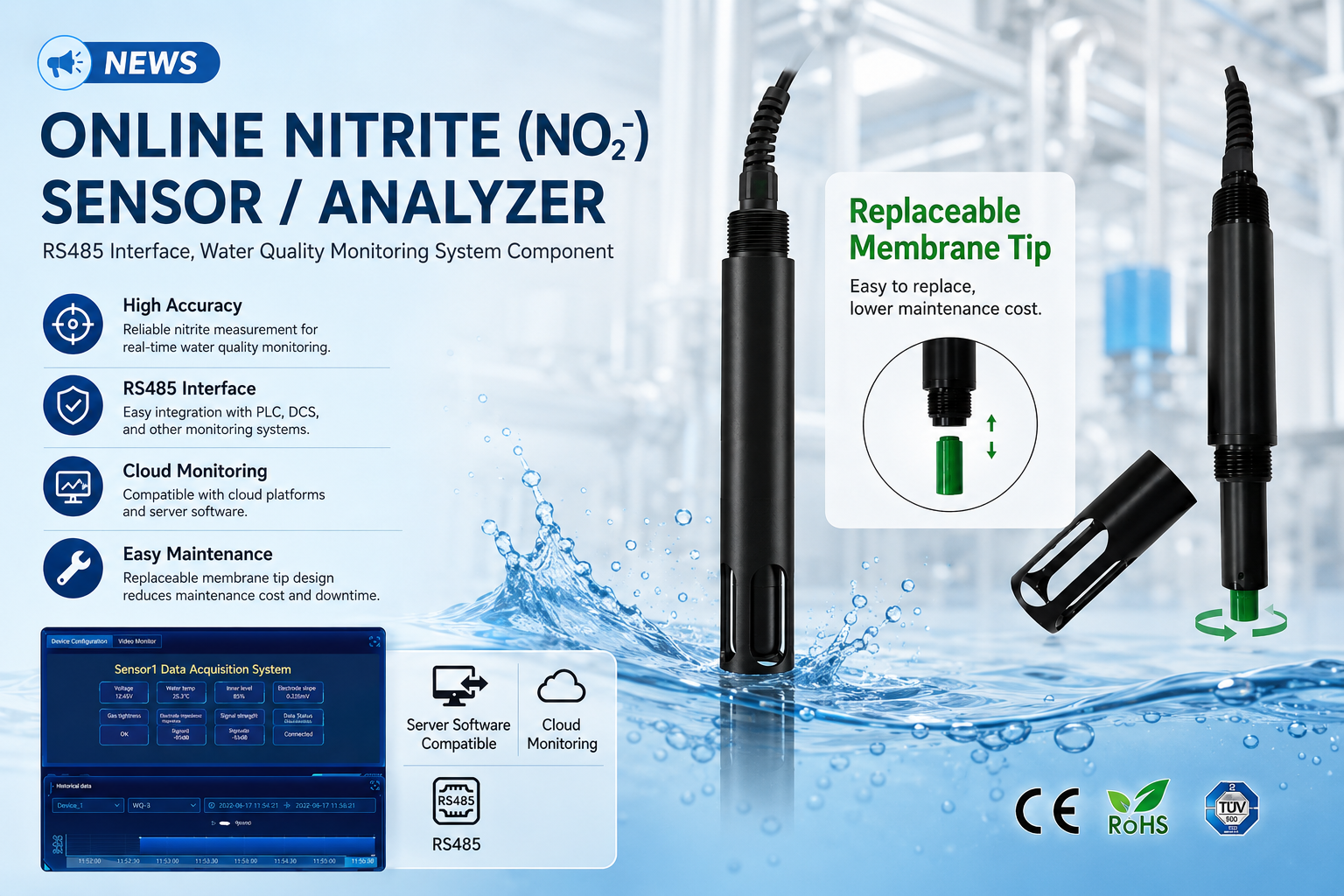
The Product
The Honde RD-WNTI-01 uses the Laminating Ion Selection Method — a layered ion-selective electrode architecture that addresses the primary measurement challenge in aquaculture water: interference. Standard ISE nitrite sensors are cross-sensitive to nitrate and chloride, both present in significant concentrations in a trout RAS. A chloride concentration of 50 mg/L (typical for trout systems at moderate salinity) can produce a false nitrite reading of 0.3–0.8 mg/L on an uncompensated sensor — a reading that sits squarely in the “watch closely” range, confusing the operator about whether there is a real problem.
The laminating electrode layers use membrane selectivity coefficients tuned to reject chloride and nitrate interference, providing a nitrite reading specific enough for the 0–10 mg/L range that governs life and death in a trout tank.
| Specification | Value |
|---|---|
| Model | RD-WNTI-01 |
| Measurement principle | Laminating Ion Selection (layered ISE) |
| Measurement range | 0–10.00 mg/L or 0–100.0 mg/L |
| Resolution | 0.01 mg/L (0–10 range) |
| Accuracy | ±5% FS or ±3 mg/L |
| Response time | 30 seconds |
| Output | RS485 Modbus-RTU / 4–20 mA |
| Wireless | GPRS / 4G / WiFi / LoRa / LoRaWAN |
| Housing | POM, IP68, 20 m depth rating |
| Operating temperature | 0–60°C |
| Primary application | Aquaculture, wastewater treatment |
The 30-second response time determines whether the sensor is an early-warning instrument or a post-event recorder. In a 50,000-liter production tank with a nitrite concentration climbing at 0.15 mg/L per hour during a biofilter crash, a 30-second response gives 12 minutes of warning advantage over a sensor with a 20-minute response. In a well-managed farm, 12 minutes is enough time to increase water exchange, bypass the biofilter, and start emergency NaCl dosing — the standard nitrite mitigation: salt reduces nitrite uptake across the gills.
Nitrite Toxicity Reference
| Nitrite concentration | Effect on rainbow trout |
|---|---|
| 0.05–0.1 mg/L | Stress threshold in soft water; blood O₂ capacity reduced |
| 0.2–0.5 mg/L | Sublethal: growth depression, immune suppression |
| 0.5–1.0 mg/L | Acute toxicity onset; feeding cessation |
| 1.0–2.0 mg/L | Methaemoglobinaemia visible; significant mortality risk |
| > 2.0 mg/L | Mass mortality in uncompensated systems |
The French Trout Farming Context
France produces approximately 55,000 tonnes of rainbow trout annually — the EU’s largest national output — concentrated in Brittany (Finistère, Côtes-d’Armor), Normandie, and the highland regions of Auvergne-Rhône-Alpes and Grand Est. The industry is shifting from pure flow-through systems toward partial or full recirculation to reduce water consumption and meet environmental discharge regulations under France’s Water Law (Loi sur l’Eau et les Milieux Aquatiques, LEMA 2006).
As recirculation intensity increases, so does the dependence on the biofilter — and therefore the exposure to nitrite risk. A flow-through system that exchanges 300% of its volume per day dilutes any nitrite buildup rapidly. A system exchanging 10% per day must rely entirely on its biofilter to keep nitrite below the tolerance threshold.
The Solution Architecture
Tier 1 — Tank instrumentation
The RD-WNTI-01 is deployed in the biofilter return line — the point where water exits the biological filter and re-enters the fish tank. This is where nitrite is lowest if the biofilter is healthy, and where it rises first when the biofilter is stressed. A Data logger with screen in the farm’s control room displays the current nitrite concentration, the 24-hour trend, and alarm status. The farm manager uses the Handmeter weekly for verification — a water sample analyzed with a photometric reference kit, compared against the installed sensor reading.
Tier 2 — Transmission
The RS485 output connects to the farm’s PLC or RTU. For regional farms in rural Brittany or the Vosges without stable 4G coverage, LoRaWAN or GPRS modules relay data to the county extension service’s monitoring platform. Urban farms near major infrastructure use 4G or WiFi modules. All data is packetized in MQTT Json format, feeding the farm management software.
Tier 3 — Cloud and nitrite crisis response
The Cloud server and software consolidates nitrite data alongside DO, ammonia, pH, and temperature, showing real-time data and history data. The Alarm relay system is the critical safety mechanism: when nitrite exceeds 0.3 mg/L — the early intervention threshold — the relay triggers three simultaneous actions: increases the water exchange rate, alerts the farm manager’s mobile device, and logs the event. If nitrite reaches 0.6 mg/L, a second relay activates the emergency NaCl dosing pump.
Field Results: Brittany Trout Farm, March–July 2026
A commercial rainbow trout producer in Finistère, operating four production circuits at partial recirculation (40% daily water exchange), installed RD-WNTI-01 sensors in the biofilter return lines of all four circuits between February and March 2026.
Hardware: 4 nitrite sensors (one per production circuit), RS485 to farm PLC, 4G module to farm management platform.
Local: Data logger with screen in control room; Handmeter verification weekly.
Cloud: MQTT Json to farm management system.
Alarm: First relay at 0.3 mg/L (exchange rate increase + SMS alert); second relay at 0.6 mg/L (NaCl dosing activation).
Nitrite monitoring event summary, March–July 2026:
| Month | Events > 0.3 mg/L | Events > 0.6 mg/L | Emergency NaCl doses | Mortality attributed to nitrite | Response time (sensor to intervention) |
|---|---|---|---|---|---|
| March | 1 | 0 | 0 | 0 | 8 minutes |
| April | 3 | 1 | 1 | 0 | 6–12 minutes |
| May | 0 | 0 | 0 | 0 | — |
| June | 2 | 0 | 0 | 0 | 7–9 minutes |
| July | 1 | 1 | 1 | 0 | 5 minutes |
Operational outcomes:
- Zero mortality attributed to nitrite across all four production circuits during the five-month period — the first nitrite-zero mortality season in the farm’s six-year operating history.
- The April biofilter crash — the most significant event — was caused by an accidental bleach contact during cleaning that suppressed the biofilm for 72 hours. The sensor detected the rising nitrite within 18 hours of the bleach event. The alarm relay’s first threshold triggered an exchange rate increase that held nitrite below 0.6 mg/L for 36 hours while the biofilm recovered. The farm manager estimated the prevented mortality at approximately €24,000 in trout biomass at that stage of the production cycle.
- The Handmeter verification program — weekly photometric reference checks — found sensor accuracy within ±0.08 mg/L across all four sensors over the five months, with zero events requiring sensor replacement.
- A secondary benefit emerged: the continuous nitrite data allowed the farm manager to optimize the biofilter loading rate, increasing biomass density in two circuits by 12% without exceeding nitrite safety margins — a production gain that would have been undetectable under the previous regime of twice-daily manual tests.
Contact Honde Technology for Aquaculture Water Quality Monitoring
Honde Technology is a Germany TUV & Alibaba verified manufacturer. We supply the laminating ISE nitrite measurement hardware, the aquaculture-optimized response time, and the alarm relay architecture required by intensive trout and salmon producers operating under increasing recirculation.
For more sensor information and customized IoT solutions, please contact Honde Technology Co., LTD.
-
WhatsApp: +86-15210548582
-
Email: info@hondetech.com
-
Company Website: www.hondetechco.com
Post time: Aug-26-2026