

A biogas digester produces a gas mixture that is simultaneously explosive, toxic, and corrosive. Raw biogas leaving a German agricultural digester typically contains 50–65% methane, 35–45% carbon dioxide, and — depending on feedstock — between 100 and 3,000 ppm hydrogen sulfide. Around the digestate storage tanks, ammonia off-gassing from nitrogen-rich substrate adds a fourth hazard.
Each gas kills differently. Methane at 5–15% concentration in air is explosive — a single spark from a pump motor or a static discharge from a plastic pipe detonates the headspace. Hydrogen sulfide at 700 ppm causes immediate respiratory paralysis; at 100 ppm it destroys the sense of smell, removing the only natural warning. Ammonia at 300 ppm causes irreversible lung damage within 30 minutes.
German plant operators historically deployed three separate single-gas detectors — a methane unit at the digester dome, an H₂S unit at the gas treatment skid, an ammonia monitor at the digestate tank. Three devices, three calibration schedules, three sets of consumable sensor cells, three cable runs, three data protocols. For a plant with 6 monitored zones, that is 18 devices to maintain, and the annual calibration and cell-replacement labor exceeds €8,000.
The consolidation logic is straightforward: one sensor housing, three gas cells, one RS485 output, one calibration visit.
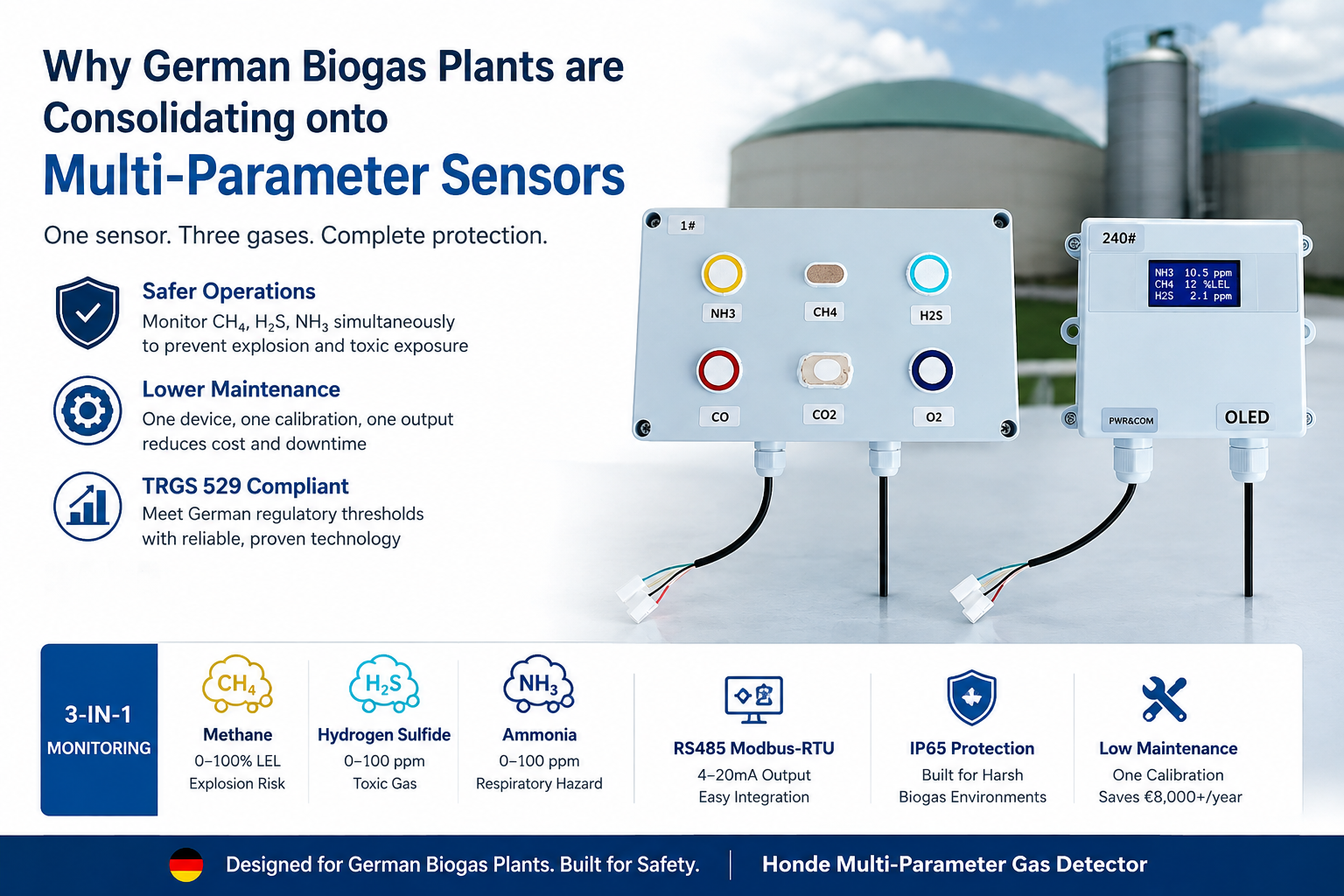
The Sensor
The Honde multi-parameter gas detector integrates NH₃, CH₄, and H₂S measurement in a single wall-mounted unit with an integrated LCD and RS485 Modbus-RTU output.
| Parameter | Range | Resolution | Sensing principle |
|---|---|---|---|
| Methane (CH₄) | 0–100% LEL | 1% LEL | Catalytic / IR |
| Hydrogen Sulfide (H₂S) | 0–100 ppm (ext. 0–1000 ppm) | 0.1 ppm | Electrochemical |
| Ammonia (NH₃) | 0–100 ppm | 0.1 ppm | Electrochemical |
| Temperature / Humidity | -30 to +85°C / 0–100% RH | 0.1°C / 0.1% RH | Digital |
| Output | RS485 Modbus-RTU / 4–20 mA | Housing | IP65, wall/bracket mount |
| Wireless | GPRS / 4G / WiFi / LoRa / LoRaWAN | Display | Integrated LCD |
The specification that matters most in a biogas environment is not detection range — it is cross-sensitivity management. H₂S poisons catalytic methane sensors. An unprotected catalytic bead exposed to 500 ppm H₂S loses 20–40% of its sensitivity within weeks, and the operator has no indication: the sensor reads low, the alarm never triggers, and the plant believes its methane monitoring is functional. The Honde unit applies H₂S-resistant filtering on the methane cell and cross-compensates the electrochemical cells against each other, maintaining calibration through the full biogas gas matrix.
German Regulatory Context
TRGS 529 defines the monitoring obligations at biogas facilities. The relevant thresholds:
| Zone | Primary hazard | Regulatory threshold | Typical field concentration |
|---|---|---|---|
| Digester dome / gas dome | CH₄ explosion | 20% LEL (alarm) | 0–5% LEL (normal), > 50% LEL (leak) |
| Gas treatment / desulfurization | H₂S toxicity | 5 ppm (8h AGW), 10 ppm (alarm) | 100–3,000 ppm (raw gas side) |
| Digestate storage | NH₃ toxicity | 20 ppm (8h AGW) | 5–80 ppm (seasonal) |
| CHP engine room | CH₄ + confined space | 20% LEL | Variable |
| Substrate feed hopper | H₂S + NH₃ | 10 ppm / 20 ppm | 10–200 ppm H₂S |
AGW = Arbeitsplatzgrenzwert, the German occupational exposure limit.
The Solution Architecture
Tier 1 — Plant-level instrumentation
Multi-gas units are wall-mounted at each monitored zone. The integrated LCD gives the plant operator an immediate local reading during rounds. A Data logger with screen in the control room aggregates all zones, displaying current concentrations and 30-day history — the record that TRGS 529 requires operators to maintain and produce on inspection.
During the annual TÜV inspection, the maintenance technician verifies each fixed unit against a Handmeter — a portable multi-gas reference with calibration gas, confirming that the fixed sensors read within tolerance before the inspector signs off.
Tier 2 — Transmission
Digester domes and remote digestate lagoons are frequently 200–500 meters from the plant control building, across ground where cable trenching is impractical. LoRaWAN modules cover these distances on the plant’s own gateway. Zones inside the main building use RS485 wired to the PLC or WiFi. Plants in multi-site operator portfolios use 4G or GPRS to report to a central monitoring office. All data is packetized in MQTT Json format.
Tier 3 — Cloud and alarm cascade
The Cloud server and software consolidates gas concentrations from all zones and all plants in an operator’s portfolio, showing real-time data and history data. The Alarm relay system implements the TRGS-aligned cascade:
| Alarm level | Condition | Relay action |
|---|---|---|
| Pre-alarm | CH₄ > 10% LEL, or H₂S > 5 ppm, or NH₃ > 20 ppm | Local strobe + operator SMS |
| Main alarm | CH₄ > 20% LEL, or H₂S > 10 ppm, or NH₃ > 50 ppm | Audible siren, zone entry lockout, ventilation start |
| Emergency | CH₄ > 40% LEL, or H₂S > 50 ppm | Emergency shutdown of CHP + gas flare isolation, escalation to on-call engineer |
Field Results: Lower Saxony Biogas Portfolio, 2026
An operator running seven agricultural biogas plants in Lower Saxony — Germany’s densest biogas region — replaced 126 single-gas detectors with 42 Honde multi-parameter units between November 2025 and February 2026.
- Hardware: 42 multi-gas units (6 zones per plant × 7 plants).
- Transmission: LoRaWAN at digester and lagoon zones (18 units); RS485/WiFi at building zones (24 units). MQTT Json to the operator’s central monitoring platform.
- Local: Data logger with screen in each plant control room; Handmeter verification at annual TÜV inspection.
- Alarm: Three-level TRGS 529 cascade with CHP shutdown interlock.
Six-month operational comparison:
| Metric | Single-gas fleet (2025) | Multi-parameter fleet (2026) |
|---|---|---|
| Devices under maintenance | 126 | 42 |
| Annual calibration labour (hours) | 189 | 63 |
| Sensor cell replacements (6 months) | 31 | 11 |
| Undetected methane cell degradation events | 4 | 0 |
| H₂S alarms triggered | 22 | 47 |
| Confined-space entries blocked by interlock | 0 | 9 |
| Annual maintenance cost (indexed) | 100% | 41% |
Operational outcomes:
- The 47 H₂S alarms in the multi-parameter fleet against 22 in the single-gas baseline was not an increase in hazard — it was an increase in detection. Four of the previous fleet’s methane cells had been degraded by H₂S poisoning, and three H₂S units had drifted low without triggering their own fault alarms. The consolidated units caught events the previous fleet had been reading through.
- 9 confined-space entries were blocked by the alarm interlock during the period — situations where a technician attempted to open a digestate tank hatch or substrate hopper while H₂S or NH₃ exceeded the entry threshold. Under the previous system, entry decisions relied on a handheld spot-check that the technician performed after opening the hatch.
- Annual maintenance cost dropped 59%. The reduction came from three sources: two-thirds fewer devices, a single calibration visit per zone instead of three, and the elimination of the cross-poisoned methane cells that had required replacement at 4-month intervals.
- The operator’s TÜV inspection in June 2026 was completed in two days rather than the previous four, with the inspector accepting the cloud-based 30-day history as the TRGS 529 documentation record.
Contact Honde Technology for Industrial Gas Safety
Honde Technology is a Germany TUV & Alibaba verified manufacturer. We supply multi-parameter gas detection hardware, cross-compensated sensing cells for aggressive gas matrices, and the LoRaWAN telemetry architecture required for distributed industrial safety monitoring.
For more sensor information and customized IoT solutions, please contact Honde Technology Co., LTD.
- WhatsApp: +86-15210548582
- Email: info@hondetech.com
- Company Website: www.hondetechco.com
The Demand Map Across Developed Multi-Gas Markets
The three-gas consolidation applies wherever anaerobic processes and confined spaces coexist. Denmark operates Europe’s most concentrated biogas sector by population and has mandated continuous gas monitoring under its working environment authority rules. The Netherlands monitors NH₃ and H₂S at its manure-processing and digestate facilities under provincial environmental permits. Italy’s agricultural biogas fleet — the EU’s second largest — operates under the same confined-space directive framework. The United Kingdom requires multi-gas monitoring at anaerobic digestion facilities under DSEAR (Dangerous Substances and Explosive Atmospheres Regulations), and Canada’s provincial biogas plants apply CSA Z1006 confined-space standards. Each jurisdiction’s regulation names different documents; each converges on the same hardware conclusion — one sensor that reads all three gases, resists cross-poisoning, and reports over a wireless link, replaces three sensors that each fail differently.
Post time: Aug-29-2026