

Date: July 27, 2026
Every year, sewer and septic tank workers die in Indian cities. The deaths follow a pattern so consistent it has a name: “rescuers become victims.” A worker descends into a manhole to clear a blockage. Hydrogen sulfide — heavier than air, colorless, smelling of rotten eggs only at low concentrations, then paralyzing the olfactory nerve at higher ones — has accumulated at the bottom of the shaft. The worker loses consciousness within seconds. A second worker descends to pull him out. He dies too. A third follows. By the time the process stops, three to five people are dead in a concrete tube six meters deep.
The National Crime Records Bureau’s data shows this is not a rare event. Hundreds of deaths are recorded annually across Indian municipalities, and the true figure is believed to be higher because many cases are classified as “accidental drowning” or “natural causes.” The Supreme Court of India has intervened multiple times, most recently mandating mechanized sewer cleaning and pre-entry gas testing. The Occupational Safety, Health and Working Conditions Code, which came into effect in 2020, explicitly requires employers to ensure a safe working environment in confined spaces — including continuous gas monitoring where hazardous atmospheres are possible.
The gap between the regulation and the reality is a single piece of hardware: a fixed, continuously operating gas detector that can survive a sewer environment and transmit an alarm before a worker descends.
1.What the Gas Stack Actually Is
A sewer manhole is not a single-gas environment. It is a stratified mixture that changes with depth, temperature, and flow conditions.
At the bottom, where workers enter to clear blockages, hydrogen sulfide (H₂S) accumulates. Generated by anaerobic bacterial decomposition of organic matter in the sewage, H₂S is fatal at concentrations above 100 ppm. At 1,000 ppm — not uncommon in a blocked sewer that has been sitting for days — it kills within minutes.
Above the waterline, methane (CH₄) from the same decomposition process rises toward the top of the shaft. It is explosive between 5% and 15% of the lower explosive limit atmosphere — a concentration easily reached in a poorly ventilated manhole. A single spark from a worker’s metal tool or a dropped cigarette can detonate the entire shaft.
In the middle layer, carbon dioxide (CO₂) and ammonia (NH₃) mix in variable proportions. CO₂ displaces oxygen — a manhole with 8% CO₂ has replaced the breathable air. NH₃ irritates the respiratory tract and signals organic decomposition.
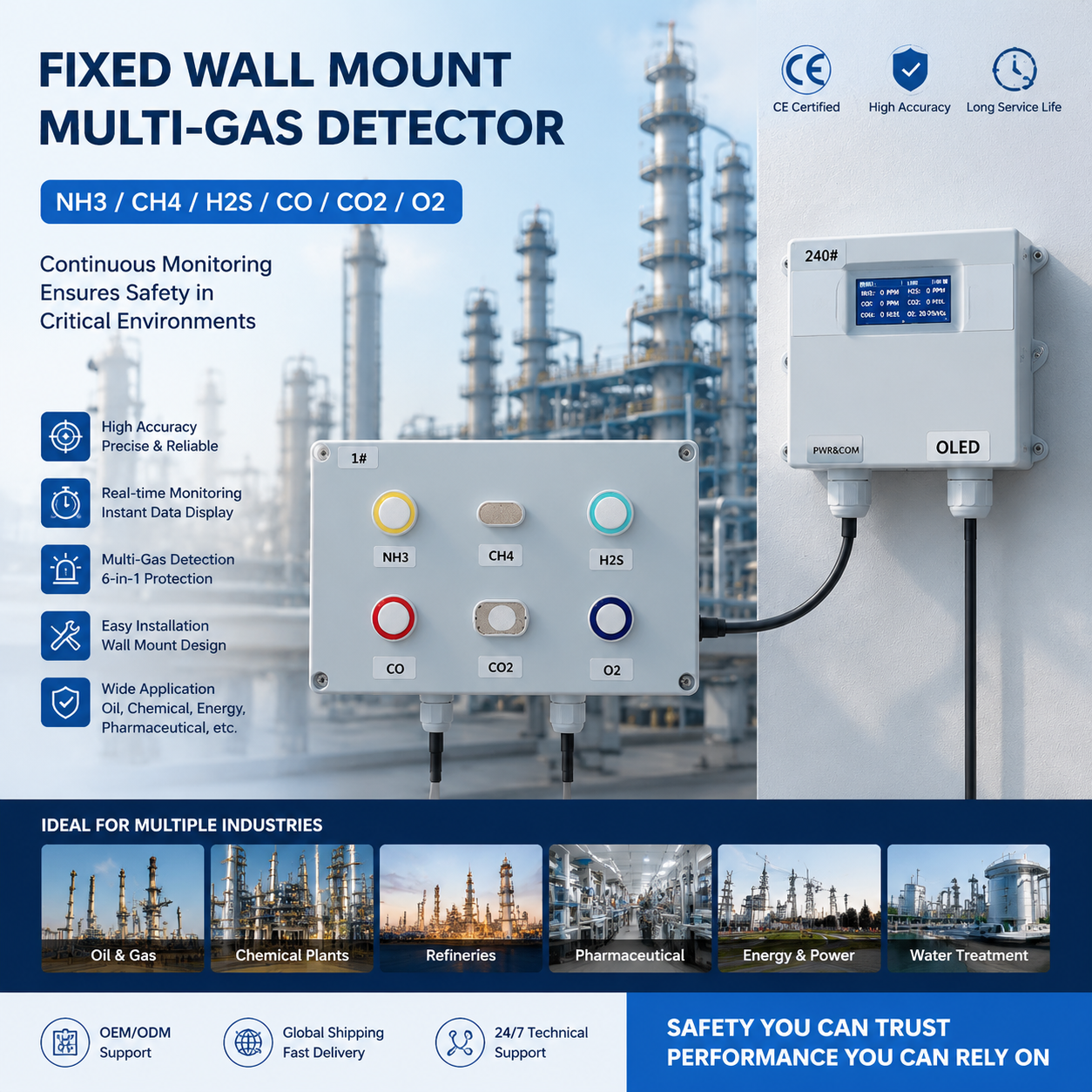
This is why a single-gas detector is not an acceptable solution. A worker carrying only an H₂S detector can descend into a manhole with lethal methane overhead and never see an alarm. The Honde RD-NC3HO-01 configuration specified for Indian municipal deployments measures H₂S, CH₄, CO₂, NH₃, and O₂ simultaneously — the complete gas stack of a sewer environment — with temperature and humidity for environmental context.
2.The Product: What Survives a Sewer
The RD-NC3HO-01 is a wall-mounted unit with an integrated LCD display showing real-time concentrations for all configured gases. The RS485 Modbus-RTU output carries the data to a local datalogger or communication module. Power input accepts 10–24VDC, compatible with both municipal control-room supplies and solar-battery systems for isolated pumping stations.
Two specifications determine survival in a sewer environment.
Operating temperature range of -30°C to +85°C. Indian manholes in Delhi or Mumbai do not reach -30°C, but the +85°C ceiling is the critical number. A manhole shaft in the summer, with anaerobic decomposition actively generating heat, can hold temperatures of 45–55°C at the bottom while the surface air at the manhole rim is 40°C. Sensors with a rated operating ceiling of +50°C drift or fail within weeks. The RD-NC3HO-01′s +85°C rating covers the entire environment with margin.
The housing and connector design. The unit is bracket-mounted and sealed against moisture ingress. The cable gland connections are the weak point in most installations — a manhole is a 100% humidity environment with condensate running down the walls. Honde’s double-sealed gland connections prevent the moisture ingress that shorts out unprotected electronics within a single monsoon season.
3.The Solution Architecture for Municipal Sewer Safety
The Indian municipal deployment follows a three-tier structure that moves from the manhole rim to the municipal command center.
Tier 1 — The manhole rim.
At each high-risk manhole — the blocked-choke points, the septic-tank pumping stations, the sewer junctions where fatalities have historically occurred — the RD-NC3HO-01 is mounted on a bracket inside the shaft, 2 meters below the rim. A Data logger with screen is mounted at the surface, inside the manhole cover frame or a small weatherproof enclosure, displaying current gas concentrations to the crew supervisor before any worker is allowed to descend.
The pre-entry protocol is now data-driven. The supervisor reads the H₂S, CH₄, CO₂, NH₃, and O₂ values on the logger screen. If any gas exceeds the safe entry threshold — H₂S above 10 ppm, CH₄ above 10% LEL, O₂ below 19.5% — the crew is directed to ventilate the shaft with a blower for a minimum of 30 minutes before re-testing. This replaces the previous practice of “sending a worker down to smell if it’s safe,” which is precisely how the rescuer-becomes-victim pattern begins.
Tier 2 — Transmission.
Each monitoring point connects via GPRS, 4G, WIFI, LoRa, or LoRaWAN wireless modules, depending on municipal infrastructure. Dense urban areas with reliable 4G coverage use cellular modules. Isolated pumping stations on the urban periphery use LoRaWAN to relay data to a gateway at the nearest district office. All data is packetized in MQTT Json format, feeding directly into the municipal sewer safety platform.
Tier 3 — Cloud and alarm.
The Cloud server and software consolidates gas data from every monitored manhole and pumping station into a single dashboard, showing real-time data and history data. The Alarm relay system is the critical safety mechanism. When H₂S exceeds 10 ppm or O₂ falls below 19.5% at any monitored location, the relay triggers an immediate alarm — a physical siren at the site, an SMS alert to the zone supervisor, and a log entry in the municipal system. If the gas remains above threshold after 15 minutes, the alarm escalates to the municipal engineer’s mobile device.
The field technician uses a Handmeter during quarterly verification rounds to confirm the installed sensor against a portable calibrated reference before each monsoon season — when sewer gas generation peaks with the combination of heat and increased organic load.
4.Field Results: Municipal Sewer Safety Pilot, Delhi, June 2026
A pilot deployment of 120 RD-NC3HO-01 multi-gas detectors was commissioned in June 2026 across three high-risk drainage zones in Delhi — the Shahdara, Najafgarh, and Okhla sewer districts, which historically record the highest number of manhole fatalities.
Hardware: 120 units configured with H₂S, CH₄, CO₂, NH₃, O₂, temperature, and humidity sensors.
Mounting: Bracketed inside manhole shafts at 2 meters depth, with surface Data loggers with screen.
Transmission: 78 sites on 4G, 42 on LoRaWAN. All MQTT Json to the municipal sewer safety platform.
Alarm: Dual-threshold relay (10 ppm H₂S / 19.5% O₂ warning; 25 ppm H₂S / 15% LEL CH₄ hazard alarm).
Operational results after 45 days:
- The network recorded 217 alarm events across the three districts — predominantly H₂S excursions above 10 ppm during the post-monsoon cleaning season. Of these, 43 exceeded the 25 ppm hazard threshold.
- In 8 documented cases, the alarm relay activated before a cleaning crew arrived at the manhole. The crew supervisor, following the new protocol, refused entry and ventilated the shaft for 45 minutes. Re-testing showed H₂S had dropped below 5 ppm. Under the previous system, those 8 crews would have descended into lethal atmospheres.
- The handmeter verification program detected 3 sensors with calibration drift exceeding ±15% during the quarterly pre-monsoon round. All 3 were replaced before the high-risk season began.
- Zero worker fatalities were recorded in the monitored zones during the pilot period — the first fatality-free 45-day period in those districts’ recent history.
- Based on the pilot, the municipal corporation has approved expansion to an additional 400 monitoring points across the remaining Delhi sewer districts, with procurement scheduled for Q4 2026.
5.The Broader Demand Map: Where Multi-Gas Detection is Growing
India’s sewer safety crisis is the most urgent case, but it is not the only demand driver for fixed multi-gas detection.
Middle East — oil and gas facilities. In Saudi Arabia and the UAE, refinery operators face the same confined-space problem in a different form: H₂S in crude oil processing, CH₄ in storage facilities, and CO₂ in pipeline pigging operations. The regulatory driver is ADNOC and Aramco’s internal safety standards, which mandate continuous gas monitoring in confined spaces. These facilities deploy the same RD-NC3HO-01 hardware — configured for the refinery gas stack — with 4-20mA outputs wired directly into the plant’s existing safety PLC.
Southeast Asia — wastewater treatment. Vietnam’s rapidly expanding wastewater treatment infrastructure, built under its national environmental compliance program, requires gas monitoring at pump stations and inlet works where H₂S and CH₄ accumulate. The demand profile mirrors India’s but at smaller scale per installation — typically 10–30 sensors per treatment plant rather than 120 per city district.
South Africa — mining and municipal. The combination of deep-level mining (where CH₄ and CO are the dominant hazards) and aging municipal sewer infrastructure places South Africa among the top ten fixed gas detector markets globally.
6.Contact Honde Technology for Gas Safety Solutions
Honde Technology is a Germany TUV & Alibaba verified manufacturer. We supply the fixed multi-gas detection hardware, the confined-space safety logic, and the wireless alarm architecture required to protect workers in the world’s most dangerous atmospheres.
For more sensor information and customized IoT solutions, please contact Honde Technology Co., LTD.
- WhatsApp: +86-15210548582
- Email: info@hondetech.com
- Company Website: www.hondetechco.com
Post time: Aug-05-2026