

1 The Disinfection Dilemma: Too Much vs. Too Little
In the operation of any municipal water supply or industrial recycling loop, chlorine dosing is a high-stakes balancing act. Under-dose the disinfectant, and you risk a catastrophic outbreak of E. coli or Legionella. Over-dose it, and you create highly carcinogenic disinfection byproducts (like trihalomethanes), ruin the taste, and accelerate pipeline corrosion.
The biggest challenge for engineers in regions with high ambient temperatures, such as Southern Europe or the GCC, is thermal decomposition. Chlorine degrades rapidly as water temperature rises, meaning a static dosing schedule is guaranteed to fail.
To maintain safety without constant manual titration, water authorities are shifting from high-maintenance “open” colorimetric systems to Membrane-Covered Electrochemical Chlorine Probes.
2 Inside the HONDETCH RD-WQRC-01: Why Membrane Technology Wins
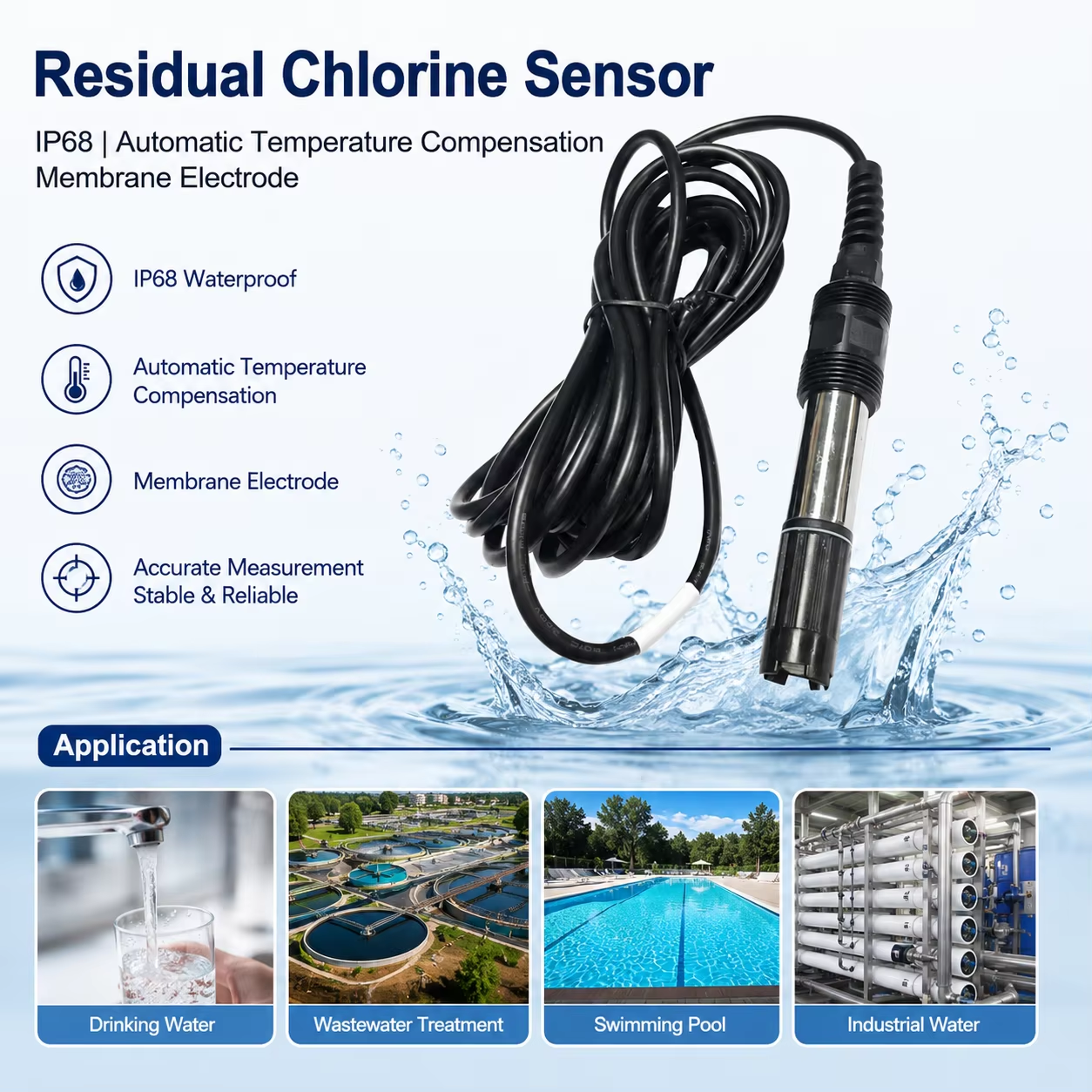
Unlike open gold/platinum ring electrodes that are highly sensitive to changes in water flow velocity and pH, the HONDETCH Membrane Electrode uses a selective permeable membrane to isolate the electrochemical cell from the raw water.
- ✓ Flow Independence: The micro-membrane ensures a stable micro-environment, meaning the sensor does not require a high-velocity flow cell to output an accurate reading.
- ✓ Automatic Temperature Compensation (ATC): Water temperature affects both the rate of chlorine diffusion and electrochemical activity. The built-in NTC thermistor in the RD-WQRC-01 corrects for this in real-time, preventing “false high” readings during hot summer afternoons.
- ✓ Zero Reagents: Unlike traditional DPD colorimeters, this membrane sensor requires no chemical reagents, dropping your ongoing operational and maintenance costs to near zero.
3 Product Specifications (RD-WQRC-01)
| Parameter | Technical Specification / Advantage |
|---|---|
| Measurement Principle | Polarographic Membrane-covered Amperometric |
| Range Options | 0.00 ~ 2.00 mg/L or 0.00 ~ 20.00 mg/L |
| Resolution / Accuracy | 0.01 mg/L / ±1% FS |
| Response Time (T90) | < 90 Seconds |
| Communication | RS485 Modbus-RTU / 4-20mA Output |
| Temperature Compensation | Automatic (0°C to 50°C) |
| Waterproof Grade | IP68 (Fully Submersible) |
4 The Integrated Solution: From Pipeline to Automated Shut-off
A sensor only tells you the chlorine concentration. To build a resilient water grid, Honde Technology provides a fully integrated hardware and software ecosystem:
- Handheld Meters & Local Displays: For rapid field verification, water engineers use our Handmeter to perform quick laboratory-comparative checks.
- Local Logging: In pumping stations, the sensor is linked to our Data Logger with integrated high-contrast screen, providing local operators with real-time graphs and 30-day storage without requiring network access.
- Deployments in Raw Water: For raw water intakes or open storage reservoirs, we deploy the Floating Buoy System integrated with a multi-parameter water quality sensor (Chlorine + pH + Turbidity). This system includes an Automatic Cleaning Brush that sweeps the optical and electrochemical surfaces to prevent biofilm buildup.
- Multi-Protocol Modules: Our modules support GPRS, 4G, WIFI, LoRa, and LoRaWAN connectivity.
- The MQTT Logic: For municipal grids, data is packetized and transmitted in MQTT Json format. This allows our sensors to integrate natively with SCADA, Digital Twins, and governmental water management portals without requiring proprietary middleware.
- Data lands on the Honde Cloud Server and Software, visualizing chlorine decay curves and trends.
- The Alarm Relay System: This is where the ROI is realized. If residual chlorine falls below the legally mandated 0.2mg/L threshold (or exceeds 2.0mg/L), the cloud platform immediately triggers a physical Alarm Relay at the dosing station to adjust the chemical dosing pumps automatically, closing the loop on water safety.
5 Real-World Case: Securing Secondary Disinfection in Spain
A municipal water utility in Andalusia, Spain, was struggling with chlorine decay in their secondary distribution network. During summer, water temperatures in shallow-laid pipelines exceeded 28°C, leading to rapid loss of residual chlorine.
- A Deployment: Installed the RD-WQRC-01 Residual Chlorine Sensor alongside a pH sensor inside a bypassed flow cell at 15 critical nodes across the city.
- B Networking: The nodes were connected to LoRaWAN gateways, transmitting data in MQTT Json back to their central SCADA system.
- C Outcome: The automatic temperature compensation ensured that the utility could track true chlorine concentrations accurately. Utilizing the Alarm Relay System, their secondary sodium hypochlorite dosing pumps now adjust dosing dynamically based on real-time sensor data, reducing overall chemical use by 22% while ensuring 100% compliance with EU drinking water standards.
6 B2B Sourcing and Municipal Project Tenders
For more sensor information and customized IoT solutions, please contact Honde Technology Co., LTD.
- WhatsApp: +86-15210548582
- Email: info@hondetech.com
- Company Website: www.hondetechco.com
Post time: Jun-08-2026