

The Gulf Reality: Desalinated Water is Chemically Aggressive
By mid-July 2026, Saudi Arabia and the UAE are producing over 12 million cubic meters of desalinated water per day — roughly 60% of their municipal supply. The plants themselves are marvels of engineering. The problem sits downstream.
Downstream Pipe Challenges:
- TDS creep. The water picks up dissolved solids from pipe walls, rising from <50 mg/L at the plant outlet to 300–600 mg/L at the customer tap.
- pH swing. Leaching reactions shift pH unpredictably, sometimes dropping below 6.5 — corrosive enough to dissolve copper fittings and release heavy metals.
- Chlorine decay accelerated by heat. In above-ground storage tanks where ambient temperatures hit 55°C, residual chlorine can vanish within 4 hours.
Traditional compliance testing — grab samples sent to a central lab once a week — captures none of this in real time. By the time a lab report flags a TDS or pH excursion, thousands of households have already consumed the affected water.
Honde Technology’s Municipal Water Series was designed to close this monitoring gap with reagent-free, thermally compensated sensors.
The Perception Layer: Parameters That Matter Post-Desalination
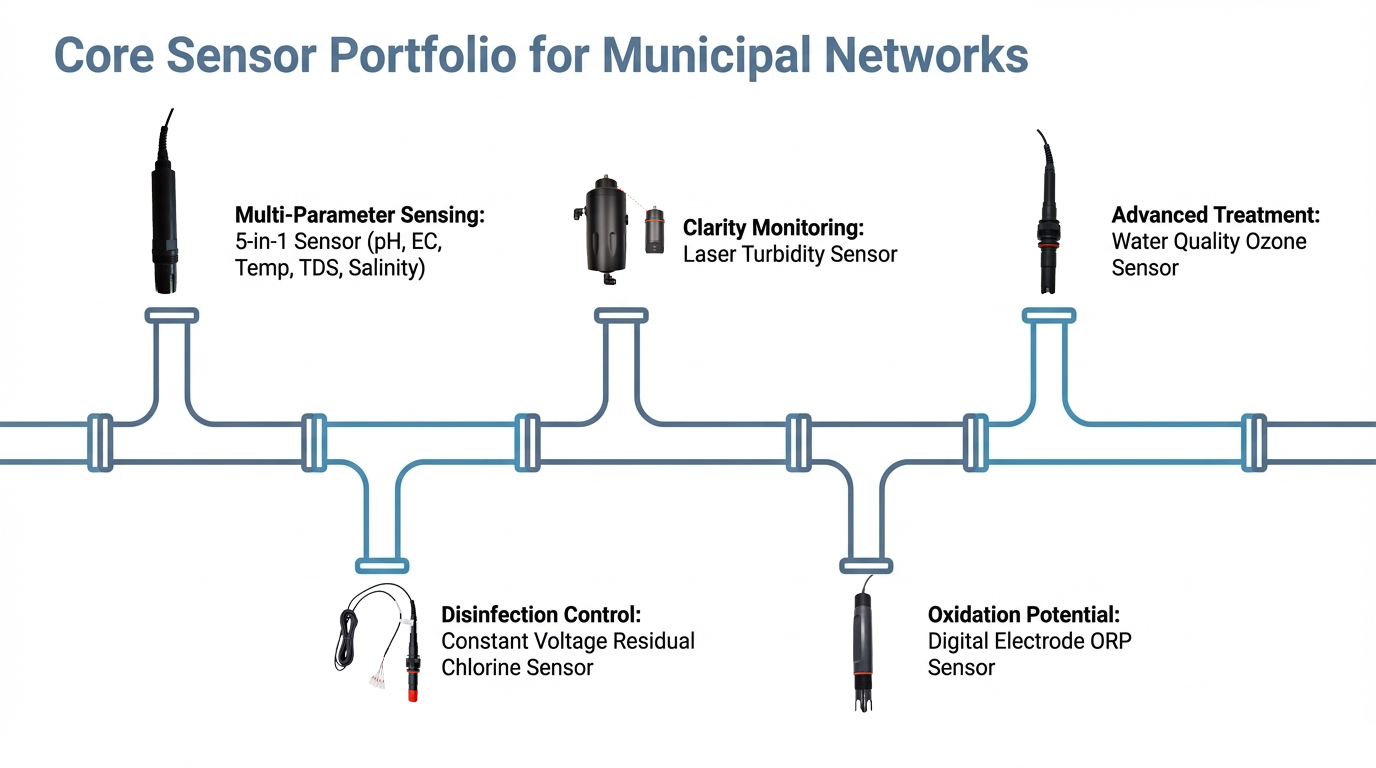
5-in-1 Core Probe: TDS, Salinity, EC, pH, Temperature (RD-PETSTS-01)
This single RS485 Modbus-RTU probe replaces five separate instruments at each monitoring node.
- TDS tracking is the primary indicator of pipe-leaching and seawater intrusion into groundwater blending stations.
- pH monitoring detects the corrosive leaching events that precede pipe failures.
- Built-in ATC corrects for the 50°C thermal environment that would cause ±15% drift in uncompensated analog sensors.
- The compact form factor allows installation in cramped pump-station bypass loops without civil work.
Constant-Voltage Residual Chlorine Sensor (RD-CVRC-02)
In Gulf conditions, the standard DPD colorimetric method is a logistical failure. Reagent supply chains to remote pump stations are unreliable, and technician availability during summer midday hours is near-zero.
- Reagent-free, membrane-free operation means this sensor can be installed, sealed, and left untouched for a 6-month audit cycle.
- The double-platinum-ring electrode maintains accuracy even when water temperature swings from 25°C (night) to 55°C (afternoon) in above-ground tanks.
Laser Turbidity Sensor (RD-LTS-01)
Aging distribution pipes in Riyadh and Jeddah experience periodic pressure surges that dislodge sediment and scale. This sensor detects turbidity excursions at 0.0001 NTU resolution — orders of magnitude more sensitive than standard 90° infrared sensors — providing the earliest possible warning of a pipe integrity failure.
The Honde Full-Stack Architecture for Gulf Utilities
Deploying sensors across 500 square kilometers of urban infrastructure requires a data loop that survives extreme heat, sandstorms, and intermittent power.
- Field technicians use the Handmeter for rapid spot-checks during quarterly calibration audits — no laptop, no cloud connection needed.
- Every monitoring node connects to a Data Logger with screen. Local access to real-time TDS trends and 30-day history on-site.
- Nodes transmit via GPRS, 4G, WIFI, LoRa, or LoRaWAN wireless modules based on building density.
- All data is packetized in MQTT Json format, feeding directly into SCADA platforms without proprietary fees.
- Cloud server consolidates city-wide parameters into real-time and history dashboards.
- Alarm Relay System: Cross-threshold events trigger physical relays to isolate branches and activate re-mineralization.
A B2B infrastructure contractor for Saudi Arabia’s National Water Company deployed 85 multi-parameter monitoring nodes across three Riyadh distribution zones in July 2026.
Hardware Deployed:
- 85 RD-PETSTS-01 5-in-1 Probes
- 45 RD-CVRC-02 Chlorine Sensors
- 4G modules transmitting MQTT Json to the central control room.
Results after 30 days:
- TDS tracking identified 7 pipe segments where leaching was pushing TDS above 600 mg/L.
- Chlorine monitoring revealed loss of residual chlorine in above-ground tanks between 12 PM and 4 PM.
- Zero sensor failures from heat or sand ingress (IP68-rated).
- Automated isolation at one node triggered within 90 seconds after a turbidity spike.
Contact Honde Technology for Municipal Water Tenders
Honde Technology is a Germany TUV & Alibaba verified manufacturer. We provide the sensors, the wireless protocols, and the automation logic needed for national-scale drinking water safety.
Post time: Jul-17-2026