LoRaWAN / 4G / WiFi / LoRa Connectivity for Aquaculture, Wastewater and Environmental Water Monitoring
Independent Website News Article | September 10, 2026
Market Snapshot
Water monitoring is shifting from periodic sampling toward continuous, connected measurement. Recent market research consistently identifies integrated multi-parameter sensing, wireless connectivity, cloud platforms and automated monitoring as major directions. One 2026 industry estimate places the global multi-parameter water quality sensor market at about US$304 million in 2025 and forecasts about US$535 million by 2032, equivalent to roughly 8.5% CAGR. Another 2026 estimate reports a 2025 market of US$320 million and a forecast of US$547 million by 2032. The different estimates reflect differences in market definition, but both point to sustained growth rather than a short-term spike.
Figure 1. Regional demand signal based on a 2025 multi-parameter water quality sensor market estimate.
| Market / region |
2025 signal |
Why it matters for buyers |
| Asia Pacific |
Largest regional share in several market estimates |
Aquaculture, industrial wastewater, water infrastructure and smart monitoring |
| North America |
Large mature market |
Environmental compliance, municipal water, RAS aquaculture and connected monitoring |
| Europe |
Large mature market |
Aquaculture, wastewater, environmental protection and traceable data |
| Latin America |
Smaller but growing |
Salmon, shrimp and freshwater aquaculture; remote sites benefit from telemetry |
| Middle East & Africa |
Smaller base with growth opportunities |
Water scarcity, reuse, desalination and remote monitoring |
Where Demand Is Most Practical Today
For a connected multi-parameter probe, the strongest commercial opportunities are not limited to one industry. The most practical buyer groups are facilities where water conditions can change quickly and where sending staff to collect samples is costly or too slow.
| Country / market |
High-potential applications |
Buying requirement |
| United States |
Municipal wastewater, industrial discharge, RAS aquaculture, lakes and rivers |
Reliable continuous data, remote access, compliance records, integration |
| Canada |
Cold-water aquaculture, municipal water, environmental monitoring |
Stable field operation, remote telemetry, low maintenance |
| Norway |
Salmon aquaculture, fjord and coastal environmental monitoring |
DO, temperature, salinity/EC, fouling control and remote data |
| Germany |
Wastewater, industrial process water, environmental stations |
Digital interfaces, traceability, maintenance efficiency |
| Netherlands |
Water management, greenhouse/hydroponics, aquaculture |
Continuous measurement, network connectivity, compact deployment |
| Australia |
Aquaculture, rivers, reservoirs, remote environmental stations |
Remote monitoring, long communication range, low site visits |
| Japan |
Aquaculture, water treatment, research and environmental monitoring |
Compact systems, dependable data, remote monitoring |
These are target-market opportunities rather than claims of a specific customer installation. The country selection reflects established water infrastructure, aquaculture activity, environmental monitoring requirements and the suitability of remote/IoT sensing for geographically distributed sites.
Why Multi-Parameter Monitoring Is Gaining Ground
A single pH or DO probe can answer one question. A multi-parameter system can show how several water conditions move together. That distinction becomes important when operators need to decide whether a change is caused by oxygen depletion, salinity/conductivity variation, suspended solids, temperature, oxidation-reduction conditions or another measurable factor.
Figure 2. Reported 2025 parameter mix in one global multi-parameter market estimate; figures are indicative, not a Honde sales breakdown.
| Parameter group |
Typical operational question |
| pH / ORP |
Is the water becoming more acidic/alkaline or chemically reducing/oxidizing? |
| Dissolved Oxygen |
Is oxygen sufficient for fish, biological treatment or ecological health? |
| EC / TDS / Salinity |
Is dissolved ionic load or salinity changing? |
| Turbidity |
Is suspended material increasing after rain, discharge or process changes? |
| Temperature |
Is temperature affecting biological activity or sensor compensation? |
| Ammonium / Nitrate / Chlorine / COD* |
Are specific nutrient, disinfection or organic-load indicators changing? |
*Parameter availability depends on the selected configuration. Do not assume every parameter is included in every probe.
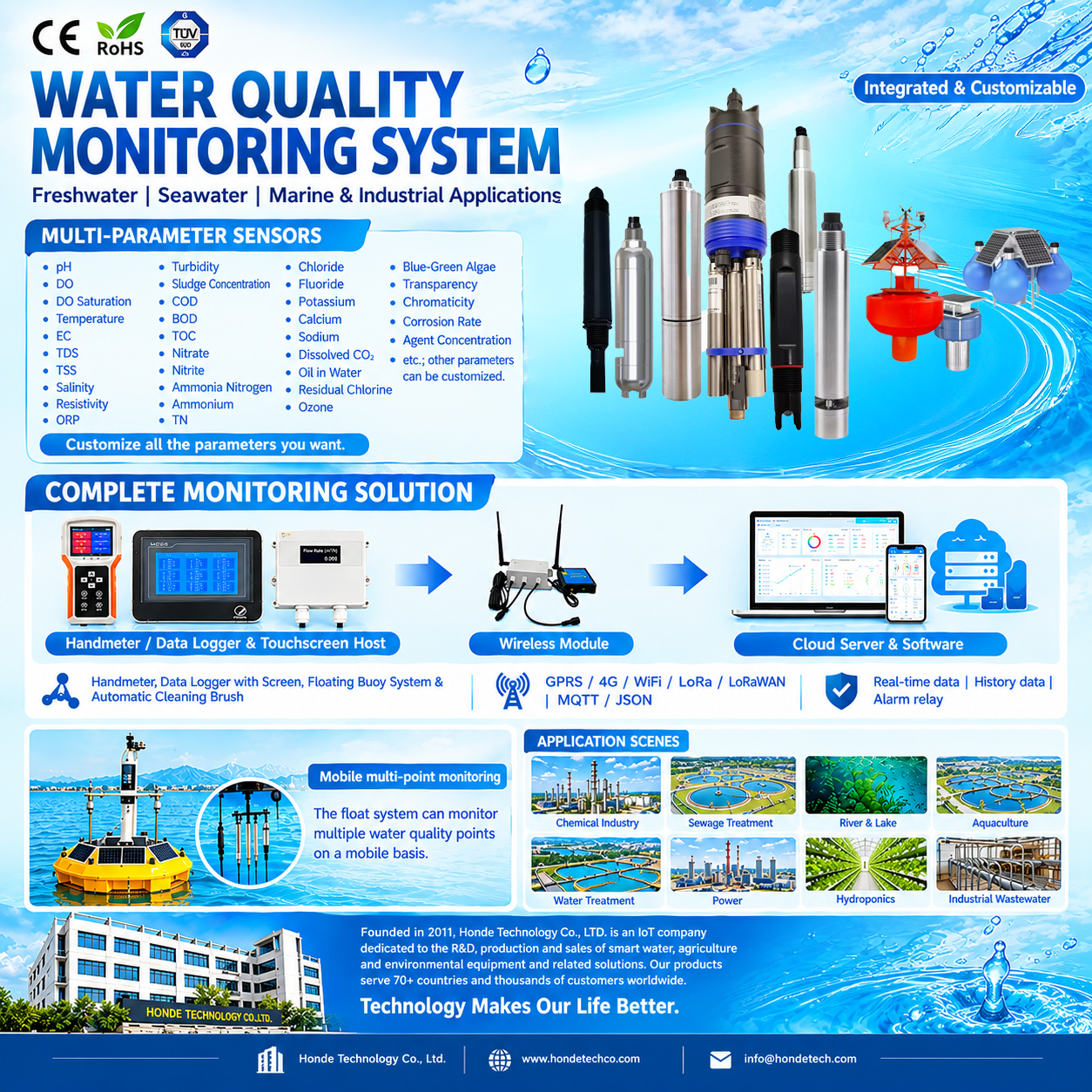
The Honde LoRaWAN Multi-Parameter Water Quality Sensor
The Honde product presented in the referenced Alibaba listing is positioned as an integrated multi-parameter water quality monitoring platform with LoRaWAN connectivity. The product listing identifies temperature, pH/ORP, dissolved oxygen and residual chlorine among the measurement options. Honde’s related multi-parameter platform also supports configurable combinations such as pH, EC, TDS, salinity, turbidity, temperature, ammonium, nitrate, residual chlorine, DO, COD and ORP, depending on the selected configuration.
| Feature |
Practical benefit |
| Integrated multi-parameter design |
One installation can provide a broader picture of water conditions and reduce the number of separate probes and mounting points. |
| RS485 / Modbus |
Provides a standard digital interface for PLCs, RTUs, data loggers and monitoring systems. |
| LoRa / LoRaWAN |
Useful for distributed ponds, rivers and remote monitoring sites where long-range, low-power communication is preferred. |
| 4G / GPRS / WiFi options |
Allows the communication method to be matched to the site instead of forcing every project into one network architecture. |
| Automatic cleaning option |
Helps reduce fouling-related drift and the frequency of manual cleaning in continuously deployed installations. |
| IP68 protection |
Suitable for submerged or wet environments when installed according to the product specification. |
| Configurable parameters |
Allows the monitoring package to be matched to aquaculture, wastewater or environmental requirements. |
| Cloud software option |
Moves data from the field into a dashboard for real-time viewing, historical curves and alarm management. |
Recommended Monitoring Solution
The sensor becomes more useful when it is treated as part of a complete data chain rather than as an isolated probe. For projects that require both local verification and remote access, Honde can combine the probe with the following three-layer solution:
1. Handmeter, Data logger with screen
for local commissioning, field checks and on-site data recording.
2. GPRS/4G/WIFI/LORA/LORAWAN wireless module supports MQTT Json format
for sending measurements from the monitoring point to a gateway, server or customer platform.
3. Cloud server and software with alarm relay system support to see real-time data and historical data
for dashboards, trends, alarm notifications and remote review.
This architecture is especially useful where the monitoring point is far from the control room. A local handmeter/data logger can remain available for technicians, while the wireless layer keeps the central dashboard updated without requiring daily site visits.
Application Scenarios
Application Scenario 1: Norwegian Salmon Farm
A representative Norwegian aquaculture deployment would place the multi-parameter probe at a cage site, intake, or other monitoring point where oxygen, temperature and conductivity/salinity trends are operationally important. The sensor sends measurements through a suitable wireless link to a remote dashboard. Farm staff can review trends before making decisions about aeration, water exchange or further inspection. Automatic cleaning can be valuable in longer deployments where biofouling would otherwise increase maintenance.
Application Scenario 2: U.S. Wastewater Treatment Facility
At a wastewater plant, a multi-parameter probe can be installed at an influent, process or receiving-water point appropriate to the monitoring objective. pH, DO, ORP, conductivity, turbidity and temperature can provide a fast view of process conditions, while additional configured parameters can support a specific treatment or discharge requirement. Data can be logged locally and transmitted to a cloud dashboard so operators can compare current readings with historical trends and respond to alarms.
Application Scenario 3: Australian Remote River or Reservoir Station
For a remote river, reservoir or environmental station, site access can be the largest operating cost. A low-maintenance multi-parameter sensor with LoRaWAN, 4G or another available communication route can reduce routine inspection frequency. The system can transmit water-quality trends to a central platform, while a local data logger retains measurements for field verification.
Application Scenario 4: German Industrial Water Reuse
In industrial water-reuse loops, operators often need more than one indicator to understand process stability. A configurable multi-parameter probe can track the variables most relevant to the process and send the data into the plant’s digital monitoring layer. The value is not simply the number of parameters: it is the ability to see changes together, identify abnormal trends earlier and reduce manual sampling where continuous measurement is appropriate.
High-Conversion Search Keywords for International Marketing
The keyword set below is designed around buyer intent rather than repeating the same phrase. It combines core product terms, application terms and connectivity terms that appear repeatedly in current marketplace listings and industry discussions.
| Keyword cluster |
Recommended high-intent keywords |
| Core product |
multi parameter water quality sensor; multiparameter water quality probe; online water quality sensor; digital water quality monitor; water quality monitoring sensor |
| Aquaculture |
aquaculture water quality sensor; fish farm water quality monitor; RAS water quality sensor; shrimp pond water quality monitor; aquaculture IoT sensor |
| Environmental |
river water quality sensor; lake water quality monitoring; surface water monitoring sensor; environmental water sensor; remote water monitoring |
| Wastewater |
wastewater water quality sensor; industrial wastewater monitor; sewage treatment water sensor; online wastewater monitoring; water treatment sensor |
| Parameters |
pH DO EC turbidity sensor; dissolved oxygen water sensor; ORP water sensor; conductivity water quality sensor; salinity temperature sensor; ammonia nitrate water sensor |
| Connectivity |
LoRaWAN water quality sensor; LoRa water quality monitor; 4G water quality sensor; WiFi water quality monitor; RS485 Modbus water sensor; MQTT water monitoring |
| System / buyer intent |
real time water quality monitoring system; remote water quality monitoring; cloud water quality monitoring; self cleaning water quality sensor; IoT water quality monitoring system |
What Buyers Are Actually Looking For
| Buyer concern |
What the solution should demonstrate |
| Less field maintenance |
Integrated design, suitable protection, optional automatic cleaning and practical calibration/maintenance procedures. |
| Reliable data |
Stable digital communication, clear calibration process and parameter-specific performance information. |
| Remote sites |
LoRaWAN/LoRa or cellular communication plus local data logging. |
| Fast response |
Real-time dashboard, historical curves and configurable alarm/relay functions. |
| Integration |
RS485 / Modbus and MQTT/JSON support for connection to existing digital systems. |
| Project flexibility |
Configurable parameter combinations, wireless options and OEM/ODM support. |
Why This Product Fits the Current Market
The strongest opportunity is not to sell a probe as a stand-alone measuring instrument. It is to offer a practical monitoring package that solves the complete path from water to decision: measurement → local verification → wireless transmission → cloud storage → alarm → operational response. This is particularly relevant to aquaculture, wastewater treatment and environmental monitoring, where the cost of delayed information can be much higher than the cost of continuous measurement.
Conclusion
Multi-parameter water quality monitoring is becoming a standard building block of connected water management. Current market research points to continued expansion, while recent technical literature shows growing interest in IoT-based aquaculture monitoring and real-time sensor networks. For buyers in the United States, Canada, Norway, Germany, the Netherlands, Australia and Japan, the strongest use cases are systems that combine dependable sensing with remote connectivity and usable data management. Honde’s integrated probe, multiple communication options, local data tools and cloud monitoring package are designed around that workflow.
Source Notes & Market References

