

The Mid-Year Crisis: The Failure of “Submerged” Hydrometry
As of June 2026, the arrival of the monsoon season in India (Ganges Basin), Vietnam (Central Highlands), and Brazil (Amazon Tributaries) has exposed a critical vulnerability in global flood defense. During high-velocity storm events, traditional submerged flow meters (such as ultrasonic Doppler or propeller meters) are frequently destroyed by floating debris, buried under silt, or become death traps for maintenance crews trying to recalibrate them in rising waters.
If your velocity sensor touches the water during a flood, it is a liability. The industry has pivoted to Non-Contact Radar Technology to ensure the survival of the data when the infrastructure is under most stress.
Honde Technology’s RD-VLC-24G Radar Velocity Sensor has become the regional standard because it operates entirely in the “air gap,” immune to the destructive power below.
The Perception Layer: 24GHz Doppler Engineering
Unlike traditional meters, our radar sensor stays dry. It is mounted on bridges or cantilever arms, using the Doppler Effect to track the velocity of the water surface.
High-Frequency 24GHz Precision
By emitting a high-frequency microwave signal and measuring the frequency shift of the return echo, the sensor tracks flow speeds from 0.03 m/s to 20 m/s.
Advanced Signal Processing
The internal DSP (Digital Signal Processor) uses a specialized algorithm to filter out rain clutter and wind-induced ripples, ensuring the data reflects the actual movement of the water body, not the weather.
Industrial Durability
Built with a rugged IP68-rated housing and integrated surge protection, the unit is designed to survive 10+ years of exposure to tropical humidity and UV radiation.
The Honde Full-Stack Solutions Architecture
In remote mountain gorges or vast river deltas, a sensor alone is not a solution. Honde provides a tiered digital architecture to turn data into action:
Tier 1: Local Awareness & Site Verification
- Field Audit Tools: Technicians utilize the Honde Handmeter for rapid on-site verification and cross-calibration against traditional current meters.
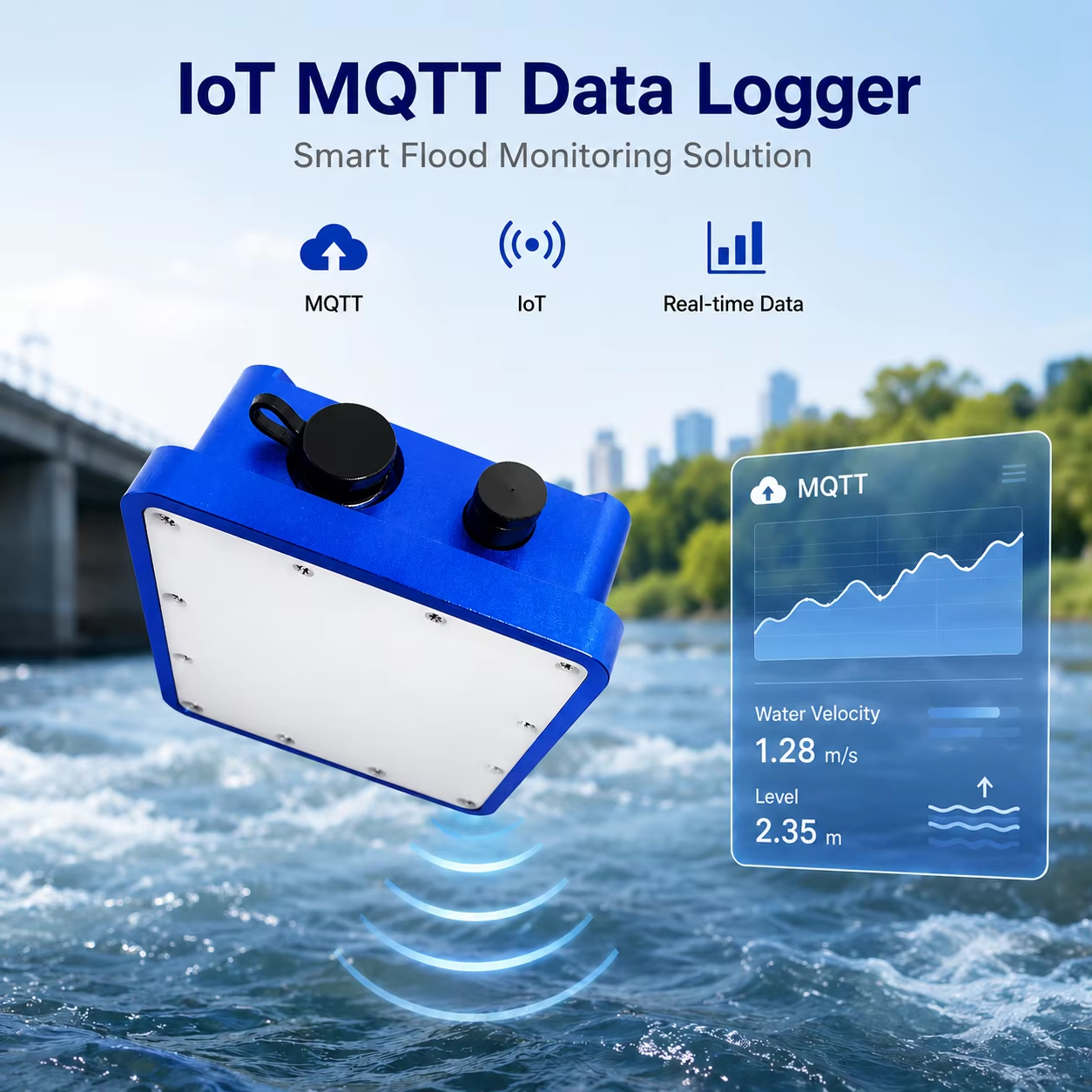
- Local Persistence: Every station is anchored by our Data Logger with screen, providing local emergency crews with real-time velocity graphs and 30-day graphical history on-site—essential for making evacuation decisions during cloud outages.
Tier 2: The Wireless Nervous System (Transmission)
- Connectivity Excellence: Terminals support GPRS/4G/WIFI/LORA/LORAWAN wireless modules.
- The MQTT Logic: For national emergency grids, data is transmitted in MQTT Json format. This standardized format allows the velocity data to feed directly into hydraulic modeling software and provincial flood dashboards without proprietary middleware.
Tier 3: Cloud Management & Active Warning (The Safety Loop)
- All data is centralized on the Cloud server and software, providing a real-time “Velocity Map” of the entire river network to see the real time data and history data.
- The Alarm Relay System: This is the critical life-saving loop. When the surface velocity crosses a dangerous threshold (indicating an incoming surge), the cloud platform triggers a physical Alarm Relay system. This can automatically activate Acoustic-Optical sirens in downstream villages or trigger automated barrier gates on low-lying bridges.
Real-World Case Study: Securing the Beas River, Himachal Pradesh, India
A B2B civil engineering firm in India required a reliable velocity network for the Beas River, which is prone to sudden “Glacial Lake Outburst Floods” (GLOF). Their previous submerged sensors were regularly ripped out by boulders during monsoon events.
- Hardware: Deployed 15 units of the RD-VLC-24G Radar Velocity Sensors on cantilever arms over critical river bottlenecks.
- Connectivity: Used LoRaWAN gateways transmitting in MQTT Json format back to the regional disaster management office.
- The Outcome: The non-contact design survived three separate major flood surges in June 2026. The Alarm Relay System provided an 18-minute advance warning for a downstream power plant, allowing them to secure their intake gates and preventing an estimated $200,000 in equipment damage.
Contact Honde Technology for Hydrology Tenders
For more sensor information and customized IoT solutions, please contact Honde Technology Co., LTD.
WhatsApp:+86-15210548582
Post time: Jul-01-2026