

September 23, 2026
Heavy rainfall does not only change water levels.
When stormwater moves through roads, industrial areas, drainage networks, construction sites and urban catchments, it can also carry chemicals, sediments and other pollutants into rivers, canals and receiving waters. For water authorities and facility operators, knowing that a flood is coming is only one part of the problem. Understanding what is happening to the water during and after the event is becoming increasingly important.
This is creating a growing role for real-time water quality sensors alongside traditional rainfall and water-level monitoring equipment.
The Economical Online pH Sensor with RS485 Modbus from Honde Technology Co., Ltd. is designed for this type of continuous water monitoring application. It can be integrated with field data loggers, wireless communication modules and cloud monitoring platforms to build a connected water-quality monitoring point.
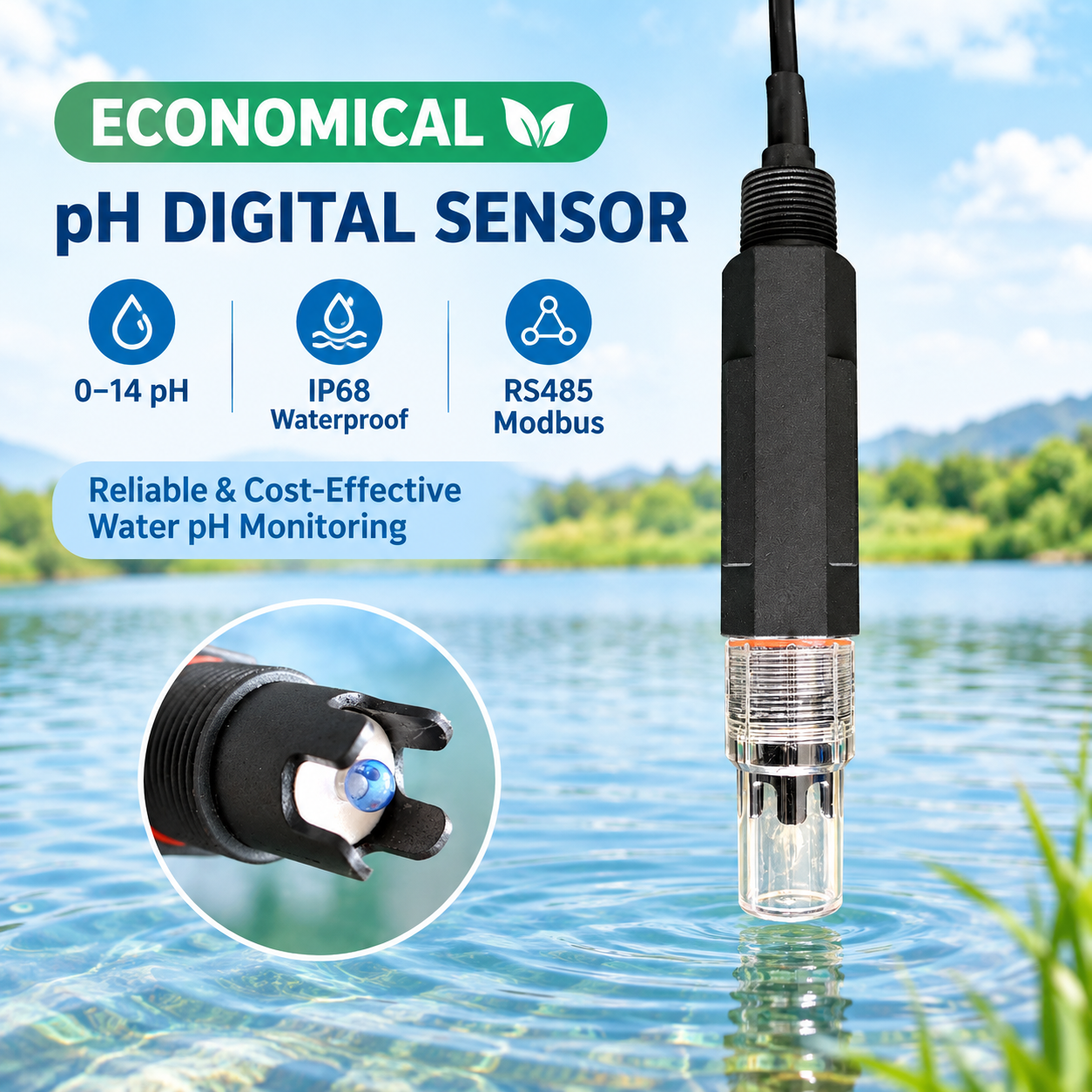
From Flood Detection to Flood-Water Monitoring
Traditional flood warning systems generally focus on rainfall, river level, flow velocity and water depth.
These measurements remain essential. However, a flood event can also rapidly change water quality.
For example, stormwater flowing through an industrial area may come into contact with acidic or alkaline materials. Runoff from urban surfaces can transport pollutants into drainage systems, while combined sewer overflow events can introduce contaminated water into rivers and other receiving waters.
The U.S. Environmental Protection Agency identifies pH as one of the practical parameters used in stormwater and urban water monitoring. EPA guidance also notes that unusually low or high pH in industrial stormwater can indicate exposure to acidic or alkaline materials.
This makes pH monitoring useful as a water-quality indicator within a broader flood and stormwater monitoring network.
Why Real-Time pH Data Matters During Extreme Rainfall
A manual water sample can provide valuable laboratory information, but it represents a specific location and time.
A permanently installed digital pH sensor provides another layer of information: continuous field data.
When connected to a communication and cloud platform, operators can monitor changes in pH remotely and compare current measurements with historical records.
| Monitoring Method | Manual Sampling | Online pH Monitoring |
|---|---|---|
| Measurement | Periodic | Continuous |
| Remote Access | Limited | Yes |
| Historical Trend | Requires manual records | Automatic |
| Alarm Function | Usually manual | Configurable |
| IoT Integration | Limited | RS485 / Wireless |
| Suitable for Remote Sites | Limited | High |
| Event Monitoring | Intermittent | Real-time |
The value becomes more obvious during heavy rainfall.
A monitoring station can record the normal pH condition before rainfall, observe changes during the runoff event and continue recording after the water level returns to normal.
Instead of asking only:
“Did the water rise?”
operators can also ask:
“Did the water quality change when the flood occurred?”
A Practical Application Architecture
The Honde solution can combine the online pH sensor with field equipment, wireless communication and cloud software.
Water Quality Monitoring → Wireless Transmission → Cloud Platform → Alarm
Online pH Sensor
↓
RS485 Modbus
↓
Handmeter / Data Logger with Screen
↓
GPRS / 4G / WiFi / LoRa / LoRaWAN Wireless Module
↓
MQTT / JSON Data Transmission
↓
Cloud Server & Monitoring Software
↓
Real-Time Data + Historical Data + Alarm Relay
This architecture allows the same monitoring point to serve both local operators and remote management teams.
Three Layers of the Honde Monitoring Solution
1. Field Measurement
The online digital pH sensor is installed directly at the monitoring point.
Possible locations include:
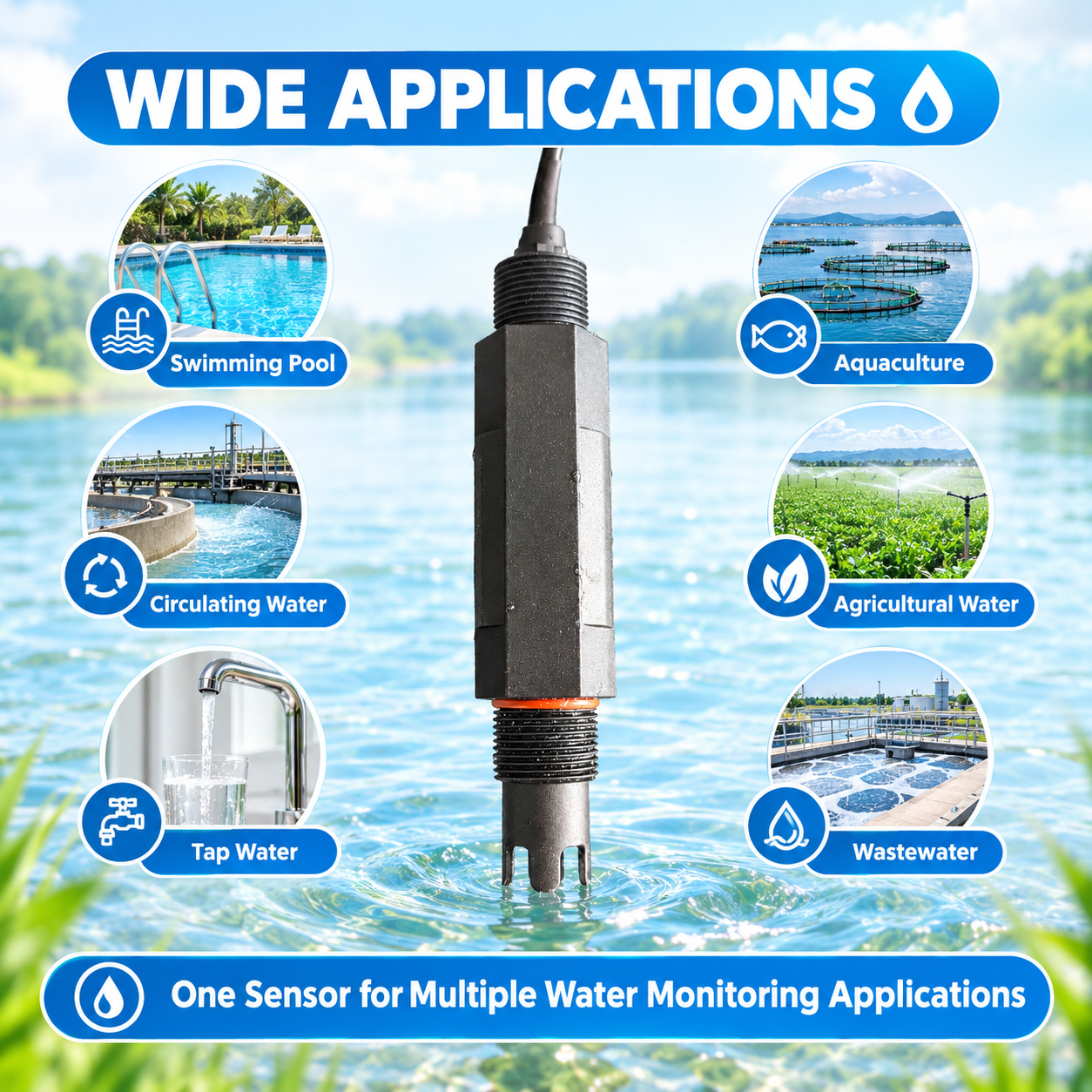
- Stormwater drainage outlets
- Urban drainage channels
- River monitoring stations
- Industrial runoff outlets
- Wastewater discharge points
- Flood-prone industrial parks
- Pump stations
- Water treatment facilities
- Agricultural drainage channels
For operators who need local inspection, a Handmeter or Data Logger with Screen can be added for on-site checking and data recording.
2. Wireless Communication
Different monitoring locations require different communication methods.
Honde’s wireless architecture supports:
GPRS / 4G / WiFi / LoRa / LoRaWAN
and supports MQTT / JSON data transmission.
For urban monitoring points with available cellular coverage, 4G can provide direct communication with the cloud.
For distributed monitoring stations covering a larger area, LoRaWAN can reduce communication power requirements and allow multiple monitoring points to communicate through a gateway.
This type of architecture is already being used in modern flood-monitoring projects. In a 2026 USGS urban flash-flood monitoring project, LoRaWAN and MQTT were used to transmit real-time measurements from distributed monitoring points to a cloud server. Cellular communication was also used where LoRa coverage was unsuitable.
3. Cloud Monitoring and Alarm
The final layer is the cloud platform.
Honde’s cloud server and software can display:
- Real-time pH data
- Historical data
- Monitoring trends
- Multiple monitoring points
- Alarm status
- Remote data access
An alarm relay system can also be integrated for threshold-based warnings.
For example:
pH > preset upper limit
or
pH < preset lower limit
can trigger an alarm.
The exact threshold should be configured according to the monitoring site’s regulatory requirements, background water quality and application conditions rather than using one universal value.
 Application Scenario 1: Urban Stormwater Monitoring in the United States
The United States has been actively developing distributed flood and stormwater monitoring networks.
In February 2026, the U.S. Geological Survey described a low-cost sensor network developed for urban flash-flood detection in Madison, Wisconsin. The project uses distributed IoT monitoring points to provide advance information on rapidly changing conditions in storm sewers. Measurements are transmitted through LoRaWAN and MQTT to a cloud-based server.
A similar architecture can be extended from water-level monitoring to water-quality monitoring.
Example deployment
A monitoring station can be installed at the outlet of an urban drainage system.
During normal weather:
pH → baseline monitoring
During heavy rainfall:
Rainfall → runoff increases → drainage flow changes → pH changes are recorded
After the event:
pH trend → recovery monitoring → historical comparison
This gives municipal engineers and environmental teams additional information when investigating stormwater events.
Application Scenario 2: River and Flood Monitoring in the United Kingdom
The UK’s Environment Agency operates a large real-time flood monitoring infrastructure covering flood warnings, river levels and flows.
Its real-time API provides information from monitoring stations, while water levels and flows are normally monitored at approximately 15-minute intervals. During periods of heightened flood risk, data transmission frequency can increase.
This type of infrastructure demonstrates an important direction for future monitoring:
Real-time measurement + automated transmission + centralized data + warning system.
For selected river or drainage locations, an online pH sensor can be installed as an additional water-quality measurement point.
The sensor does not replace the flood-level gauge.
Instead:
Water Level Sensor = Flood Condition
pH Sensor = Water Quality Condition
Cloud Platform = Data Integration
Together, these measurements provide a more complete picture of the event.
Application Scenario 3: Flood Warning and Water Management in Australia
Australia operates a broad national flood-warning network that combines rainfall observations, river-height measurements, weather radar, satellite information and other data sources.
According to Australia’s Bureau of Meteorology, its flood-warning network relies on gauges owned by multiple organizations, and the Bureau’s own gauge network was operating at approximately 97% availability at the end of 2025.
For remote Australian monitoring sites, low-power communication can be particularly useful.
A potential monitoring station can combine:
pH Sensor
Data Logger
LoRaWAN / 4G
Solar Power
Cloud Platform
This configuration can support remote monitoring without requiring operators to visit every station for routine data collection.
Application Scenario 4: Industrial Runoff and Flood Events in Europe
Flooding around industrial areas creates a different monitoring requirement.
Rainwater can enter storage areas, production zones, material yards and drainage systems. If chemicals or process materials are exposed to runoff, water quality can change rapidly.
EPA stormwater guidance specifically identifies low and high pH as potential indicators of acidic or alkaline materials entering stormwater.
In Europe, this type of monitoring can be relevant to:
- Industrial parks
- Chemical facilities
- Manufacturing plants
- Wastewater treatment plants
- Construction sites
- Port areas
- Stormwater retention facilities
A monitoring point can therefore be designed as:
Rainfall / Flood Event
→ Runoff Collection
→ Online pH Measurement
→ RS485 Communication
→ Wireless Transmission
→ Cloud Platform
→ Alarm / Response
The result is not simply a pH reading. It becomes an event-based water quality record.
Why an Economical pH Sensor Can Be Valuable for Distributed Monitoring
Large monitoring networks often require many measurement points.
A high-end instrument may be appropriate for demanding applications, but not every monitoring point requires the same specification.
For secondary drainage channels, distributed stormwater monitoring points, agricultural drainage or preliminary environmental monitoring, an economical digital sensor can make it more practical to deploy a larger number of stations.
Key Product Advantages
| Feature | Benefit for Monitoring Projects |
|---|---|
| Digital pH Measurement | Direct water-quality data |
| RS485 Modbus | Easy integration with RTU, PLC and IoT devices |
| Online Monitoring | Supports continuous measurement |
| Compact Sensor Design | Suitable for distributed monitoring points |
| Waterproof Design | Suitable for submerged water applications |
| Digital Communication | Reduces dependence on analog signal wiring |
| Wireless Integration | Supports remote monitoring |
| Cloud Compatibility | Enables centralized data management |
| Cost-Oriented Design | Suitable for multi-point deployments |
The product can therefore be positioned not only as an individual pH probe, but as a component of a distributed environmental monitoring network.
Market Demand Signals in 2026
The current market direction can be summarized through several real-world developments:
| Market Signal | Evidence / Development | Implication |
|---|---|---|
| Urban flash flooding | USGS developed low-cost IoT flood detection network | More distributed monitoring points |
| LoRaWAN + MQTT | Used in US urban flood monitoring | Strong fit for low-power IoT monitoring |
| Real-time flood data | UK Environment Agency provides near-real-time monitoring data | Continuous data is becoming standard |
| Flood warning upgrades | Northwestern Europe has upgraded warning systems after 2021 floods | More monitoring infrastructure |
| Multi-source observation | Australia combines gauges, radar, satellite and rainfall data | Integrated monitoring is increasingly important |
| Stormwater pH monitoring | EPA identifies pH as a practical stormwater parameter | pH can complement flood monitoring |
Recommended System Configuration
For a typical distributed flood and stormwater monitoring project, Honde can provide a modular configuration:
| Layer | Recommended Equipment |
|---|---|
| Water Quality | Online Digital pH Sensor |
| Local Interface | Handmeter / Data Logger with Screen |
| Communication | GPRS / 4G / WiFi / LoRa / LoRaWAN |
| Protocol | RS485 Modbus + MQTT / JSON |
| Data Platform | Cloud Server & Monitoring Software |
| Alarm | Alarm Relay / Threshold Alert |
| Power | DC / Solar Power according to site |
| Application | Stormwater / River / Drainage / Industrial Runoff |
The system can also be expanded by adding other parameters such as DO, EC, turbidity, temperature, ORP, conductivity or other water-quality sensors, depending on the project requirements.
Building a More Complete Flood Monitoring Network
Flood monitoring is moving toward a distributed model.
Instead of relying on one monitoring station, cities, water utilities and industrial operators can deploy multiple small monitoring points across vulnerable areas.
Each station collects local data.
Wireless communication transfers the information.
The cloud platform brings all stations together.
Alarm rules identify abnormal conditions.
Historical records help engineers understand what happened before, during and after a rainfall or flood event.
For pH monitoring, the goal is not to predict flooding by pH alone. Rather, pH provides an additional water-quality signal that can help identify changes in runoff and receiving-water conditions during flood and stormwater events.
That distinction is important when designing a reliable environmental monitoring system.
Honde Technology – Smart Monitoring for Connected Water Management
Honde Technology provides water-quality and environmental monitoring equipment for distributed field applications.
The Economical Online pH Sensor with RS485 Modbus can be integrated into standalone monitoring points or larger IoT water-monitoring systems.
A complete solution can include:
pH Sensor
Handmeter / Data Logger
RS485 Modbus
GPRS / 4G / WiFi / LoRa / LoRaWAN
MQTT / JSON
Cloud Server
Real-Time Data
Historical Data
Alarm Relay
For water authorities, environmental monitoring companies, system integrators and industrial users, this modular architecture provides a practical way to expand from individual sensor measurements toward a connected monitoring network.
Smart Monitoring, Better Water Management.
Contact Honde Technology
WhatsApp: +86-15210548582
Email: info@hondetech.com
Website: www.hondetechco.com
Post time: Sep-23-2026