

The Mid-Year Challenge: Beyond the “Tipping” Limitation
As of June 2026, the arrival of the hurricane season in the United States (Gulf Coast) and the monsoon in India has exposed a fatal flaw in traditional hydrology: Tipping Bucket failure. Mechanical rain gauges frequently clog due to leaves, bird droppings, or spiders, leading to “Zero Data” during the very storms they were meant to track.
Furthermore, for high-tech Smart Cities in Canada and Northern Europe, traditional buckets cannot accurately distinguish between light drizzle and melting snow, or they simply freeze solid.
The Engineering Consensus:
To build a resilient 2026 meteorology network, the industry is shifting toward All-Solid-State Optical Sensors. These sensors provide millisecond detection without a single moving part.
The Perception Layer: Honde Optical Integrated Architecture
Honde Technology’s Integrated Wireless Optical Rain Gauge is engineered to solve the “Mechanical Reliability Gap”:
1. Infrared Light Beam Detection
Unlike a bucket that must wait to “fill up,” our optical sensor detects individual raindrops (or snowflakes) using an Infrared Light Beam.
- The Advantage: It captures the onset of precipitation in seconds, not minutes. This is critical for triggering automated window systems in smart buildings or rapid flood warnings in urban tunnels.
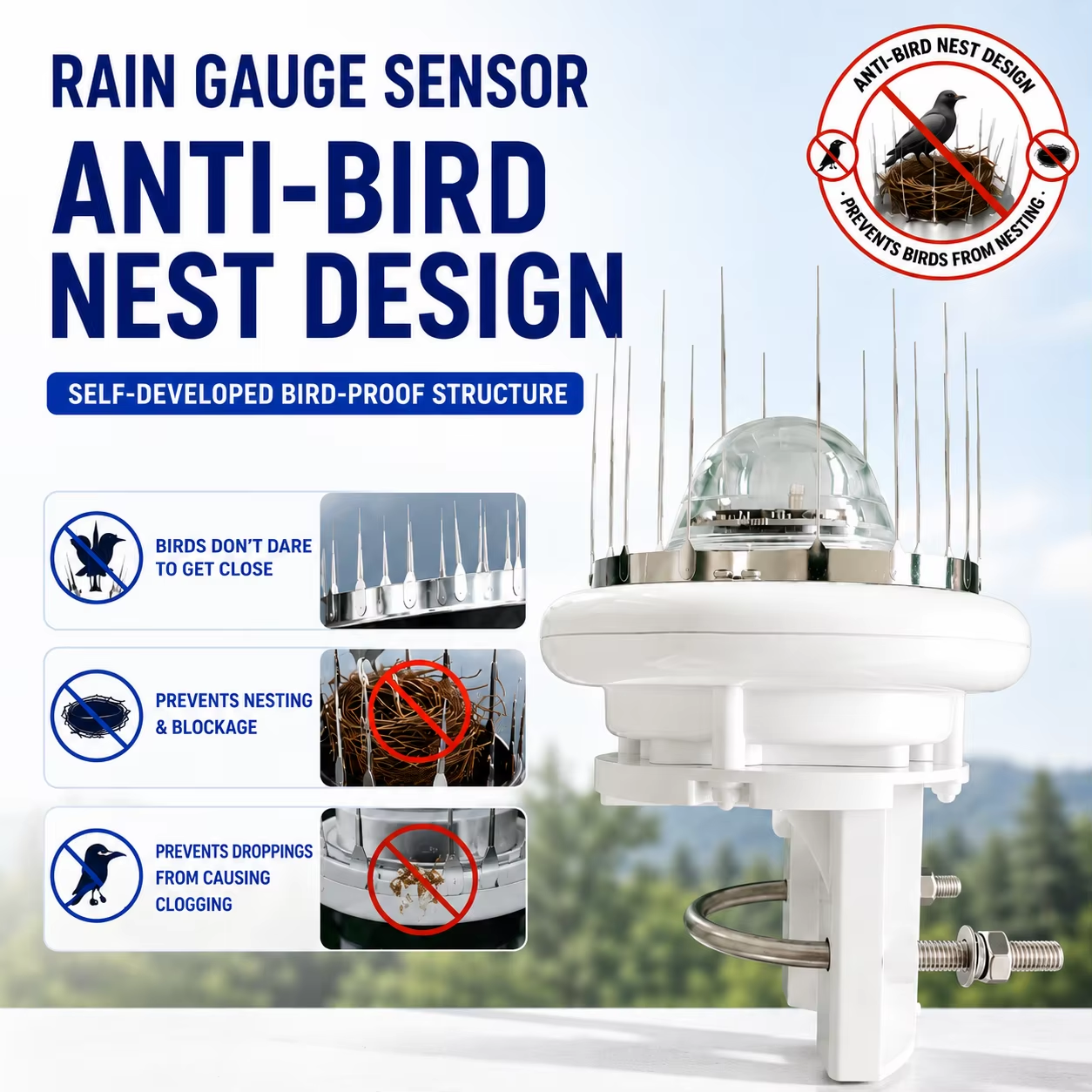
- Zero Clogging: The streamlined dome design sheds leaves and debris, eliminating the #1 maintenance cost of traditional hydrology.
2. All-in-One Compact Design
This single unit integrates the sensing element, high-precision processing electronics, and an RS485 Modbus-RTU interface. It weighs less than 500g, allowing for instant deployment on smart light poles or communication towers.
3. Extreme Weather Durability
With an IP66/IP67 rating and an wide operating range of
−40°C to
+70°C, the sensor remains functional in both arctic blizzards and tropical hurricanes where mechanical buckets would freeze or overflow.
The Honde Full-Stack Solutions Architecture
Deploying a rainfall grid across a province or a sprawling metropolis requires more than just a sensor; it requires a tiered data loop:
Tier 1: Local Awareness & Site Verification
- Handheld Auditing: Field technicians utilize the Honde Handmeter to verify the optical signal strength during annual audits.
- Local Persistence: Each station is anchored by our Data Logger with screen, providing local operators with real-time intensity graphs and 30-day graphical history on-site—essential for audits during network outages.
Tier 2: The Wireless Nervous System (Transmission)
- Urban-Ready Modules: Data is transmitted from smart poles or remote rooftops using GPRS/4G/WIFI/LORA/LORAWAN wireless modules.
- The MQTT Logic: For Smart City integrators, data is transmitted in MQTT Json format. This ensures the rainfall data feeds directly into hydraulic modeling software and Digital Twins without proprietary middleware.
Tier 3: Cloud Management & Active Warning (The Safety Loop)
- All data is centralized on the Cloud server and software, offering 24/7 visibility into the city’s precipitation intensity maps.
- The Alarm Relay System: This is the critical life-saving loop. If rainfall intensity crosses a dangerous “Flash Flood” threshold, the cloud platform triggers an Alarm Relay system to see the real time data, automatically closing floodgates or activating roadside sirens in low-lying areas.
Real-World Case Study: Managing Urban Resilience in Houston, USA
The city of Houston required a high-density, low-maintenance grid to monitor “Micro-Rain-Bombs” that cause flash flooding in underpasses.
The Honde Intervention:
- Hardware: Deployed 150 Honde Optical Rain Gauges on existing smart light poles.
- Connectivity: Used 4G wireless modules transmitting in MQTT Json format back to the city’s emergency ops center.
- Outcome: The All-solid-state design eliminated the need for monthly cleaning crews (saving an estimated $12,000 in OPEX annually). The Alarm Relay System helped the city automate its tunnel barricades, reacting to intense rain 8 minutes faster than previous mechanical sensors could trigger.
Contact Honde Technology for Project Sourcing
For more sensor information and customized IoT solutions, please contact Honde Technology Co., LTD.
- WhatsApp: +86-15210548582
- Email: info@hondetech.com
- Company Website: www.hondetechco.com
Post time: Jun-30-2026