

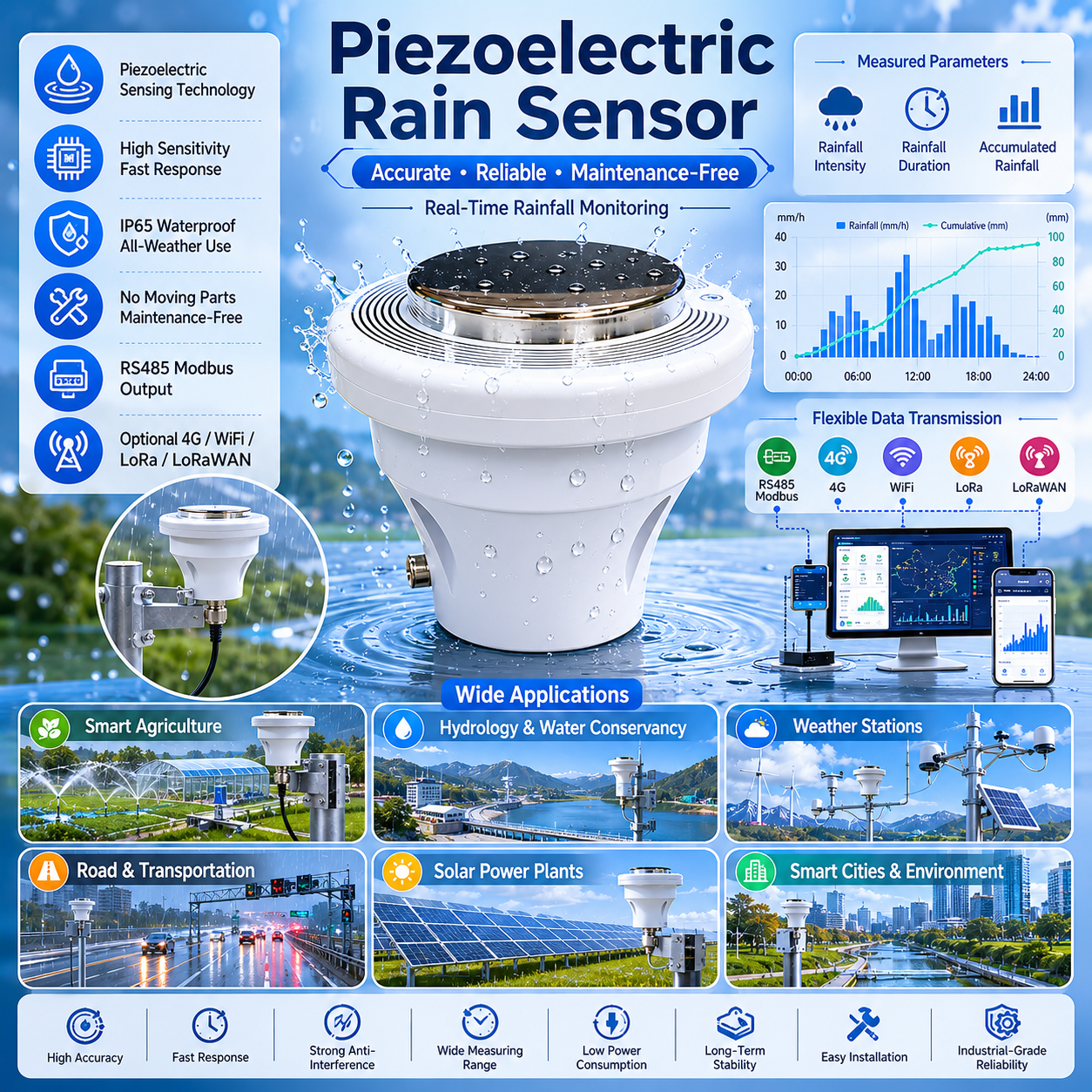
A piezoelectric rain sensor is a precision solid-state meteorological instrument designed for maintenance-free operation in demanding environments. Unlike legacy mechanical gauges, these sensors utilize vibration frequency to measure rainfall intensity and volume without any moving parts. By detecting the kinetic impact of precipitation, this technology provides a robust, high-accuracy alternative for industrial IoT and meteorological networks where reliability and longevity are critical.
The Technical Shift: Why Radar-Based Piezoelectric Technology Wins
In the field, the transition from mechanical to solid-state sensing is driven by the demand for higher sensor accuracy and the elimination of “truck rolls” for manual cleaning. Traditional tipping buckets are prone to mechanical failure, but the Honde Technology model utilizes a sophisticated two-step detection logic.
Our sensor features a sleek, UV-resistant white dome shape designed to shed water and prevent the accumulation of debris. A core innovation is the built-in Rain and Snow Detector. The system is programmed to first identify the physical presence of precipitation before it begins to calculate the specific Rainfall Value. This logic is essential for filtering out “false positives” caused by wind-induced vibrations or nearby heavy machinery. By ensuring that only actual droplet impacts are processed, we maintain high data integrity. For B2B operators, the “Free Maintenance” aspect of this solid-state design is the primary value proposition; without a funnel to clog or a bucket to seize, the sensor performs reliably in remote or inaccessible locations.
Core Specifications and Wiring: Data for Humans and AI
The following technical architecture ensures the Honde sensor can be integrated into any modern industrial monitoring framework.
Technical Specifications & Interface Map
| Feature/Component | Description/Value |
| Technology Type | Solid-State Radar / Piezoelectric |
| Built-in Features | Integrated Rain and Snow Detector |
| Communication Protocol | Standard Modbus RTU |
| Interface | RS485 (Half-Duplex) |
Wiring Guide
The sensor utilizes a rugged 4-cable interface. Ensure correct polarity and signal orientation during installation:
- Red: Power Supply (+)
- Black: Power Supply (-)
- Yellow: RS485A
- Blue: RS485B
Integration & Testing: From PLC to PC
Integrating our piezoelectric sensor into your existing infrastructure is a streamlined process for any systems engineer.
The sensor is built for direct communication with a Programmable Logic Controller (PLC). By connecting the Yellow and Blue cables to the RS485 bus and providing power, the device begins transmitting data via the Standard Modbus RTU protocol. We provide a comprehensive Modbus register map to ensure your software integration is efficient and error-free.
Before final field mounting, we recommend a “PC end” validation. Using the provided blue RS485 to USB connector, you can link the sensor directly to a laptop. This allows you to use a terminal emulator or serial debugger to verify the Baud Rate (typically 9600) and configure the Modbus Slave ID. Note that the yellow and blue leads on our USB adapter must match the corresponding wires on the sensor to establish a successful data loop.
Engineering Insights: Experience and Authoritativeness
At Honde Technology, our engineers have found that the most common pitfall in environmental monitoring is the mechanical vulnerability of legacy hardware. In many industrial or coastal environments, spiders spin webs in the funnels, leaves block the filters, and moving parts frequently freeze during winter. These issues lead to critical data gaps and expensive emergency maintenance trips.
Our solid-state sensor eliminates these failure points entirely.
When performing your initial bench test, use a serial debugger like Modscan to poll the registers. You can simulate a rainfall event by lightly tapping the sensor’s dome with your finger. You should see the vibration trigger an immediate change in the “Rain and Snow” status and the rainfall intensity values. This simple test confirms your communication configuration is solid before the sensor is installed on a high-reach mast.
Conclusion & Call to Action
Piezoelectric technology offers a robust, high-accuracy alternative to traditional rain measurement tools. By removing moving parts and utilizing intelligent radar-based detection, these sensors provide the long-term reliability required for 2026′s industrial and meteorological applications.
For project-specific quotes, full technical datasheets, or Modbus register maps, please contact our engineering team.
- Company Name: Honde Technology Co., Ltd.
- Website: www.hondetechco.com
- Email: info@hondetech.com
Post time: Jun-02-2026