

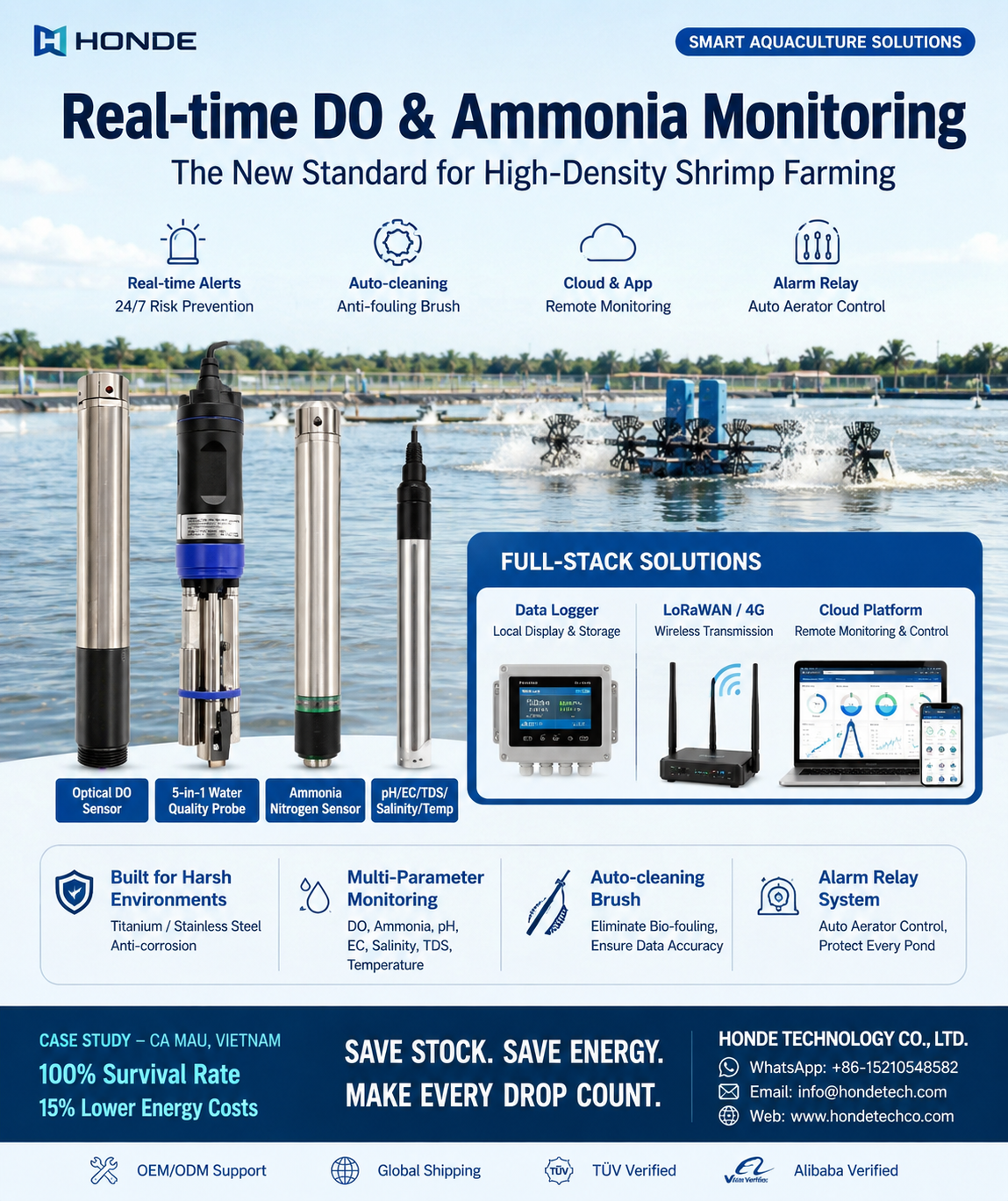
The June Crisis in Southeast Asia: Temperature, Rain, and Hypoxia
As of June 2026, major aquaculture hubs—specifically Vietnam (Mekong Delta), Thailand (Chachoengsao), and Indonesia (East Java)—are in the middle of their highest-risk production window. The combination of intense tropical heat and sudden monsoon downpours creates a “perfect storm” for high-density shrimp ponds:
- Thermal Inversion & Hypoxia: Rising water temperatures drastically reduce the solubility of oxygen. At 32°C, a 2-hour power failure in aeration can wipe out an entire pond of Whiteleg shrimp.
- Ammonia Spikes: High feeding rates in June lead to massive organic loading. When the pH fluctuates due to rain, non-ionized ammonia (
NH3) becomes toxic, killing stock within hours.
The engineering consensus in 2026 is that manual sampling is a gamble. If you aren’t monitoring your dissolved oxygen (DO) and ammonia levels 24/7 with autonomous alerts, you are operating at a 30% higher risk of total crop loss.
The Honde Perception Layer: Built for the “Salt and Sludge”
Aquaculture environments are brutal. Saltwater corrodes, and algae fouls sensors. Honde Technology’s 2026 Smart Aquaculture Series is engineered for these exact field conditions:
1. Titanium/Stainless Steel Optical DO Sensor (RD-WQ-DO)
Unlike traditional electrochemical probes that require constant membrane changes and water flow, our Optical Fluorescence sensor consumes zero oxygen.
- The Advantage: It is completely immune to the “poisoning” effects of
H2S and maintains accuracy in stagnant water.
- The Durability: Encased in Titanium (for seawater) or 316L Stainless Steel (for freshwater), it withstands the harsh salinity of shrimp ponds for years, not months.
2. The Multi-Parameter “Shield” (pH, EC, Salinity, TDS, Temp)
A single 5-in-1 probe allows for the simultaneous tracking of Salinity and pH, the two most critical parameters for managing shrimp molting cycles and osmotic stress after heavy rainfall.
3. Real-time Ammonia & Nitrate (RD-WQ-ION)
Using ion-selective electrode technology with built-in compensation, this sensor tracks
NH4+ and
NO3−, providing the “Digital Evidence” needed to adjust feeding or water exchange rates before the water becomes toxic.
The Honde Full-Stack Solutions Architecture
Managing 50 ponds across a remote coastal farm requires a three-tiered digital nervous system:
Tier 1: Local Field Operations & Maintenance
- Handheld Auditing: Farm managers utilize our Handmeter for rapid cross-verification during daily pond walks.
- Local Station Visibility: Each cluster of ponds is equipped with our Data Logger with screen, providing local staff with real-time graphs and 30-day history on-site—critical during network outages.
- Integrated Maintenance: For high-density ponds where algae and biofilm growth are aggressive, our sensors are integrated into a Floating Buoy system and equipped with an Automatic cleaning brush. By wiping the sensor face every 15 minutes, we eliminate the #1 cause of data drift in aquaculture.
Tier 2: The Wireless Nervous System (Transmission)
- Connectivity in Remote Areas: Our modules support GPRS/4G/WIFI/LORA/LORAWAN wireless modules.
- The MQTT Logic: For large-scale commercial farms, data is transmitted in the MQTT Json format. This ensures the water quality data feeds directly into the farm’s ERP or “Digital Farm” platform without proprietary drivers.
Tier 3: Cloud Intelligence & Active Automation (The Safety Loop)
- All data is centralized on the Cloud server and software, offering a real-time management dashboard accessible via smartphone or tablet.
- The Alarm Relay System: This is the ultimate life-saver. If DO levels drop below 4mg/L or Ammonia spikes, the cloud platform triggers an Alarm Relay system on-site. This automatically activates the Paddlewheel Aerators or oxygen injection pumps, responding to the crisis faster than any human watchman.
Real-World Case Study: Saving a High-Density Shrimp Farm in Ca Mau, Vietnam
A B2B client in Ca Mau province, Vietnam, managing 20 super-intensive shrimp ponds, faced recurring nighttime losses due to localized hypoxia and ammonia spikes.
The Honde Intervention:
- Hardware: Deployed Optical DO Sensors and 5-in-1 Water Quality Probes at 2-meter depths across the farm.
- Transmission: Due to the remote coastal location, LoRaWAN was utilized to transmit data in MQTT Json format to a central 4G gateway.
- Automation: The system was linked to the farm’s existing aerators via the Alarm Relay System.
- The Outcome: Within the first June cycle, the system detected 12 critical hypoxia events at 2 AM. The Alarm Relay triggered the aerators automatically, keeping DO levels above 5mg/L. The farm reported a 100% survival rate and a 15% reduction in electricity costs by only running aerators when the real-time data required it.
Contact Honde Technology for Aquaculture Sourcing
For more sensor information and customized IoT solutions, please contact Honde Technology Co., LTD.
WhatsApp: +86-15210548582
Email: info@hondetech.com
Company Website: www.hondetechco.com
Post time: Jun-22-2026