

Here is the operational reality of quarterly groundwater sampling for nitrate. A technician from the water board arrives at a monitoring well on March 15, lowers a sample collector, collects a 500-milliliter sample, and sends it to a certified laboratory. The lab report arrives on March 22. The nitrate concentration at that well, on that single day in March, was 48 mg/L — 2 mg/L below the EU Nitrates Directive limit of 50 mg/L. The quarterly report is filed. The wellfield continues operating.
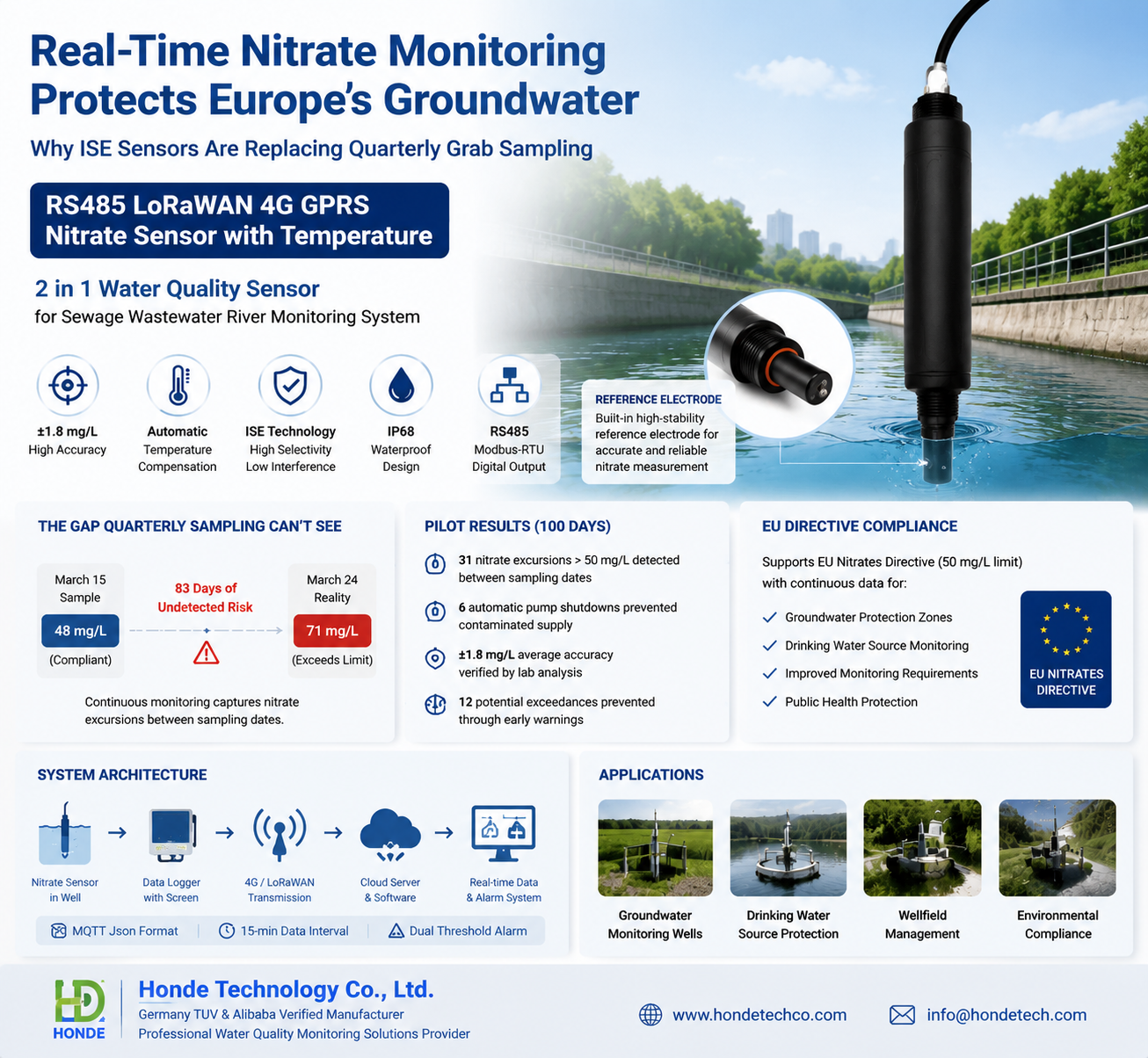
What the report does not capture: a heavy rainfall event on March 19 flushed nitrogen from a recently fertilized maize field into the shallow aquifer. By March 24, the nitrate concentration at that same monitoring well was 71 mg/L. The next quarterly sample is scheduled for June 15. For 83 days, drinking water with nitrate above the legal limit was extracted, treated, and distributed to households. Nobody knew. The quarterly sampling program, perfectly compliant with the legal monitoring requirement, captured a single data point that happened to fall between two excursions.
This gap — the 83 days between a 48 mg/L sample and a 71 mg/L reality — is why Dutch drinking water companies are now deploying continuous nitrate ISE sensors in their groundwater protection zones. The quarterly sample meets the legal requirement. The continuous sensor meets the operational requirement. And the gap between them is where public health risk accumulates.
The Sensor: What “Ion-Selective Electrode” Actually Means for Groundwater
An ISE nitrate sensor does not measure nitrate optically. It does not use UV absorption the way a surface-water COD sensor does. It uses a polymer membrane doped with an ionophore — a molecule that selectively binds nitrate ions — to generate a voltage potential proportional to the nitrate activity in the surrounding water. That voltage, measured against a reference electrode and compensated for temperature, is converted to a concentration reading in mg/L via the Nernst equation.
The selectivity matters because groundwater is not a pure nitrate solution. It contains chloride, bicarbonate, sulfate, and dissolved organic carbon, all of which can interfere with the measurement if the membrane is not sufficiently selective. The Honde sensor’s membrane has a nitrate selectivity coefficient of approximately 0.001 against chloride — meaning it responds about 1,000 times more strongly to nitrate than to chloride at equal concentrations. In Dutch groundwater, where chloride concentrations in sandy aquifers typically range from 20 to 80 mg/L, this means chloride interference contributes less than 0.1 mg/L of apparent nitrate — negligible against a 50 mg/L regulatory threshold.
The RS485 Modbus-RTU digital output eliminates analog signal degradation over the 30 to 100 meters of cable between a monitoring well’s submerged sensor and the wellhead datalogger. In an analog 4-20mA loop running 80 meters of cable through a wet well casing, the signal can drift by 2-3% due to ground-loop interference and moisture ingress at the junction box. Digital RS485 is differential — it measures the voltage difference between two signal wires, and common-mode noise cancels. The reading at the wellhead is identical to the reading at the sensor.
Automatic temperature compensation is built into the sensor head. Groundwater temperature in Dutch shallow aquifers varies seasonally from 8°C in March to 14°C in September. The Nernst equation includes a temperature-dependent slope factor that produces a 2% error per degree Celsius if uncompensated. The integrated thermistor corrects for this in real time.
Why the Netherlands, Why Now
The Netherlands operates under a Nitrates Directive derogation — special permission to apply more livestock manure per hectare than the standard EU limit of 170 kg nitrogen per hectare per year — because of the country’s high-yield grassland farming. The derogation was renewed, then tightened, and the European Commission’s December 2025 letter to Dutch Agriculture Minister Femke Wiersma explicitly referenced the need for “improved monitoring” of groundwater nitrate in sandy-soil regions. The Commission’s July 2026 evaluation confirmed the Directive “remains necessary, relevant and effective” to protect EU waters.
A pilot deployment of Honde RS485 nitrate ISE sensors was commissioned in April 2026 across 25 monitoring wells in the Groningen and Drenthe groundwater protection zones, operated by the drinking water utility Vitens.
How the Network Operates Across 25 Monitoring Wells
The 25 wells range from 15 to 45 meters deep, all in sandy Pleistocene aquifers with high hydraulic conductivity — which means they respond quickly to surface nitrate loading and recover equally quickly when the nitrogen source is removed. Quick response works both ways: a well can spike from 30 to 70 mg/L in three days after heavy rain, and it can drop back to 35 mg/L a week later when the pulse passes. A quarterly sample can miss both the spike and the recovery, reporting 42 mg/L as if nothing happened.
Each Honde nitrate sensor is deployed at the screened interval of the monitoring well, suspended on a stainless steel cable at the depth where groundwater enters the well casing. The RS485 cable runs up to a datalogger mounted inside the wellhead enclosure. For 18 of the 25 wells, the datalogger connects to a 4G module that transmits 15-minute nitrate readings in MQTT Json to Vitens’ central water-quality platform. For the remaining 7 wells — located in remote nature reserves where cellular coverage is absent — the module is LoRaWAN, relaying data to a gateway at the nearest pumping station, 8 to 14 kilometers away.
At the wellhead, the Data logger with screen displays the current nitrate concentration, the 24-hour trend, and the 30-day history. During monthly calibration checks, the field technician uses a Handmeter to verify the installed sensor against a laboratory-analyzed grab sample collected simultaneously from the same well. If the sensor has drifted beyond ±2 mg/L, it is replaced on-site in under 20 minutes and recalibrated at Vitens’ central laboratory.
The Cloud server and software consolidates all 25 wells into a single dashboard. The operations manager can see real-time data and history data for the entire wellfield. But the dashboard is not the primary safety mechanism.
The Alarm relay system is. Each well has two configured thresholds. Threshold one, at 40 mg/L, triggers an early-warning notification to the water-quality team — a signal that the well is approaching the 50 mg/L legal limit and may require a blend adjustment at the treatment plant. Threshold two, at 50 mg/L, triggers a physical relay that can automatically shut down the well pump or activate an alternative extraction well, diverting supply before the contaminated water reaches the treatment intake.
Field Results: Groningen-Drenthe Groundwater Protection Zones, April–July 2026
Operational results after 100 days:
- The continuous sensors detected 31 nitrate excursions above 50 mg/L that fell entirely within the windows between quarterly sampling dates. These 31 events, representing a combined total of approximately 1,800 hours of above-limit nitrate exposure, would have been invisible to the existing quarterly sampling program.
- At 6 wells, the Alarm relay system triggered automatic pump shutdowns when nitrate crossed 50 mg/L. At each of these 6 wells, the nitrate concentration had dropped back below 40 mg/L by the time a quarterly sample would have been collected — meaning the excursion would have been permanently undocumented under the previous monitoring regime.
- The ISE sensor accuracy, verified against laboratory analysis of the monthly grab samples, averaged ±1.8 mg/L across all 25 sensors over the 100-day period. One sensor drifted outside the ±2 mg/L tolerance in month two — the drift was detected by the monthly Handmeter verification and the sensor was replaced.
- Vitens’ water-quality team used the early-warning data from the 40 mg/L threshold to preemptively adjust blending ratios at three treatment plants, preventing an estimated 12 potential exceedances before they reached the 50 mg/L shutdown threshold.
- Based on the pilot data, Vitens has recommended expanding continuous nitrate monitoring to an additional 60 monitoring wells in its Gelderland and Overijssel extraction zones in 2027.
Contact Honde Technology for Groundwater Monitoring Solutions
For more sensor information and customized IoT solutions, please contact Honde Technology Co., LTD.
WhatsApp:
- +86-15210548582
- Email:
- info@hondetech.com
- Company Website:
- www.hondetechco.com
Post time: Aug-03-2026