

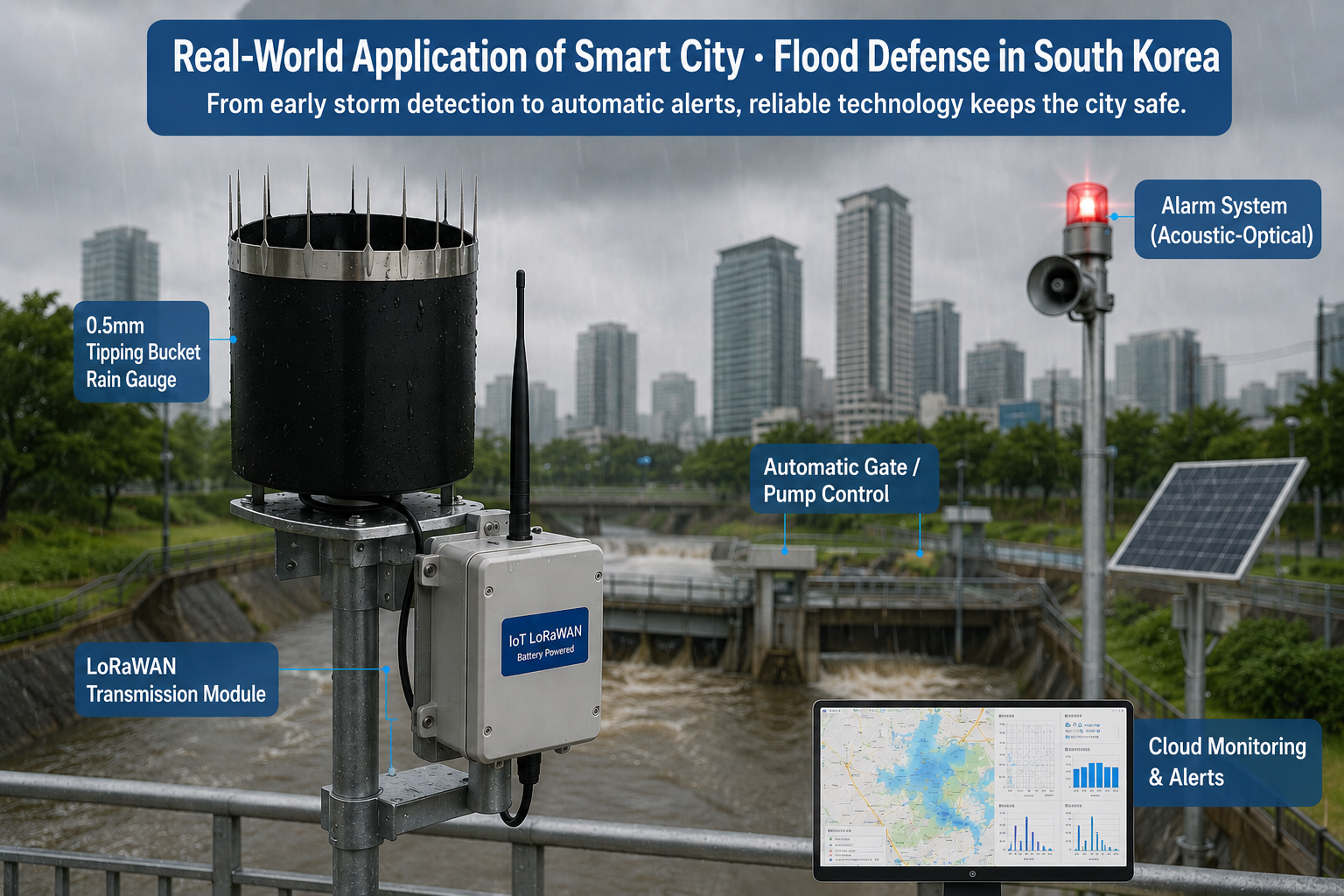
The Reality of “Micro-Storms”: Why National Forecasts are No Longer Enough
In South Korea, the 2024 and 2025 “Changma” (monsoon) seasons proved a costly point: traditional, sparse weather networks cannot capture localized “Cloudbursts.” In districts like Gangnam (Seoul) or the rugged terrain of Gangwon-do, rainfall can vary by 50mm between adjacent neighborhoods. To build “Resilient Cities,” South Korean engineers are now deploying Hyper-Local Precipitation Grids.
The primary obstacle in these grids is not accuracy—it is maintenance and power. In high-density urban canyons and remote mountain landslide zones, expensive ultrasonic gauges fail due to high power draw and complex recalibration needs.
Honde Technology’s Pulse-Output Tipping Bucket Rain Gauge has emerged as the preferred “Infrastructure Workhorse” because it relies on a Passive Mechanical Logic that survives where electronics drift.
Engineering Edge: Passive Reliability in a Connected World
The logic behind selecting a mechanical pulse sensor for a high-tech K-Smart City is rooted in operational physics:
-
1Zero-Idle Power Consumption: Unlike digital sensors that require constant current to remain active, the Honde 0.5mm gauge uses a Passive Reed Switch. It only draws power during the millisecond a tip occurs. This is the only way to achieve a 5-year battery life on the LTE-M or LoRaWAN nodes used across Korea’s national grid.
-
2Signal Integrity (Modbus vs. Pulse): While the raw output is a pulse, our integrated converters allow for RS485 Modbus-RTU stability, ensuring that rain data isn’t lost to electromagnetic interference in dense urban environments.
-
3Built for Humidity: With a 304 stainless steel housing and an anti-insect mesh, the unit eliminates the #1 cause of sensor failure in Asia: clogging and internal corrosion.
The Honde Full-Stack Architecture: From Tip to Trigger
A sensor is a data point; a Honde Solution is a safety loop. We integrate this hardware into a three-tiered digital ecosystem:
Tier 1: Local Verification & Data Persistence
- Field Audit Tools: On-site installation teams use the Honde Handmeter to verify pulse counts in seconds.
- Offline Resilience: In mountainous landslide zones where signal gaps are common, our Data Logger with screen acts as the local black box, storing 30 days of 1-minute interval history for physical retrieval if the network fails.
Tier 2: The Wireless Nervous System (Transmission)
- IoT Ready: Our stations utilize GPRS, 4G, WIFI, LORA, or LORAWAN wireless modules.
- The MQTT Standard: To meet South Korea’s strict “Smart City Integration” requirements, all modules transmit in MQTT Json format. This allows the rain data to feed directly into the city’s “Digital Twin” dashboard or “K-Smart Farm” control center without custom API development.
Tier 3: Cloud Intelligence & Automated Defense
- Data is visualized on the Honde Cloud Server and Software, providing real-time precipitation intensity maps.
- The Alarm Relay System: This is the critical life-saving loop. When the 0.5mm gauge detects rainfall exceeding a dangerous “Flash Flood” threshold (e.g., 25mm in 10 minutes), the cloud platform triggers a physical Alarm Relay system. This automatically activates Acoustic-Optical sirens at riverside parks or triggers automated shut-off gates in underground tunnels.
Real-World Case Study: Urban Drainage Automation in Incheon, South Korea
Incheon Metropolitan City required a high-density grid to manage its “Deep Tunnel” drainage system. They needed a sensor that could survive coastal salt air and integrate with their existing LoRaWAN network.
The Honde Intervention:
The Hardware: Deployed 120 units of the Stainless Steel Tipping Bucket Rain Gauges.
The Link: Used LoRaWAN modules transmitting in MQTT Json format.
The ROI: By achieving neighborhood-level data granularity, the city successfully automated its pumping stations. The Alarm Relay System now triggers pumps based on local rainfall intensity rather than delayed city-wide averages, reducing urban flood damage by 28% in the 2025 season.
Contact Honde Technology for Infrastructure Sourcing
For more sensor information and customized IoT solutions, please contact Honde Technology Co., LTD.
WhatsApp:+86-15210548582
Email:info@hondetech.com
Company Website:www.hondetechco.com
Product Link:View on Alibaba
Post time: Jun-17-2026