

Reverse osmosis removes salt. It also removes everything else. The water that emerges from an RO membrane is chemically aggressive — low pH, near-zero hardness, near-zero alkalinity, and a corrosion potential that will leach lead from solder joints and dissolve cement linings from distribution pipes. In Spain’s Mediterranean coastal systems, where desalinated water travels from coastal plants through aging networks to inland cities, that corrosion potential is not theoretical. It is the reason pipe failures in desalinated-water distribution systems cost more to maintain than conventional supply networks.
The engineering fix is remineralization: inject dissolved CO₂ into the product water to lower its pH, then pass it through a limestone contactor where the CO₂ reacts with calcium carbonate to dissolve calcium and bicarbonate into the water. The result is water with controlled hardness and alkalinity — a stable Langelier Saturation Index that will not corrode or scale pipe walls.
The CO₂ dosing rate controls everything. Too little CO₂: insufficient calcium dissolves from the limestone, the water remains corrosive. Too much CO₂: excess gas passes the contactor unchanged, enters the distribution system, and drops the water’s pH at the tap — a regulatory violation under Spain’s Real Decreto 140/2003 (drinking water standards, maximum 500 mg/L CO₂). The dissolved CO₂ sensor is the only instrument that measures the actual dose delivered to the process, not the dose commanded by the dosing pump.
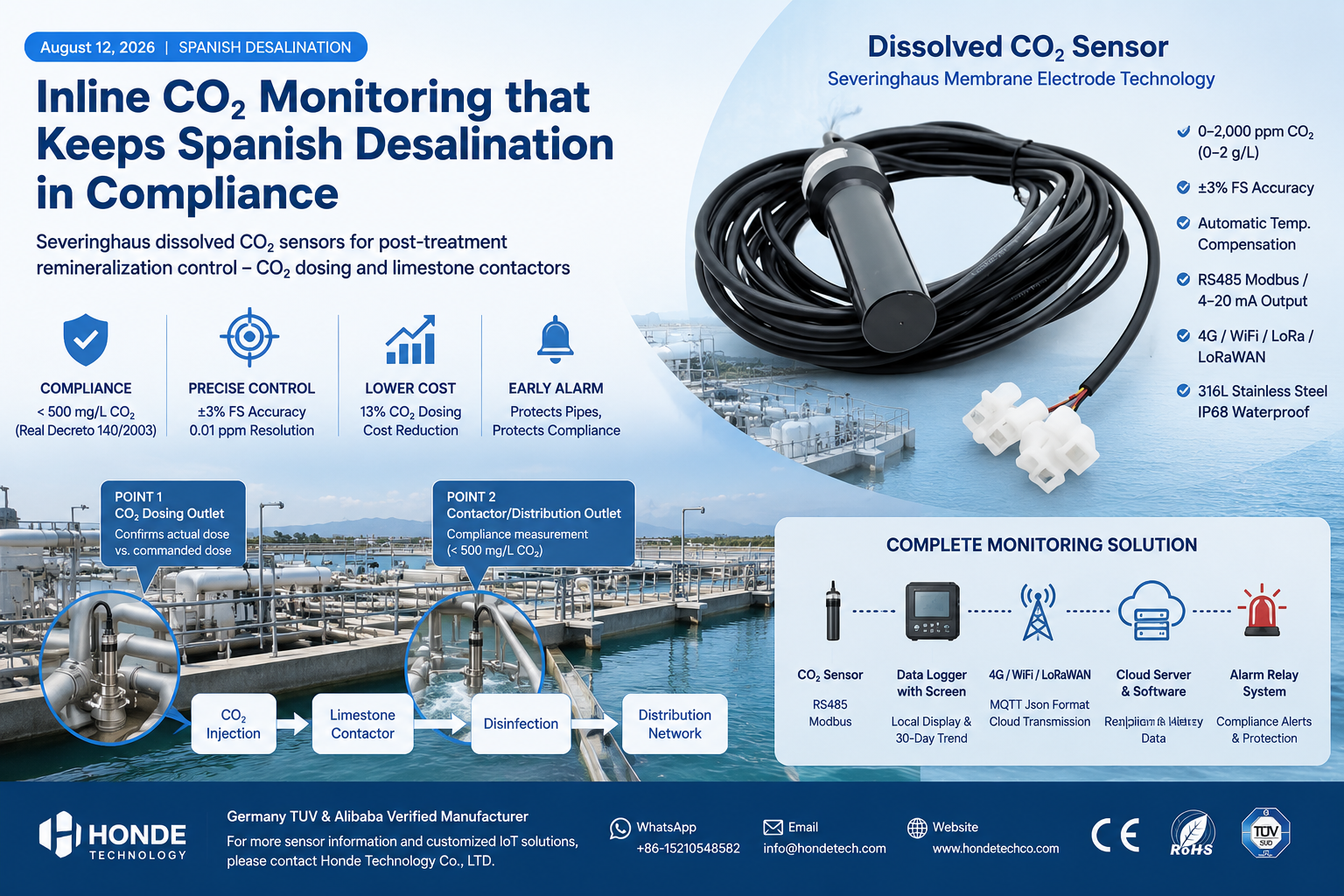
The Sensor
The Honde dissolved CO₂ sensor uses a Severinghaus-type membrane electrode. CO₂ diffuses from the process water through a gas-permeable membrane into an internal buffer, where it produces a pH change that the electrode converts to a concentration reading. The measurement is specific to dissolved CO₂ — it does not respond to bicarbonate, carbonate, or any other dissolved species.
| Specification | Value |
|---|---|
| Measurement principle | Severinghaus membrane electrode |
| CO₂ range | 0–2,000 ppm (0–2 g/L) |
| Accuracy | ±3% FS |
| Resolution | 0.01 ppm |
| Temperature compensation | Automatic, 0–50°C |
| Output | RS485 Modbus-RTU / 4–20 mA |
| Wireless | GPRS / 4G / WiFi / LoRa / LoRaWAN |
| Housing | 316L stainless steel, IP68 |
The automatic temperature compensation is the critical specification for Spanish Mediterranean desalination. Product water temperature varies from 16°C in winter to 28°C in summer — a 12°C swing that produces a 12–15% error in uncompensated dissolved CO₂ measurement. Spanish drinking water regulations require CO₂ levels measured at the distribution point, which is at ambient temperature. A sensor calibrated at 20°C reading summer product water at 28°C overstates CO₂ content by approximately 15% — enough to trigger a false high alarm at a standard dosing plant. Temperature compensation eliminates this seasonal drift.
The Post-Treatment Process Configuration
At a Spanish SWRO (seawater RO) plant, the dissolved CO₂ sensor is installed at two measurement points:
Point 1: CO₂ dosing outlet downstream of the CO₂ injection header, upstream of the limestone contactors. The sensor confirms the actual dissolved CO₂ concentration before the water enters the limestone bed. Dosing pump output and actual dissolved CO₂ diverge when the CO₂ supply pressure fluctuates or the water’s partial pressure equilibrium shifts — events the dosing pump controller does not detect. The sensor detects them immediately.
Point 2: Contactor outlet / distribution header after the limestone contactors. The sensor measures residual dissolved CO₂ in the finished water, confirming that the limestone reaction has consumed CO₂ within the regulatory range. This is the compliance measurement point.
| Process measurement point | Sensor function | Regulatory threshold |
|---|---|---|
| CO₂ dosing outlet | Confirms actual dose vs. commanded dose | No direct threshold; drives PID control |
| Contactor/distribution outlet | Compliance measurement | < 500 mg/L CO₂ (Real Decreto 140/2003) |
The Solution Architecture
Tier 1 — Plant instrumentation Both sensors connect to the plant’s process control network via RS485 Modbus-RTU. A Data logger with screen in the plant control room displays both measurement points simultaneously — the dosing CO₂ concentration and the finished-water residual — with 30-day trend graphing. The plant operator verifies each sensor monthly against a Handmeter reference: a grab sample analyzed with a portable CO₂ meter, compared against the installed reading.
Tier 2 — Transmission Plant sensors transmit via GPRS, 4G, or WiFi modules to the water utility’s centralized SCADA network. For satellite plants on the Canary Islands and remote coastal stations in Almería and Murcia where dedicated WAN connectivity is limited, LoRaWAN relays data to the utility’s regional operations center. All data is packetized in MQTT Json format, feeding both the plant’s local PID controller and the utility’s centralized water quality monitoring platform.
Tier 3 — Cloud and dosing control The Cloud server and software consolidates dissolved CO₂ data from all monitored desalination plants, showing real-time data and history data across the utility’s treatment network. The Alarm relay system operates on the compliance threshold: when the contactor-outlet CO₂ exceeds 450 mg/L — 50 mg/L below the regulatory limit — the relay alerts the shift supervisor and flags the event for the quarterly compliance report. A second relay at the dosing-outlet sensor triggers when CO₂ drops below the minimum contactor-feed concentration, alerting the operator that insufficient CO₂ is reaching the limestone bed.
Field Results: Mediterranean Coastal SWRO Plant, Murcia, Spain, 2026
A SWRO plant in Murcia serving 180,000 urban consumers installed Honde dissolved CO₂ sensors at both measurement points in January 2026, replacing a previous regime of manual grab-sample CO₂ testing twice per shift.
- • Hardware: 2 dissolved CO₂ sensors per treatment train (4 trains = 8 sensors total), RS485 to plant PLC, 4G to utility SCADA.
- • Local: Data logger with screen in the control room; Handmeter verification monthly.
- • Cloud: MQTT Json to the utility’s centralized quality platform.
- • Alarm: 450 mg/L high-CO₂ relay; minimum dosing-outlet relay per train.
| Metric | Grab-sample baseline (2025) | Inline CO₂ sensor (2026) |
|---|---|---|
| Finished-water CO₂ exceedances (>500 mg/L) | 7 | 0 |
| Dosing-pump failures undetected >2 hours | 9 | 0 |
| pH excursions at distribution inlet | 23 | 4 |
| CO₂ dosing chemical cost (indexed) | 100% | 87% |
| Manual CO₂ lab analyses per month | 720 | 72 (verification only) |
- The 7 finished-water CO₂ exceedances recorded in 2025 — each a regulatory event requiring notification to Spain’s Ministry of Health — dropped to zero in the first seven months of instrumented operation. The alarm relay system caught three incipient exceedances at the 450 mg/L threshold and alerted the shift supervisor, who corrected the CO₂ dosing rate before the finished-water point was affected.
- 9 dosing-pump failures in 2025 had gone undetected for more than 2 hours before grab-sample testing caught them — because the pump’s control signal showed “running” while a stuck valve prevented CO₂ delivery. The inline sensor at the dosing outlet detected each equivalent event in the 2026 season within 2 minutes of failure onset, each triggering an immediate relay alarm.
- CO₂ dosing cost dropped 13% — the inline feedback loop allowed the plant to tighten the dosing setpoint from 280 mg/L to 240 mg/L at the dosing outlet, eliminating the safety margin that had been compensating for the uncertainty of twice-shift grab sampling.
- Manual CO₂ analyses reduced from 720 to 72 per month — the inline sensors handle continuous compliance monitoring; the monthly grab samples provide the verification audit trail.
Contact Honde Technology for Water Treatment Monitoring
Honde Technology is a Germany TUV & Alibaba verified manufacturer. We supply the dissolved CO₂ measurement hardware, the Severinghaus membrane technology, and the process-control telemetry required for water treatment facilities operating under regulatory CO₂ limits.
For more sensor information and customized IoT solutions, please contact Honde Technology Co., LTD.
- WhatsApp: +86-15210548582
- Email: info@hondetech.com
- Company Website: www.hondetechco.com
The Demand Map Across Developed Desalination and Water Treatment Markets
The dissolved CO₂ sensor for remineralization control is a specification shared across every country operating SWRO desalination at municipal scale. Israel’s Sorek and Hadera plants — the world’s largest SWRO facilities — run continuous dissolved CO₂ monitoring at their limestone contactors. Australia’s Perth Seawater Desalination Plants (SWDP) and Sydney’s Kurnell facility specify inline CO₂ sensors as part of the regulatory compliance instrumentation. Portugal’s Algarve desalination network, expanded after the 2022–2025 drought, requires CO₂ monitoring at every contactor outlet. Cyprus and Malta, where desalination provides more than 50% of drinking water supply, operate dissolved CO₂ sensors as the primary compliance instruments for their distribution networks. Each plant converges on the same sensor requirement: Severinghaus membrane electrode, automatic temperature compensation, and RS485/MQTT output — the specification that closes the dosing control loop that manual grab sampling cannot.
Post time: Aug-25-2026