

Introduction: How Does a WiFi MQTT Weather Station Work?
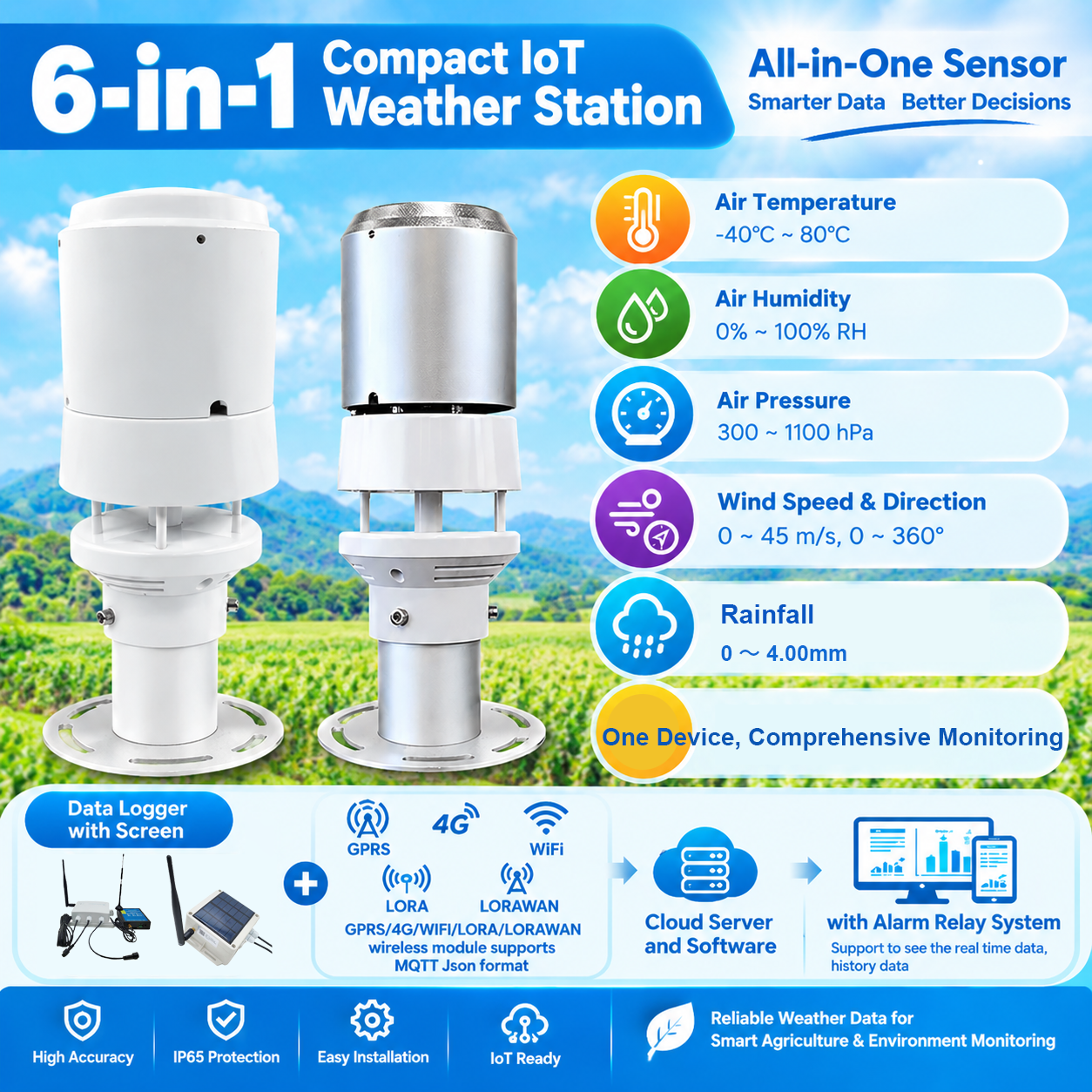
A WiFi MQTT weather station combines meteorological sensors, wireless connectivity, and an IoT communication protocol to transmit environmental data to compatible monitoring platforms. It helps system integrators, agricultural technology providers, and industrial users collect weather information and integrate it into their digital systems.
For projects that require remote weather monitoring, the key is not only to measure environmental conditions but also to deliver data reliably to the right platform. By combining a suitable weather station with WiFi connectivity and MQTT communication, project developers can build a flexible monitoring system for smart agriculture, environmental monitoring, smart cities, and industrial applications.
In this guide, Honde Technology explains how WiFi MQTT weather monitoring works, what buyers should consider before purchasing, and how to select a suitable solution for an IoT project.
1. What Is a WiFi MQTT Weather Station?
A WiFi MQTT weather station is a meteorological monitoring system designed to collect environmental measurements and transmit them through a WiFi network using MQTT, or Message Queuing Telemetry Transport, when supported by the selected configuration.
MQTT is a lightweight messaging protocol commonly used in Internet of Things applications. It allows connected devices to publish data to a broker, which distributes messages to authorized subscribers.
A typical system architecture is:
Weather Sensors → Data Acquisition and Processing → WiFi Network → MQTT Broker → Monitoring Platform → PC or Mobile Device
Depending on the hardware and software configuration, the system may also include a data logger, cloud server, local display, alarm functions, or connections to other monitoring equipment.
The exact architecture depends on the weather station model and the customer’s integration requirements.
2. How MQTT Improves IoT Weather Monitoring
Traditional weather monitoring systems may rely on local displays, manual data collection, or dedicated software. An IoT-enabled weather station can make environmental data available to other systems through a compatible network connection.
MQTT offers several useful capabilities:
- Lightweight messaging: Suitable for many IoT applications where communication efficiency matters.
- Publish-subscribe communication: Separates data producers from data consumers.
- Flexible integration: Allows compatible applications to subscribe to weather data and process it.
- Configurable message delivery: MQTT supports different Quality of Service (QoS) levels according to application requirements.
- Scalable architecture: Multiple devices can publish data to a broker, subject to network capacity and system design.
These capabilities make MQTT a practical option for projects that need to connect environmental sensors with dashboards, databases, alert systems, or other IoT services.
However, MQTT alone does not guarantee real-time delivery, uninterrupted connectivity, or automatic compatibility with every cloud platform. Network quality, broker configuration, device firmware, and data-processing design all affect system performance.
3. Which Weather Parameters Can an IoT Weather Station Monitor?
The available measurements depend on the selected weather station and sensor configuration.
| Weather parameter | Typical application |
|---|---|
| Air temperature | Crop management and local climate observation |
| Relative humidity | Greenhouse and environmental monitoring |
| Wind speed | Weather assessment and operational safety |
| Wind direction | Wind-pattern analysis and site monitoring |
| Atmospheric pressure | Meteorological observation |
| Rainfall | Irrigation planning and precipitation monitoring |
| Solar radiation | Solar energy assessment and agricultural research |
| Illuminance | Outdoor lighting and environmental studies |
Not every weather station includes all these parameters. Before ordering, confirm the supported sensors, measurement ranges, accuracy, output format, and available communication interfaces for the specific model.
For projects requiring additional measurements, such as soil moisture, soil temperature, or other environmental indicators, a compatible sensor integration plan may be necessary.
4. WiFi MQTT vs. RS485 Modbus vs. 4G and LoRaWAN
Selecting the right communication method is one of the most important decisions when designing an IoT weather monitoring system.
| Feature | WiFi with MQTT | RS485 Modbus | 4G with MQTT | LoRaWAN |
|---|---|---|---|---|
| Primary purpose | Wireless data integration | Wired device communication | Cellular remote monitoring | Long-range, low-power sensor networking |
| Network requirement | Suitable WiFi coverage | Compatible wired connection | Cellular coverage and service | Compatible LoRaWAN gateway and network |
| Typical integration | MQTT broker and application | PLC, logger, gateway | MQTT broker and application | LoRaWAN network server and application |
| Best suited for | Sites with available WiFi | Local industrial systems | Remote sites with cellular coverage | Distributed low-power sensor networks |
| Main consideration | WiFi range and network security | Cable layout and protocol compatibility | Signal strength and operating costs | Coverage, payload and reporting requirements |
These technologies serve different roles. MQTT is an application messaging protocol, while WiFi, cellular networks, and LoRaWAN provide different communication mechanisms. RS485 is a physical communication interface commonly used with protocols such as Modbus RTU.
They are therefore not direct substitutes in every system. A project may use more than one technology, such as an RS485 weather station connected to a gateway that publishes data through MQTT.
5. Four Practical Applications of WiFi MQTT Weather Stations
5.1 Smart Agriculture and Greenhouse Monitoring
Agricultural operators need timely information about local weather conditions to support crop management and environmental observation.
A WiFi MQTT weather monitoring system can provide weather measurements to a compatible agricultural management platform. When combined with suitable soil sensors, it can help users evaluate above-ground and below-ground environmental conditions together.
Potential system components include:
- A weather station for atmospheric measurements.
- Soil moisture and temperature sensors, where required.
- A WiFi-enabled data acquisition device or compatible MQTT interface.
- A monitoring dashboard for data visualization.
- Optional alert logic configured by the project developer.
The final system should be selected according to the crop, monitoring site, network coverage, and required data collection frequency.
5.2 Smart Cities and Distributed Environmental Monitoring
Urban environments can experience different weather conditions across relatively short distances. A distributed network of monitoring stations can help city managers collect localized environmental information.
WiFi MQTT connectivity can be useful at sites where an appropriate wireless network is available. Data can be delivered to a compatible central platform for visualization, storage, and further analysis.
For outdoor sites without dependable WiFi coverage, a cellular or other suitable communication option may be more appropriate.
5.3 Industrial Facilities and Infrastructure
Weather conditions can affect outdoor industrial operations, construction sites, storage facilities, and transportation infrastructure.
A connected weather station can provide environmental measurements to an existing monitoring platform, allowing operators to review conditions alongside other operational information.
Before deployment, buyers should assess the installation environment, enclosure protection, operating temperature, power supply, network availability, and required alarm logic.
5.4 Solar Energy and Renewable Energy Projects
Weather information can help renewable energy operators understand local environmental conditions.
Depending on the selected configuration, monitoring may include solar radiation, air temperature, wind speed, wind direction, and rainfall.
When these measurements are transmitted to a compatible IoT platform, project teams can analyze environmental data alongside operational records from the energy system.
A weather station does not replace dedicated photovoltaic performance instrumentation. Its role is to provide the environmental measurements required by the project.
6. How to Choose the Right WiFi MQTT Weather Station
Before purchasing a weather station for an IoT project, evaluate the following points.
Step 1: Define the required parameters
List every measurement needed for the application. Avoid paying for unnecessary sensors, but ensure that important measurements are not omitted.
Step 2: Confirm WiFi coverage
Check whether the installation site has dependable WiFi coverage. For remote agricultural fields or infrastructure sites, consider whether cellular connectivity or a gateway-based architecture would be more suitable.
Step 3: Verify MQTT compatibility
Ask the supplier to confirm whether MQTT is supported directly by the device or through an external gateway. Clarify the supported broker connection method, authentication, topic configuration, payload format, and data update interval.
Step 4: Check data integration requirements
Determine whether your platform requires JSON or another payload format, specific field names, timestamps, device identifiers, or a particular topic structure.
Do not assume that two MQTT-enabled devices will exchange data automatically. Their message formats and integration settings must be compatible.
Step 5: Evaluate outdoor installation requirements
Review the sensor specifications, ingress protection rating, operating temperature, mounting method, cable connections, and power requirements.
Step 6: Plan cybersecurity and reliability
Use appropriate network access controls, authentication, and encrypted communication where supported. For critical monitoring applications, consider reconnect behavior, data buffering, network outages, and recovery after power interruptions.
Step 7: Confirm the complete system configuration
Check whether the project requires a weather station only or a complete solution with a data logger, wireless module, cloud software, display, solar power supply, or additional sensors.
7. Common Mistakes to Avoid When Buying an MQTT Weather Station
Several integration problems can be prevented during the selection stage.
- Assuming MQTT means universal compatibility: The broker, authentication method, topic structure, and payload must be compatible with the receiving application.
- Ignoring WiFi availability: A technically compatible device cannot provide dependable remote monitoring if the site has insufficient network coverage.
- Choosing sensors by quantity alone: Measurement range, accuracy, environmental suitability, and calibration requirements are equally important.
- Overlooking data security: Network credentials and MQTT access permissions should be configured appropriately.
- Failing to test network recovery: Confirm how the device behaves after WiFi disconnection, broker interruption, or power loss.
- Ignoring installation and maintenance: Sensor placement, mounting stability, weather exposure, and maintenance access all affect long-term data quality.
For B2B projects, it is best to verify these requirements with the supplier before finalizing the order.
8. Frequently Asked Questions
What is MQTT in a weather station?
MQTT is a lightweight messaging protocol used to exchange data between connected devices and applications. In a weather monitoring system, a compatible device can publish weather measurements to an MQTT broker for authorized applications to receive and process.
Can a WiFi MQTT weather station send data to a cloud platform?
Yes, if the selected device or its gateway supports the required MQTT connection and the cloud platform is configured to receive the messages. Broker access, authentication, payload format, and topic settings must be verified.
Can MQTT weather stations be used for smart agriculture?
Yes. They can provide weather measurements to compatible agricultural monitoring platforms. When combined with suitable soil sensors, they can contribute to a broader environmental monitoring system.
What is the difference between MQTT and Modbus?
MQTT is a messaging protocol commonly used to exchange data between IoT devices and applications. Modbus is an industrial communication protocol used to read and write device data. Modbus RTU commonly operates over serial interfaces such as RS485, while MQTT typically operates over a network connection. Gateways can connect the two within an appropriately designed system.
Is WiFi suitable for remote weather monitoring?
WiFi is suitable when the installation site has reliable network coverage. For locations outside WiFi coverage, consider 4G or another communication technology supported by the selected equipment.
Can the weather station be customized?
Sensor combinations, communication methods, mounting arrangements, power supplies, and software integration requirements vary by model. Confirm the available options with the manufacturer before placing an order.
9. Conclusion: Build an IoT Weather Monitoring System That Fits Your Project
A WiFi MQTT weather station can serve as an important sensing component in a connected environmental monitoring system. Its value depends on more than the weather sensors themselves: network reliability, MQTT configuration, data compatibility, outdoor installation, and maintenance planning all contribute to a successful deployment.
For B2B buyers, the most effective approach is to define the required parameters and system architecture before choosing the equipment. This makes it easier to evaluate technical compatibility, compare supplier proposals, and avoid integration problems after installation.
Contact Honde Technology for Your Weather Monitoring Project
Honde Technology Co., Ltd. provides weather monitoring equipment and IoT environmental sensing solutions for agricultural, industrial, and environmental applications.
We welcome inquiries from distributors, system integrators, engineering contractors, and project developers looking for suitable weather monitoring configurations.
Company Name: Honde Technology Co., Ltd.
Website: https://www.hondetechco.com
Email: info@hondetech.com
Contact our team with your required weather parameters, communication protocol, installation environment, power supply, and preferred data platform.
Request a customized weather station configuration and quotation for your project.
Post time: Oct-10-2026