

A Weather Station with LED Display combines real-time meteorological measurement with an easy-to-read outdoor information display. Instead of collecting weather data only for a computer or cloud platform, the system can show key weather conditions directly on site while simultaneously transmitting data through RS485, 4G, WiFi, LoRa or LoRaWAN.
For smart agriculture, environmental monitoring, road safety, photovoltaic projects and industrial applications, this combination provides two important functions: local real-time visibility and remote digital monitoring.
Honde Technology Co., Ltd. provides integrated weather station solutions that can be configured with an LED display screen, 7-inch touch screen, wireless communication modules, solar power systems, cloud software and customized meteorological sensors.
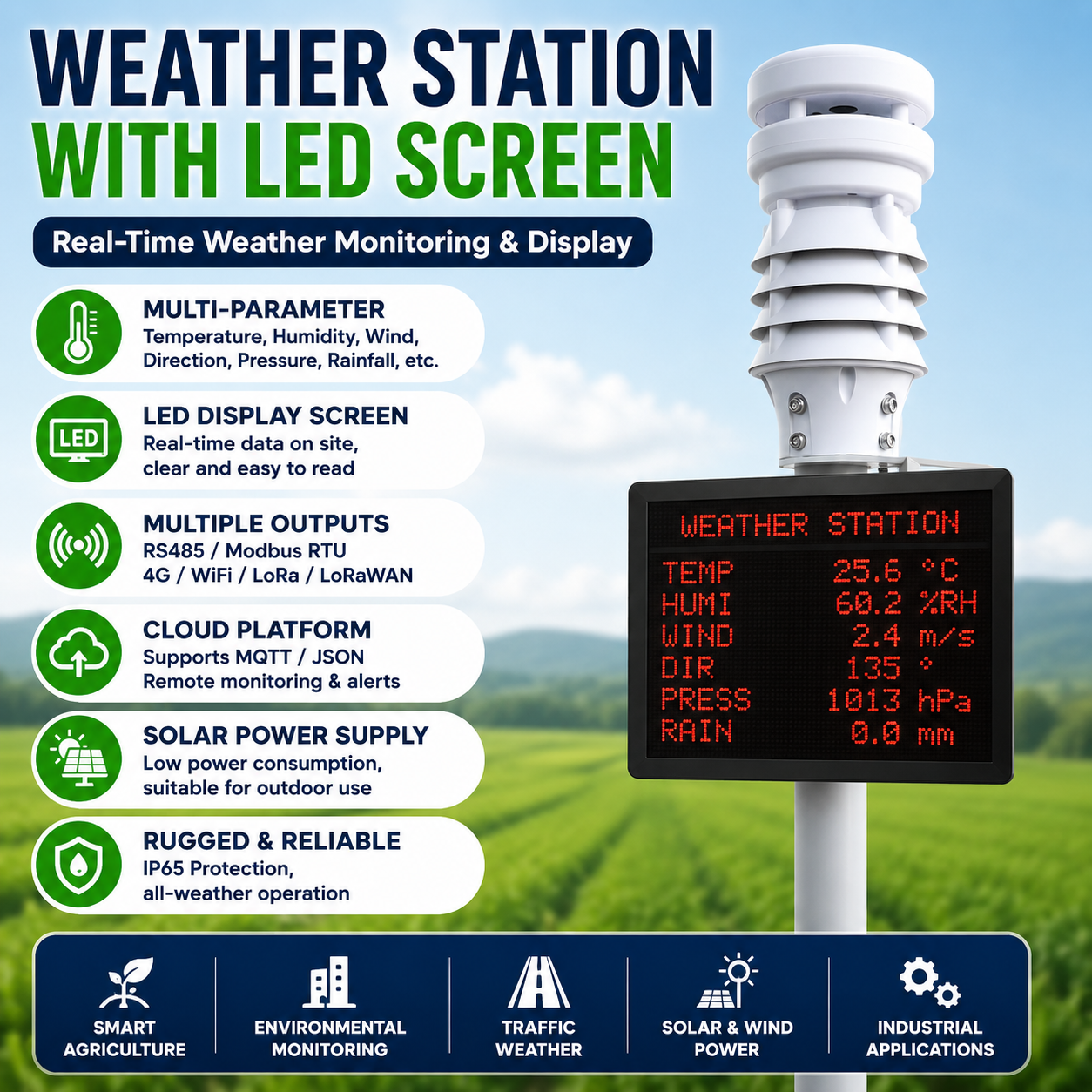
What Is a Weather Station with LED Display?
A Weather Station with LED Display is an automatic weather monitoring system equipped with a visible electronic display for showing real-time meteorological information.
A conventional weather station normally follows this data path:
A weather station with an LED screen adds another layer:
This means people near the monitoring site can immediately see the weather data without opening a computer or mobile application.
Typical information displayed on the LED screen can include:
- Air Temperature
- Relative Humidity
- Wind Speed
- Wind Direction
- Atmospheric Pressure
- Rainfall
- Illuminance
- UV Index
- Other customized parameters
The exact measurement combination depends on the selected weather station configuration. Honde offers compact and integrated weather stations that can monitor multiple meteorological parameters simultaneously and support customized sensor combinations.
Why Add an LED Display to an Automatic Weather Station?
The biggest advantage of an LED display is simple:
The data becomes visible to everyone at the monitoring site.
A cloud dashboard is useful for engineers and managers working remotely. However, many projects also require people physically present at the site to understand current weather conditions.
For example:
- Farmers can see current temperature and humidity near a field.
- Construction workers can check wind conditions.
- Visitors can view environmental information in a park.
- Road operators can monitor weather conditions.
- Solar plant operators can see environmental conditions around PV equipment.
- Researchers can immediately observe current measurements.
This creates a two-level monitoring system:
| Monitoring Method | Main Purpose |
|---|---|
| LED Display | Real-time local information |
| PC Software | Remote monitoring |
| Cloud Platform | Centralized data management |
| Mobile Access | Remote field management |
| Data Logger | Historical data storage |
| Alarm System | Abnormal-condition notification |
Honde’s weather monitoring solutions can provide real-time data viewing, historical data downloads and parameter alarms through the matched cloud server and software.
What Parameters Can a Weather Station with LED Display Measure?
There is no single fixed configuration for every weather station.
A professional weather station should be configured according to the application.
Common Weather Parameters
| Parameter | Why It Matters |
|---|---|
| Temperature | Crop growth, environmental conditions and equipment operation |
| Humidity | Agriculture, greenhouse and environmental monitoring |
| Wind Speed | Safety, agriculture, construction and energy applications |
| Wind Direction | Wind analysis and environmental assessment |
| Atmospheric Pressure | Meteorological monitoring and weather analysis |
| Rainfall | Irrigation, flood monitoring and agriculture |
| Solar Radiation | PV performance and environmental research |
| Illuminance | Agricultural and environmental applications |
| UV | Outdoor environmental monitoring |
| Soil Temperature | Agriculture and root-zone analysis |
| Soil Moisture | Smart irrigation |
| PM2.5 / Air Quality | Environmental monitoring |
Honde’s integrated weather station platforms can also be configured with additional environmental sensors according to project requirements.
How Does a Real-Time LED Weather Display Work?
The basic architecture is straightforward.
Step 1: Sensors Collect Environmental Data
The weather station measures atmospheric and environmental parameters continuously.
For example:
Humidity → 60.2%RH
Wind Speed → 2.4 m/s
Wind Direction → 135°
Pressure → 1013 hPa
Rainfall → 0.0 mm
Step 2: The Controller Processes the Data
The internal controller collects measurements from the different sensors and converts them into standardized data.
Step 3: Data Is Sent to the LED Screen
The LED display shows the selected parameters in a highly visible format.
Step 4: Data Can Also Be Transmitted Remotely
The same weather data can be transmitted through:
- RS485 Modbus RTU
- 4G
- GPRS
- WiFi
- LoRa
- LoRaWAN
Honde’s published weather station configurations support these communication options, allowing buyers to select the most appropriate connectivity method for their deployment environment.
Weather Station with LED Display vs. Cloud-Only Weather Station
Which solution is better?
The answer depends on the application.
| Feature | Cloud-Only Weather Station | Weather Station with LED Display |
|---|---|---|
| Remote monitoring | Yes | Yes |
| Local real-time visibility | Limited | Excellent |
| Cloud data | Yes | Yes |
| Historical data | Yes | Yes |
| Public information display | Limited | Excellent |
| Agricultural monitoring | Yes | Yes |
| Smart city applications | Good | Excellent |
| Construction sites | Good | Excellent |
| Environmental information boards | Limited | Excellent |
| On-site decision making | Moderate | Excellent |
For a project where people need to see weather conditions immediately, adding an LED screen can significantly improve the usability of the monitoring system.
RS485 Modbus: A Practical Interface for Weather Monitoring
For industrial and agricultural monitoring projects, communication compatibility is often just as important as sensor accuracy.
Honde weather stations commonly provide RS485 with Modbus RTU, allowing the weather station to communicate with external data loggers, PLCs, gateways and monitoring systems. Published specifications list RS485 communication and Modbus protocols across multiple weather station configurations.
This makes the weather station easier to integrate into existing systems.
A typical industrial architecture can be:
RS485 / Modbus RTU
Industrial Gateway
4G / WiFi / LoRaWAN
Cloud Server
PC / Mobile Dashboard
For system integrators, this architecture is often more useful than a weather sensor that only provides a proprietary output.
4G, WiFi, LoRa or LoRaWAN: Which Wireless Communication Should You Choose?
One of the most important decisions when purchasing an IoT weather station is the communication method.
4G Weather Station
4G is suitable when the monitoring location has cellular network coverage and the project needs direct wide-area connectivity.
Typical applications include: Remote farms, roads, construction sites, environmental monitoring stations, solar power plants, and remote industrial sites.
WiFi Weather Station
WiFi is convenient where a stable local wireless network already exists.
Particularly suitable for: Greenhouses, schools, buildings, research facilities, and farms with existing WiFi infrastructure.
LoRa Weather Station
LoRa is useful for long-range, low-power communication.
Can be considered for agricultural fields and distributed monitoring points where low power consumption is important.
LoRaWAN Weather Station
LoRaWAN is especially useful when multiple weather stations need to communicate with a centralized IoT network.
Valuable for: Smart agriculture, large farms, environmental monitoring networks, smart city projects, and distributed meteorological stations.
Honde offers LoRa, LoRaWAN, GPRS, 4G and WiFi options across its weather station product range.
Cloud Weather Monitoring: From Local Display to Remote Management
An LED screen solves the problem of local visibility.
A cloud platform solves the problem of remote management.
Combining the two provides a more complete monitoring architecture.
Honde’s matched cloud software can provide functions including:
- Real-time weather data viewing
- Historical data downloading
- Parameter alarm settings
- Email alarm notifications
- Remote monitoring
- Centralized data management
Historical measurements can also be exported in Excel format in supported Honde configurations.
This is particularly valuable for companies managing multiple monitoring stations. Instead of visiting every site, an engineer can review data remotely and identify abnormal weather conditions before sending personnel to the field.
Solar-Powered Weather Station with LED Display
Outdoor weather stations are often installed in locations where grid electricity is unavailable or expensive to deploy.
For these projects, solar power can be integrated into the monitoring system.
Honde provides optional solar power systems, including customized solar panels, controllers and mounting accessories for its weather station solutions.
A typical solar-powered system consists of:
Solar Charge Controller
Battery
Weather Station + Communication Module + LED Display
The actual solar system should be sized according to the weather station configuration, communication frequency, LED display power consumption and local solar conditions. For B2B projects, this calculation should be completed before selecting the final solar panel and battery capacity.
IP65 Protection for Outdoor Weather Monitoring
Weather monitoring equipment operates continuously in outdoor environments.
Typical environmental challenges include:
- Rain
- Humidity
- Dust
- Strong sunlight
- Temperature fluctuations
- Wind
- Snow
- Long-term UV exposure
Honde’s compact weather station configurations specify IP65 protection, while some integrated systems use different protection levels for different components.
For buyers, it is important not to look only at the IP rating. A complete outdoor monitoring system should also consider:
- Sensor housing
- Cable connectors
- Mounting structure
- Lightning protection
- Solar power enclosure
- Data logger enclosure
- LED display protection
Honde can also provide mounting poles, waterproof equipment cases, ground cages, lightning rods and mounting brackets as optional accessories for applicable weather station configurations.
Why Ultrasonic Wind Measurement Is Important
Wind speed and wind direction are two of the most important parameters in a weather station.
Traditional mechanical anemometers use moving components.
An ultrasonic weather station uses ultrasonic measurement technology instead.
Honde’s integrated ultrasonic weather stations are designed without conventional rotating mechanical wind components, which can reduce mechanical wear and support long-term outdoor monitoring. This design can be particularly useful for applications requiring continuous monitoring and reduced mechanical maintenance.
Applications of Weather Station with LED Display
1. Smart Agriculture
Agricultural decisions are closely connected to weather conditions.
A weather station with LED display can monitor:
- Temperature
- Humidity
- Rainfall
- Wind
- Atmospheric pressure
- Solar radiation
- Other agricultural parameters
The data can then be used together with soil sensors and irrigation systems.
A smart agriculture architecture can become:
This provides farmers and agricultural managers with a more complete environmental dataset.
2. Environmental Monitoring
Environmental monitoring stations can use LED displays to show current local conditions to the public or operators.
Typical parameters may include:
- Temperature
- Humidity
- Wind
- Rainfall
- Light
- UV
- PM2.5
- Other air-quality parameters
Honde’s integrated weather monitoring systems are designed for applications including environmental monitoring, meteorology and outdoor monitoring.
3. Road and Traffic Weather Monitoring
Weather conditions can influence road safety.
Wind, rain, temperature, humidity and visibility-related environmental conditions can be monitored at important road locations.
An LED display can provide visible information to nearby operators or road users.
Potential applications include:
- Highways
- Bridges
- Tunnels
- Roadside monitoring stations
- Traffic management centers
- Construction zones
4. Solar and Wind Power
Weather information is essential for renewable energy projects.
Solar power stations may need:
- Solar radiation
- Temperature
- Humidity
- Wind speed
- Wind direction
- Atmospheric pressure
Honde provides dedicated photovoltaic environmental monitoring solutions that combine weather parameters with solar radiation monitoring and support RS485, 4G, WiFi, LoRa and LoRaWAN communication.
5. Ports, Airports and Coastal Areas
Weather conditions are especially important in transportation environments.
Wind speed, wind direction, rainfall and atmospheric pressure can provide valuable environmental information for operational monitoring.
Honde weather station product documentation lists applications including airports, ports, marine environments and transportation.
6. Construction Sites
Construction projects can use weather stations to monitor environmental conditions that may affect:
- Crane operation
- Concrete work
- Outdoor construction
- Worker safety
- Material handling
An LED screen can make current conditions visible directly at the construction site.
What Should You Check Before Buying a Weather Station with LED Display?
A common mistake is to select a weather station based only on the number of parameters.
For a B2B project, buyers should evaluate the entire system.
1. Measurement Parameters
Determine whether the project needs:
- Temperature, Humidity, Wind speed, Wind direction, Pressure, Rainfall, Solar radiation, Illuminance, UV, PM2.5, Soil parameters, or other customized sensors.
2. Display Requirements
Ask:
- LED or LCD? Indoor or outdoor? Required viewing distance? Required display size? Which parameters need to be displayed? Is customized text/logo required?
3. Communication
Select:
- RS485, 4G, GPRS, WiFi, LoRa, or LoRaWAN based on the actual project network.
4. Power Supply
Check whether the site provides:
- AC power, DC power, Battery, or Solar power.
5. Cloud Platform
Determine whether you need:
- Real-time monitoring, Historical data, Excel export, Alarm notifications, API integration, MQTT / JSON, Private cloud, or Third-party platform integration.
6. Installation
Confirm:
- Pole height, Mounting bracket, Ground cage, Lightning protection, Cable length, or Equipment enclosure.
Honde offers customized mounting heights and accessories for different weather station configurations.
Weather Station with LED Display: Key Specifications at a Glance
| Feature | Honde Configuration |
|---|---|
| Product Type | Automatic Weather Station |
| LED Display | Optional |
| 7-inch Touch Screen | Optional |
| Temperature | Available |
| Humidity | Available |
| Wind Speed | Available |
| Wind Direction | Available |
| Atmospheric Pressure | Available |
| Rainfall | Available |
| Illuminance / UV | Optional depending on configuration |
| RS485 | Available |
| Modbus RTU | Available |
| 4G | Optional |
| GPRS | Optional |
| WiFi | Optional |
| LoRa | Optional |
| LoRaWAN | Optional |
| Solar Power | Optional |
| Cloud Server | Available with supported wireless configurations |
| Historical Data | Available |
| Alarm Function | Available in supported cloud software |
| Pole / Bracket | Optional |
| OEM / ODM | Available |
Exact specifications vary by weather station model and sensor configuration. Buyers should request the datasheet for the required configuration before placing an order.
Why Choose Honde Technology for a Weather Station Project?
A weather station project is rarely just about buying a sensor.
For many B2B customers, the complete project may require:
Sensor + Display + Communication + Power + Mounting + Cloud Software
Honde Technology Co., Ltd. can provide these components as an integrated solution.
The available options include:
- Multi-parameter weather stations
- LED display screens
- 7-inch touch screens
- RS485 Modbus
- 4G communication
- GPRS communication
- WiFi
- LoRa
- LoRaWAN
- Solar power systems
- Data loggers
- Cloud servers
- PC software
- Historical data export
- Alarm functions
- Customized sensors
- OEM / ODM services
This integrated approach can simplify procurement for distributors, system integrators and project contractors.
Frequently Asked Questions
What is a Weather Station with LED Display?
It is an automatic weather monitoring system that combines meteorological sensors with an LED screen for real-time local weather information display.
What weather parameters can it measure?
Depending on the configuration, it can measure temperature, humidity, wind speed, wind direction, atmospheric pressure, rainfall, illuminance, UV and other environmental parameters.
Can the LED display be customized?
The LED display is an optional configuration on applicable Honde weather stations. The display content and system configuration should be confirmed according to the project requirements.
Can the weather station connect to the cloud?
Yes. Honde provides matched cloud server and software options for supported wireless configurations, including real-time monitoring, historical data download and alarm functions.
Does it support 4G and LoRaWAN?
Yes. Honde weather station configurations can support 4G, GPRS, WiFi, LoRa and LoRaWAN depending on the selected model and wireless module.
Can the system use solar power?
Yes. Solar panels, controllers and related mounting components can be supplied as optional configurations for applicable outdoor weather station systems.
Can Honde customize the weather station?
Yes. Honde provides OEM and ODM services, and additional sensors can be integrated into applicable weather station configurations according to project requirements.
Conclusion: More Than a Weather Display
A Weather Station with LED Display is more than a digital screen attached to a weather sensor.
It combines three important functions:
Measure → Display → Connect
The weather station measures real-world environmental conditions.
The LED screen makes the information immediately visible.
Wireless communication and cloud software make the same information available remotely.
For smart agriculture, environmental monitoring, road safety, renewable energy, construction and industrial applications, this combination creates a practical bridge between physical weather conditions and digital decision-making.
For organizations building an IoT weather monitoring project, the most important question is therefore not simply:
“Which weather sensor should we buy?”
A better question is:
“What complete weather monitoring system does our project require?”
That system may include the weather station, LED display, RS485 Modbus, 4G/LoRaWAN/WiFi connectivity, solar power, data logging, cloud software and customized sensors.
Get a Custom Weather Station with LED Display
Honde Technology Co., Ltd. provides weather monitoring solutions for distributors, system integrators, agricultural projects, environmental monitoring projects and other B2B applications.
Company Name: Honde Technology Co., Ltd.
Website: www.hondetechco.com
Email: info@hondetech.com
We can help configure:
- Weather Station with LED Display
- Multi-Parameter Weather Station
- 4G / WiFi / LoRa / LoRaWAN Weather Station
- RS485 Modbus Weather Monitoring System
- Solar-Powered Weather Station
- Cloud-Based Weather Monitoring
- Customized Meteorological Sensors
- OEM / ODM Weather Station Projects
Tell us your required parameters, display size, communication method, power supply and installation environment, and Honde Technology can provide a suitable configuration and project quotation.
Post time: Aug-21-2026