

Honde Technology provides mechanical wind speed and direction monitoring solutions with sound and light alarms, RS485, 4-20mA and 0-5V outputs, allowing the sensor to work as a standalone warning instrument or integrate with a larger monitoring system.
For projects where wind conditions directly affect operational safety, the key question is not only “How fast is the wind?” but also “What happens when the wind exceeds the safety threshold?”
That is where a Wind Speed Sensor With Alarm becomes particularly useful.
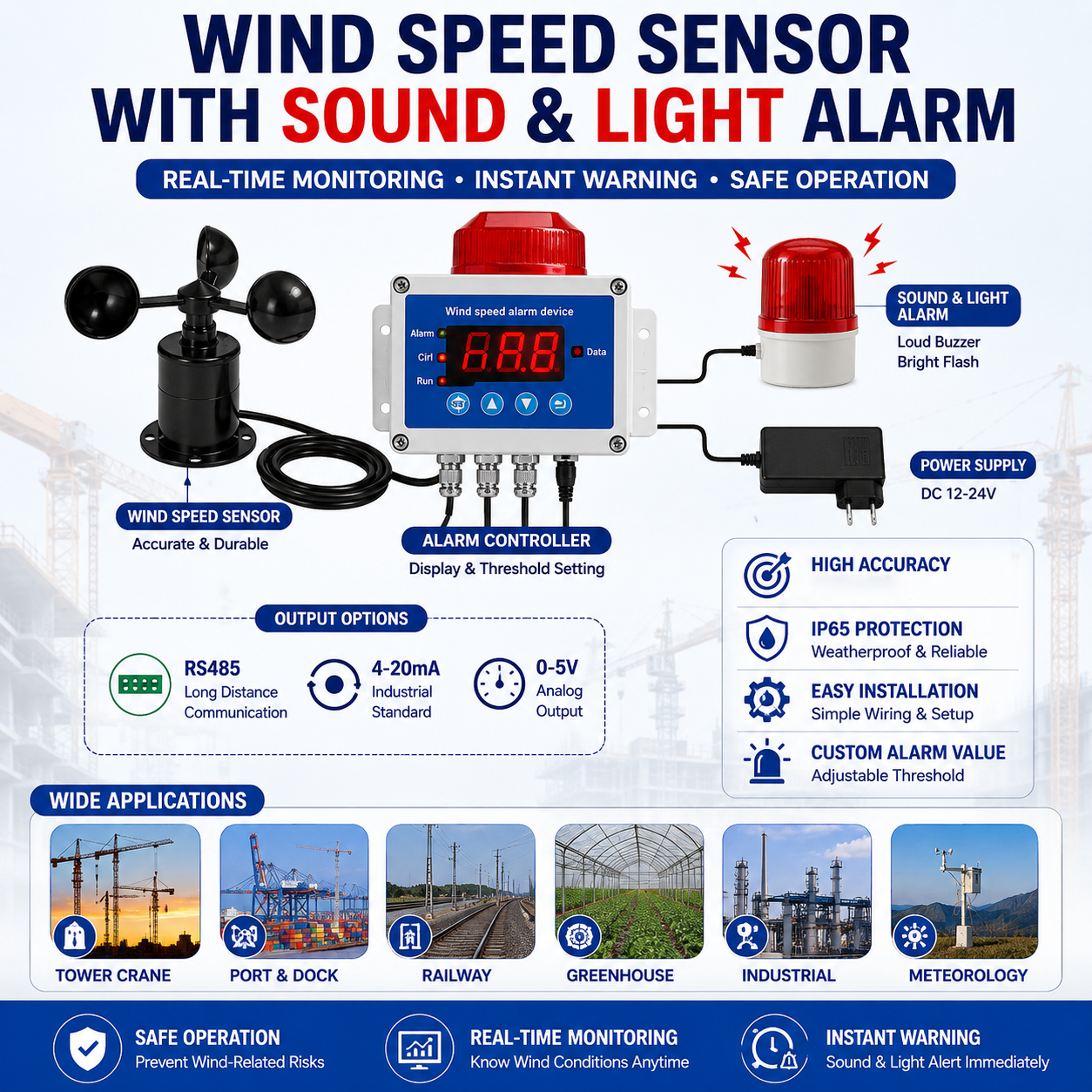
What Is a Wind Speed Sensor With Alarm?
A Wind Speed Sensor With Alarm is an integrated wind monitoring device that measures wind conditions and provides an alarm when the measured wind speed exceeds a preset threshold.
A typical system consists of:
- Wind Speed Sensor
- Wind Direction Sensor
- Digital Display
- Alarm Controller
- Sound And Light Warning Device
- Signal Output Interface
Instead of requiring operators to continuously watch a display, the alarm function provides an active warning when wind conditions reach a predefined limit.
Honde’s alarm wind sensor uses a mechanical wind speed and direction sensing structure and can be equipped with an alarm monitoring recorder for real-time monitoring.
Why Wind Speed Monitoring Matters for Cranes
Tower cranes, crawler cranes and other lifting equipment can be highly sensitive to strong or rapidly changing wind conditions.
A conventional wind sensor can provide measurement data, but operators may not always notice a sudden increase in wind speed.
A Wind Speed Alarm Sensor adds another layer of protection:
| Function | Traditional Wind Sensor | Wind Speed Sensor With Alarm |
|---|---|---|
| Wind Speed Measurement | ✓ | ✓ |
| Real-Time Display | Optional | ✓ |
| Threshold Setting | Optional | ✓ |
| Sound Alarm | — | ✓ |
| Light Alarm | — | Optional |
| RS485 Output | Optional | ✓ |
| Remote Monitoring | Optional | Optional |
| Equipment Integration | Optional | ✓ |
The purpose is simple: measure → compare → warn → respond.
This makes alarm-based wind monitoring particularly suitable for construction sites and other applications where wind conditions can affect equipment operation.
Key Features of Honde Wind Speed Alarm Sensor
Honde’s mechanical wind speed and direction alarm sensor is designed for industrial and outdoor monitoring applications. The product page specifies an aluminum alloy housing, multiple signal output options and an optional sound and light alarm.
1. Real-Time Wind Monitoring
The system continuously measures wind conditions and displays the current value on the digital display.
This allows operators to monitor wind conditions directly at the installation site.
2. Sound Alarm
A preset wind speed threshold can be configured.
When the measured wind speed exceeds the threshold, the system can trigger an audible warning.
This is especially useful when operators cannot continuously watch the display.
3. Visual Warning
The system can also be configured with a visual warning function, making the alarm easier to recognize in noisy construction environments.
The combination of sound + light provides a more visible warning than a digital display alone.
4. Multiple Signal Outputs
Depending on the configuration, the system supports:
- RS485
- 4-20mA
- 0-5V
The RS485 version can also support long-distance transmission, with the product page specifying up to 1000 m for the farthest lead length.
Technical Parameters at a Glance
For buyers comparing industrial wind monitoring systems, the main specifications should be evaluated before selecting a sensor.
| Parameter | Honde Wind Speed Alarm Sensor |
|---|---|
| Product Type | Mechanical Wind Speed And Direction Alarm Sensor |
| Wind Direction Range | 0-360° |
| Wind Direction Resolution | 1° |
| Power Supply | DC 12-24V |
| Display | 1-inch LED Digital Display |
| Accuracy | ±3% |
| Protection | IP65 |
| Output | RS485 / 4-20mA / 0-5V |
| RS485 Transmission | Up To 1000m |
| Wireless Options | LoRa / LoRaWAN / GPRS / 4G / WiFi |
| Housing | Aluminum Alloy |
| Alarm | Optional Sound And Light Alarm |
These specifications are based on Honde’s published product information and should be confirmed against the exact configuration required for your project.
Wind Speed Sensor With Alarm vs. Standard Anemometer
Not every application needs an alarm system.
For simple meteorological data collection, a standard anemometer may be sufficient.
For safety-critical applications, however, the difference becomes important.
Standard Anemometer
A conventional wind sensor primarily answers:
What is the current wind speed?
The operator or control system must then interpret the data and decide what action to take.
Wind Speed Sensor With Alarm
An alarm wind sensor adds:
Has the wind exceeded the predefined safety threshold?
If yes, the system can immediately issue a warning.
This makes the second solution particularly attractive for:
- Tower Cranes
- Construction Sites
- Ports
- Railways
- Power Plants
- Cableways
- Greenhouses
- Outdoor Industrial Equipment
- Agricultural Facilities
- Meteorological Monitoring
Honde specifically lists construction machinery, cranes, ports, railways, meteorology, greenhouses and breeding among the application fields for this type of wind alarm recorder.
How the Wind Alarm System Works
The basic working principle is straightforward.
Step 1: Measure
The mechanical wind sensor continuously detects the current wind condition.
Step 2: Transmit
The measured data is sent to the alarm controller through the selected signal interface.
Step 3: Compare
The controller compares the measured wind speed with the preset alarm threshold.
Step 4: Trigger
When the wind speed exceeds the configured value, the alarm function is activated.
Step 5: Take Action
The operator can then stop or adjust equipment operation according to the project’s safety procedure.
This architecture can also be connected to a larger industrial monitoring system through RS485 or other available outputs.
Why RS485 Is Important for Industrial Wind Monitoring
For industrial projects, the sensor itself is only one part of the monitoring system.
Data often needs to be transferred to:
- PLC systems
- Data loggers
- Industrial computers
- Weather stations
- IoT gateways
- Cloud platforms
- Building management systems
RS485 is therefore an important interface for B2B buyers.
Honde’s wind monitoring products support RS485 as well as analog outputs such as 4-20mA and 0-5V, providing flexibility for different control architectures.
For larger projects, wireless communication options such as LoRa, LoRaWAN, GPRS, 4G and WiFi are also available.
How to Choose the Right Wind Speed Alarm Sensor
Before purchasing a Wind Speed Sensor With Alarm, buyers should check five important points.
1. Measurement Range
The required wind speed range depends on the application.
Construction cranes, coastal monitoring stations and industrial projects may require a different range from greenhouse applications.
2. Alarm Threshold
The alarm threshold should match the actual operational safety requirements of the equipment.
Do not select an alarm value simply because it is convenient. It should be determined according to the equipment, operating environment and project safety procedures.
3. Signal Output
Choose the communication interface according to the existing control system:
RS485 → Industrial digital communication
4-20mA → Industrial analog control
0-5V → Analog measurement systems
4. Environmental Protection
Outdoor equipment should be evaluated for:
- Waterproofing
- Dust protection
- Temperature
- Corrosion
- Mechanical durability
The Honde alarm wind sensor is specified with an IP65 protection level and aluminum alloy construction.
5. Remote Monitoring
For large sites, wireless transmission can eliminate long communication cables.
Honde offers optional LoRa, LoRaWAN, GPRS, 4G and WiFi communication options for compatible configurations.
Applications of Wind Speed Alarm Monitoring
Tower Crane Safety
Wind speed monitoring is particularly valuable for tower cranes and other lifting equipment.
The system can provide an immediate warning when the measured wind exceeds the configured threshold.
Port And Dock Monitoring
Ports and docks can experience strong and rapidly changing winds.
Wind monitoring can provide operators with real-time information for equipment management.
Agriculture And Greenhouses
Wind conditions can affect greenhouse ventilation, crop protection and agricultural operations.
A wind alarm can provide an early warning when strong wind conditions occur.
Railway And Highway Monitoring
Wind monitoring systems can also be integrated into broader environmental monitoring infrastructure for exposed transportation facilities.
Meteorological Monitoring
For weather stations and environmental monitoring networks, wind speed and direction are important parameters for understanding local atmospheric conditions.
Honde also offers integrated weather stations that combine wind speed, wind direction, temperature, humidity, pressure and other environmental parameters.
From Standalone Alarm to Smart Monitoring System
One important advantage of Honde’s product architecture is that the wind sensor does not have to operate as an isolated instrument.
Wind Sensor → Alarm Controller → RS485/4-20mA → Data Logger → Wireless Gateway → Cloud Platform
For larger projects, this architecture allows users to combine wind monitoring with other environmental sensors.
Honde’s broader environmental monitoring portfolio includes weather stations, soil sensors, wireless modules and cloud monitoring solutions.
This makes it possible to build a customized monitoring system rather than purchasing completely independent devices for each parameter.
Honde Technology: Wind And Environmental Monitoring Solutions
Company Name: Honde Technology Co., Ltd.
Website: www.hondetechco.com
Email: info@hondetech.com
Honde Technology develops and supplies environmental monitoring equipment including wind sensors, weather stations, soil sensors, agricultural monitoring systems and wireless IoT solutions. The company’s product portfolio covers agriculture, environmental monitoring, meteorology, industrial applications and other monitoring scenarios.
For customers who need more than a standalone wind sensor, Honde can also combine sensors with wireless communication and cloud software solutions.
FAQ: Wind Speed Sensor With Alarm
What is a Wind Speed Sensor With Alarm?
It is a wind monitoring device that measures wind conditions and triggers an alarm when the measured value exceeds a preset threshold.
Can the wind alarm sensor measure wind direction?
Yes. Honde’s mechanical alarm sensor can measure 0-360° wind direction with 1° resolution.
Does the sensor support RS485?
Yes. RS485 is one of the available signal output options, together with 4-20mA and 0-5V.
Can it be used for tower cranes?
Yes. Tower cranes and other construction machinery are among the listed applications for the wind speed and direction alarm recorder.
Can wireless communication be added?
Compatible configurations can support LoRa, LoRaWAN, GPRS, 4G and WiFi wireless transmission.
Can Honde customize the system?
Honde’s product range supports different communication and sensor configurations, making it possible to develop monitoring solutions around specific project requirements.
Conclusion: When Should You Choose a Wind Speed Sensor With Alarm?
If your application only needs historical wind data, a conventional wind sensor may be enough.
But if wind conditions can directly affect equipment safety, lifting operations or outdoor production, an alarm function provides an important additional layer of protection.
A practical Wind Speed Sensor With Alarm should combine:
Accurate Measurement + Real-Time Display + Adjustable Alarm + Industrial Output + Reliable Outdoor Protection
For B2B projects, the ability to integrate RS485, 4-20mA, 0-5V, LoRa, 4G or WiFi can make the difference between a simple measuring instrument and a scalable wind monitoring system.
If you are sourcing a Wind Speed Sensor With Alarm for tower cranes, construction sites, ports, agriculture, greenhouses or industrial monitoring, contact Honde Technology Co., Ltd. for a suitable configuration and quotation.
Email: info@hondetech.com
Website: Honde Technology Official Website
Post time: Aug-31-2026