

Date: June 11, 2026
Keywords: Ammonia Nitrogen Sensor, Nitrate Nitrogen Probe, Auto-cleaning Water Quality, Smart Aquaculture Vietnam, LoRaWAN Nutrient Monitoring, MQTT Water IoT.
1.The June Challenge: Ammonia Spikes and “Silent Mortality”
As of June 2026, the aquaculture industry in Vietnam (Mekong Delta) and Thailand (Chachoengsao) is facing a critical production bottleneck. High feeding rates combined with tropical monsoon rains trigger sudden fluctuations in pond pH, causing non-ionized ammonia ( NH3) levels to spike to toxic levels in minutes. This “Silent Mortality” can wipe out 15% of a shrimp pond’s stock before an operator even notices a change in behavior.
The Engineering Problem:
Traditional chemical titration is too slow, and basic electrochemical probes fail because Bio-fouling (biofilm growth) blinds the selective membrane within 72 hours in nutrient-rich water.
Honde Technology’s IP68 Integrated Ammonia & Nitrate Series has become the regional standard because it integrates physical cleaning with digital compensation.
2.The Perception Layer: 6-in-1 Integration with Active Defense
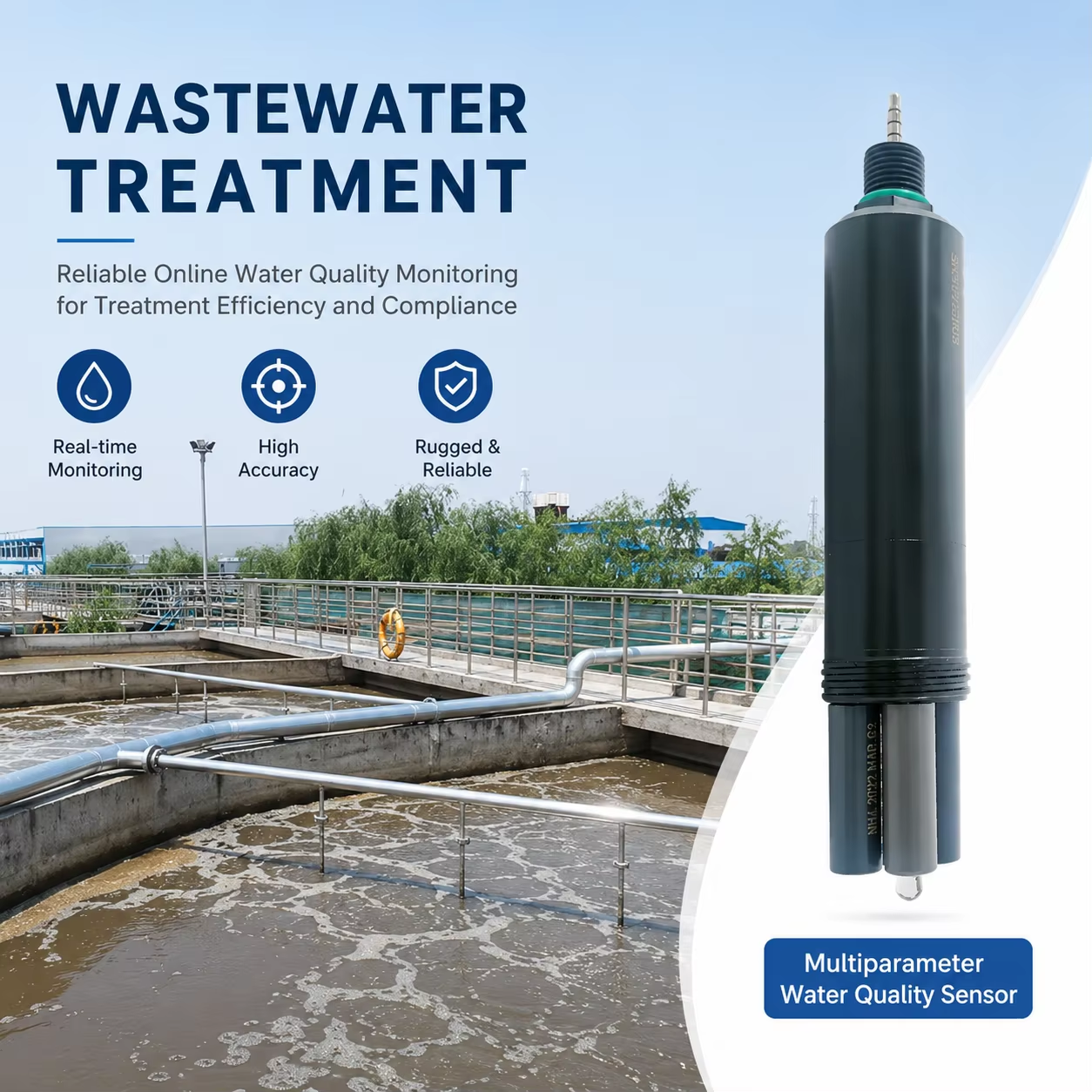
Unlike standard single-parameter sensors, the Honde RD-ANBTNP-01 is a multi-layered sensing laboratory:
1. Integrated Parameter Compensation
The sensor doesn’t just measure Ammonia ( NH4+). It simultaneously tracks pH, Temperature, and Chloride or Potassium ions.
- The Advantage: Our built-in algorithm uses the real-time pH and temperature data to automatically calculate the Total Ammonia Nitrogen (TAN) and the specific toxicity of non-ionized ammonia, providing the only data that matters for stock survival.
2. The Self-Cleaning Edge
Equipped with an Integrated Automatic Cleaning Brush, the sensor physically clears its ion-selective membrane at a 15-minute cycle. This prevents algae and biofilm from “smothering” the probe, extending maintenance-free operation from days to months.
3. Industrial Durability
Built with 316L Stainless Steel or Titanium (optional) and an IP68 waterproof rating, the unit survives continuous submersion in high-salinity shrimp ponds and industrial outfalls.
3.The Honde Full-Stack Solutions Architecture
Deploying nutrient monitoring across 100+ ponds requires a resilient, three-tier data loop:
Tier 1: Local Awareness & Resilient Deployment
- Verification: Field technicians utilize the Handmeter for rapid spot-checks and on-site electrode calibration.
- Local Station Persistence: Each pond cluster is equipped with our Data Logger with screen, allowing local farm managers to see real-time ammonia curves and 30-day graphical trends on-site.
- Deep Water Setup: For large-scale reservoirs or off-shore pens, we utilize the Floating Buoy system. This keeps the Automatic cleaning brush for multi-parameter water sensor active at the optimal biological depth, independent of surface water level fluctuations.
Tier 2: The Wireless Nervous System (Transmission)
- Our terminals support GPRS/4G/WIFI/LORA/LORAWAN wireless modules.
- The MQTT Logic: For Smart Farm integrators, data is transmitted in MQTT Json format. This standardized format allows the ammonia and nitrate data to feed directly into the farm’s automated feeding and aeration software without custom drivers.
Tier 3: Cloud Management & Active Mitigation (The Safety Loop)
- All data is centralized on the Cloud server and software, providing a real-time “Nitrogen Map” of the entire farm operation.
- The Alarm Relay System: This is the critical life-saving loop. If ammonia levels cross the “High-Alert” threshold, the cloud platform triggers an Alarm Relay system to see the real time data and automatically activates freshwater intake valves or shuts down automated feeders to prevent further organic loading.
4.Real-World Case Study: Managing Intensive Shrimping in Ca Mau, Vietnam
A B2B aquaculture group in Vietnam’s Ca Mau province faced recurring losses due to “Ammonia Shock” during the 2026 rainy season.
The Honde Intervention:
- Hardware: Deployed 30 Integrated Ammonia/Nitrate Sensors with Auto-cleaning.
- Transmission: Due to the remote coastal geography, LoRaWAN was utilized to transmit data over 10km in MQTT Json format.
- The Outcome: The Automatic cleaning brush reduced site visits by
80%. In the first cycle, the Alarm Relay System automatically adjusted aeration and water exchange rates during 14 separate ammonia spike events. The farm achieved a
98% survival rate, generating an estimated $45,000 in additional revenue compared to previous cycles.
5.Contact Honde Technology for Nutrient Monitoring Tenders
For more sensor information and customized IoT solutions, please contact Honde Technology Co., LTD.
- WhatsApp: +86-15210548582
- Email: info@hondetech.com
- Company Website: www.hondetechco.com
Post time: Jun-26-2026