

Date: June 10, 2026
Keywords: Surface water quality monitoring, Floating buoy station, COD BOD sensor online, Self-cleaning water probe, LoRaWAN water telemetry, River restoration IoT.
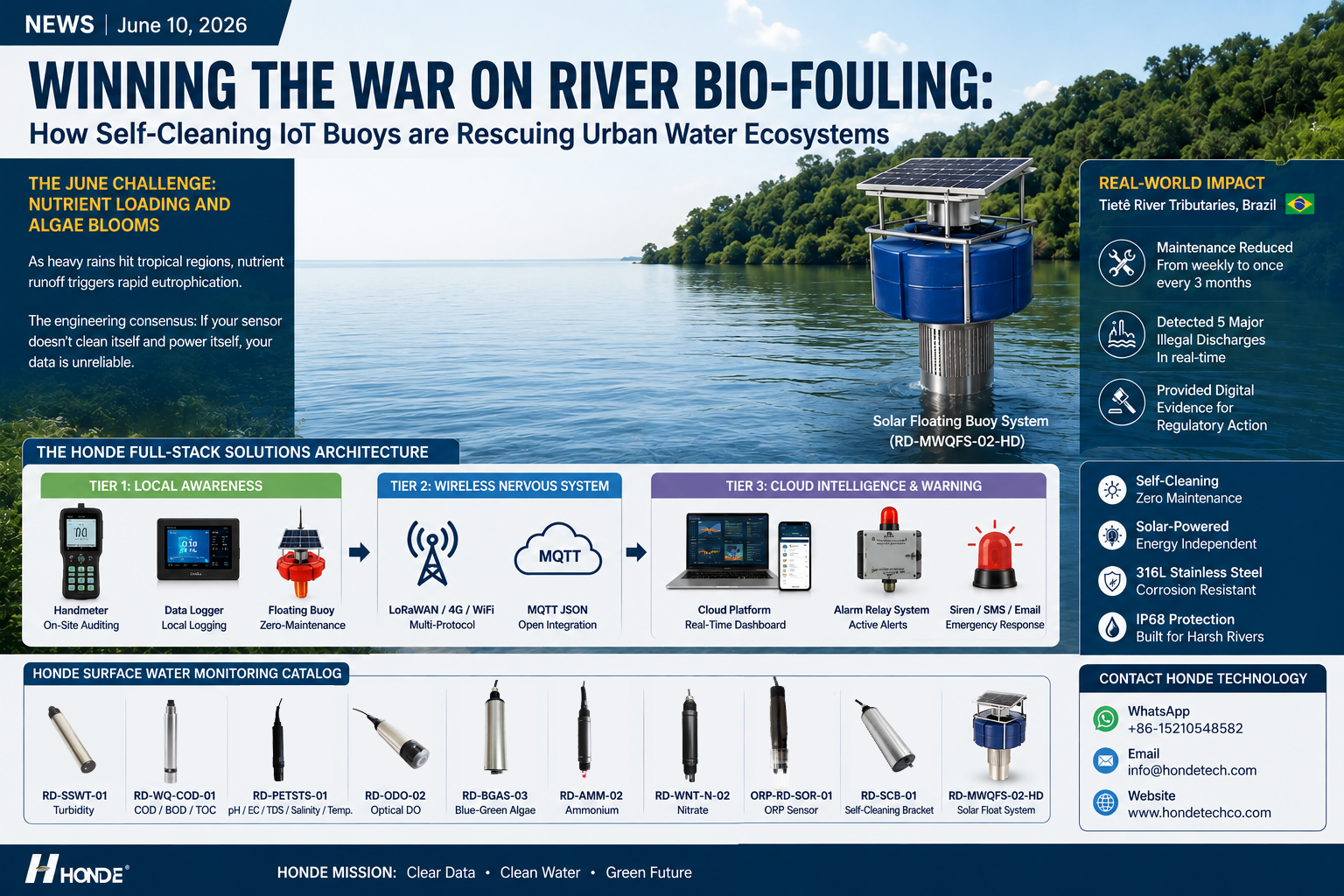
The June Challenge: Nutrient Loading and Algae Blooms
As of June 2026, many tropical and subtropical regions (particularly Brazil, India, and Indonesia) have entered their peak runoff season. Heavy rainfall flushes agricultural nutrients and urban waste into river systems, leading to rapid eutrophication and sudden oxygen depletion events.
For environmental agencies managing these vast watersheds, the primary struggle is not just “measuring” water quality, but maintaining sensor accuracy in remote, bio-active environments where algae and biofilm can “blind” an optical sensor in less than 48 hours.
The Honde Perception Layer: 316L Stainless Steel & Intelligence
Based on Honde’s latest Surface Water Monitoring Catalog, we have deployed a robust “Zero-Maintenance” sensing shield:
1 The 5-in-1 COD/BOD/TOC Sensor (RD-TSS-03)
Utilizing the UV254 absorption principle, this probe provides instantaneous organic load data without the need for expensive chemical reagents or secondary pollution.
- Anti-Fouling Edge: Features an Integrated Automatic Cleaning Brush that physically wipes the optical window at a 15-minute cycle, ensuring that 24/7 data reflects the true water state, not the biofilm growth.
2 6-in-1 Ion Integration (RD-ANBTNP-01)
For rivers affected by fertilizer runoff, this probe simultaneously measures Ammonia Nitrogen (NH4-N), Nitrate Nitrogen (NO3-N), pH, and Temperature, automatically compensating for pH fluctuations to provide the most accurate Total Nitrogen (TN) calculation in the industry.
3 Fluorescence Optical DO Sensor (Stainless Steel Series)
Our Optical Dissolved Oxygen sensor eliminates the need for electrolyte refilling or membrane replacement. With a 5-10 second stabilization time, it is perfect for low-power duty cycle operations.
The Honde Full-Stack Solutions Architecture
Managing a river restoration project across 500km of terrain requires a resilient three-tier data loop:
Tier 1: Local Awareness & Resilient Deployment
- On-Site Auditing: Field crews use our Handmeter for rapid cross-verification.
- Local Logging: Stations are anchored by our Data Logger with screen, providing local operators with real-time graphs and 30-day historical data on-site, even during cellular outages.
- Remote River Infrastructure: For lake, reservoir, and wide river deployments, the Floating Buoy system provides a self-righting, solar-powered platform. It keeps the Automatic cleaning brush for multi-parameter water sensor active, ensuring the system remains maintenance-free for months at a time.
Tier 2: The Wireless Nervous System (Transmission)
- Multi-Protocol Connectivity: Our modules support GPRS/4G/WIFI/LORA/LORAWAN wireless modules.
- The MQTT Logic: For national environmental grids, data is transmitted in MQTT Json format. This allows the sensor data to feed directly into governmental “Digital Twin” platforms and Smart City dashboards without proprietary middleware or licensing fees.
Tier 3: Cloud Intelligence & Active Warning (The Safety Loop)
- All data is centralized on the Cloud server and software, visualizing the real-time data and history data of the river’s ecological health.
- The Alarm Relay System: This is the critical “Action” loop. When COD or Ammonia levels spike (indicating an illegal discharge) or DO levels drop (indicating a fish kill risk), the platform triggers an Alarm Relay system to see the real time data, and automatically activates sirens at the site or notifies emergency response teams via SMS/Email.
Real-World Case Study: Restoring the Tietê River Tributaries, Brazil
A B2B environmental engineering firm in Sao Paulo required a network of 25 monitoring stations to track the effectiveness of a new riparian restoration project along the Tietê River tributaries.
The Honde Intervention:
- The Setup: Deployed Solar Floating Buoy Systems equipped with 5-in-1 COD/BOD sensors and Optical DO sensors.
- Connectivity: Due to the dense riverbank vegetation, LoRaWAN was utilized to transmit data in MQTT Json format to a central 4G gateway every 10km.
- The Outcome: The Automatic cleaning brush reduced site maintenance from once a week to once every three months. The Alarm Relay System helped the client identify and document 5 major illegal industrial discharge events in real-time, providing the “Digital Evidence” needed for regulatory enforcement.
Contact Honde Technology for Environmental Tenders
For more sensor information and customized IoT solutions, please contact Honde Technology Co., LTD.
- WhatsApp: +86-15210548582
- Email: info@hondetech.com
- Company Website: www.hondetechco.com
Post time: Jun-16-2026