

What Is a 9-in-1 Soil Sensor with Soil Health Index?
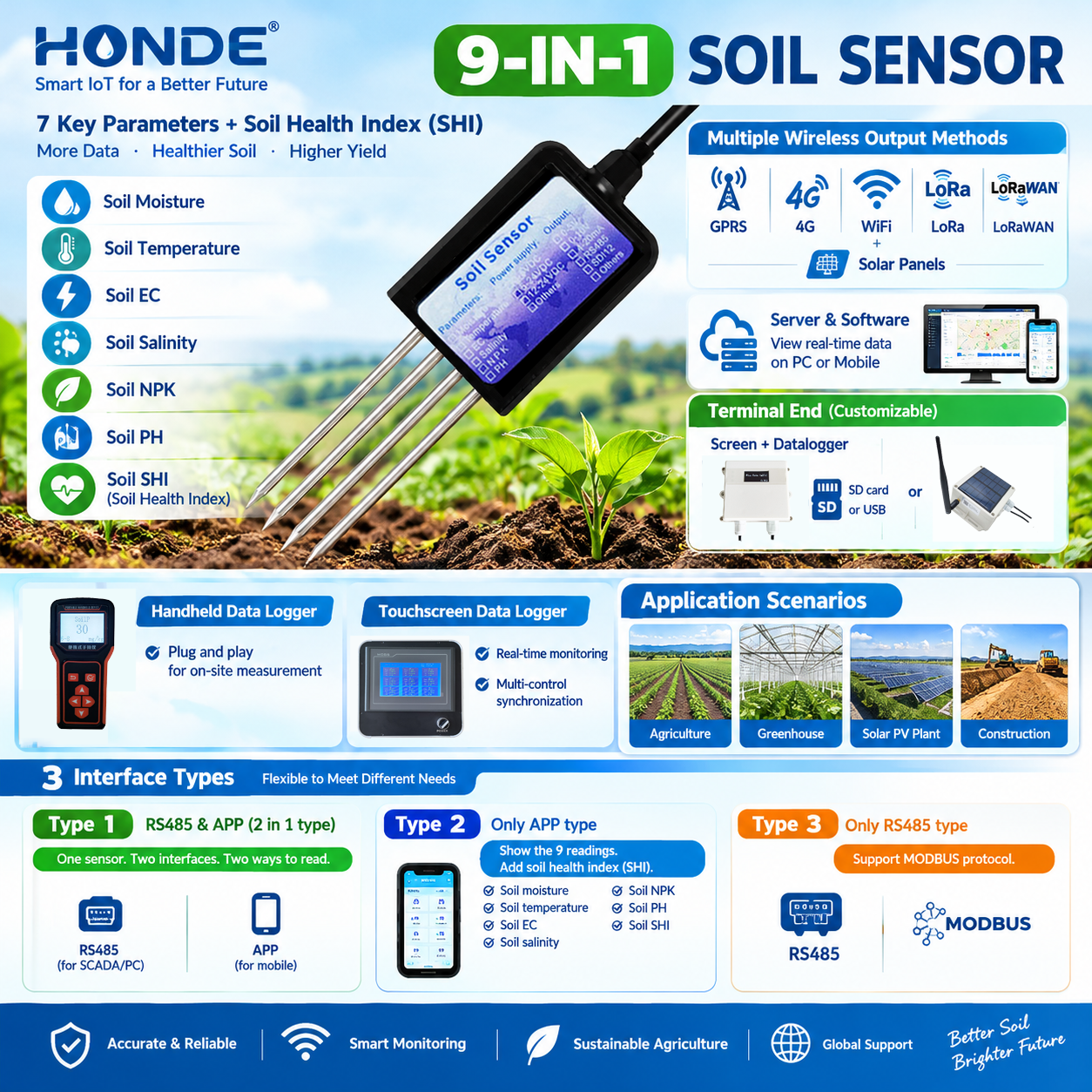
A 9-in-1 soil sensor with Soil Health Index (SHI) measures eight soil parameters and adds a calculated ninth indicator to help users assess general root-zone suitability. The Honde HD-S9IN1-01 series monitors soil temperature, volumetric moisture, electrical conductivity (EC), pH, nitrogen, phosphorus, potassium and salinity, while SHI combines soil temperature, moisture and EC response into a single index ranging from 0 to 100.
Unlike conventional multi-parameter soil sensors that display individual measurements only, this upgraded solution provides both the underlying soil data and an easy-to-scan soil health reference. It is designed for precision agriculture, greenhouse management, smart irrigation projects, agricultural research and soil monitoring system integration.
With RS485 Modbus-RTU, mobile APP and selected dual-interface configurations, Honde Technology helps agricultural equipment manufacturers, system integrators and distributors choose a soil monitoring solution that fits their project requirements.
1. Why Is the Soil Health Index (SHI) the Key Upgrade?
Traditional soil monitoring provides valuable data, but interpreting several measurements together can take time. Soil moisture may be suitable while temperature is outside the preferred range, or electrical conductivity may require additional investigation.
The Honde 9-in-1 soil sensor introduces SHI as a calculated indicator to simplify the initial assessment.
From 8 measured parameters to 9 soil indicators
| Feature | Conventional 8-Parameter Monitoring | Honde 9-in-1 with SHI |
|---|---|---|
| Direct soil measurements | Eight parameters | The same eight parameters |
| Soil Health Index | Not included in the original eight-value configuration | Added as the ninth calculated parameter |
| Soil temperature and moisture | Available | Available |
| EC and salinity | Available | Available |
| Soil pH and NPK | Available | Available |
| Overall suitability reference | Requires interpretation of individual readings | SHI provides a summarized reference |
| Additional SHI probe | Not applicable | No additional probe required for SHI |
The key innovation is not an additional physical sensing probe. SHI is calculated from the temperature, moisture and EC response curves, adding an extra layer of interpretation to the existing measurements.
Why does this matter for B2B agricultural projects?
- Faster initial screening: Identify soil zones that may need further investigation.
- More accessible data: Provide farm operators with a summarized reference alongside detailed readings.
- Better monitoring workflows: Combine the SHI value with the original measurements when reviewing irrigation and root-zone conditions.
- Simpler hardware architecture: Obtain the ninth calculated indicator without adding a separate SHI probe.
SHI should be treated as a screening and comparison tool, not as a standalone diagnosis of soil fertility or crop health.
2. Nine Parameters Measured by the Honde Soil Sensor
The HD-S9IN1-01 series combines eight direct soil measurements with one calculated Soil Health Index. This makes it suitable for projects that require a broader view of soil conditions from a single sensor.
| No. | Parameter | Reference Range in the Supplied Manual | Monitoring Purpose |
|---|---|---|---|
| 1 | Soil Temperature | -30 to 70°C; 0–50°C or custom ranges available | Understand root-zone thermal conditions |
| 2 | Volumetric Soil Moisture | 0–100% VWC | Assess water availability in soil |
| 3 | Electrical Conductivity (EC) | 0–2,000 or 0–20,000 μS/cm | Evaluate soil conductivity |
| 4 | Soil pH | pH 3–9 | Assess soil acidity and alkalinity |
| 5 | Nitrogen (N) | 0–1,999 mg/kg (mg/L) | Track the indicated nitrogen trend |
| 6 | Phosphorus (P) | 0–1,999 mg/kg (mg/L) | Track the indicated phosphorus trend |
| 7 | Potassium (K) | 0–1,999 mg/kg (mg/L) | Track the indicated potassium trend |
| 8 | Soil Salinity | 0–2,000 or 0–20,000 μS/cm | Monitor soil salinity-related conditions |
| 9 | Soil Health Index (SHI) | 0–100 index points | Summarize general root-zone suitability |
Technical note: Measurement ranges depend on the selected configuration. The manual identifies NPK outputs as trend indications and does not specify their accuracy. EC and salinity are separate listed parameters, but both use conductivity-related units; they should not be interpreted as identical measurements in every application.
Why monitor all eight direct measurements?
Soil moisture and temperature help explain the physical conditions around plant roots. Moisture data supports irrigation assessment, while temperature data helps identify conditions that may be too cold or too warm for the intended crop.
EC and salinity provide information relevant to soil conductivity and salt-related management. These readings need to be interpreted in the context of soil moisture and local conditions.
pH and NPK provide additional chemical indicators for agricultural monitoring. They can help users observe trends and identify areas that require further testing. For fertilizer recommendations, laboratory analysis and crop-specific agronomic guidance may still be necessary.
By combining these eight measurements with SHI, the sensor provides both detailed observations and a general suitability reference.
3. How Does the Soil Health Index Work?
SHI is a calculated indicator based on three calibrated response channels:
- Temperature response: Evaluates whether soil temperature is near a suitable range.
- Moisture response: Assesses whether water availability is within a suitable range without excessive wetness.
- EC response: Evaluates conductivity against the configured suitability curve.
These signals are integrated into a single score. The score rises toward the defined suitable conditions and decreases when the readings move too far away from those conditions.
Reference conditions in the supplied SHI overview
| Factor | Reference Suitability Band | Important Consideration |
|---|---|---|
| Soil Temperature | 15–25°C | Suitability depends on the crop and its growth stage |
| Volumetric Soil Moisture | 20–30% | Appropriate moisture varies with soil texture and crop requirements |
| Soil EC | 1,000–2,000 μS/cm | EC interpretation depends on moisture and soil conditions |
The manual notes that when volumetric soil moisture is below approximately 20%, EC may not reliably represent the true salinity condition. In this situation, users should wet the soil appropriately and recheck EC before drawing conclusions.
This is an important practical consideration: a high or low EC reading should not be interpreted in isolation when soil moisture is very low.
The reference bands above describe the supplied SHI model. They are not universal optimum values for every crop or soil type.
4. How to Interpret SHI Scores in the Field
The supplied technical overview provides the following general-crop interpretation:
| SHI Score | Classification | Suggested Next Step |
|---|---|---|
| 80–100 | Excellent | Review the original readings to confirm that conditions remain suitable |
| 60–79.9 | Good | Monitor the factor that has moved away from its preferred range |
| 40–59.9 | Fair | Review irrigation timing and root-zone salinity |
| 20–39.9 | Poor | Investigate possible heat, water or salt stress |
| 0–19.9 | Bad | Promptly review extreme root-zone conditions |
These classifications are a starting point for screening and comparison. A lower score does not automatically identify the cause of a problem, and a higher score does not guarantee healthy crops or higher yields.
For crops with specific soil requirements, such as blueberries or rice, crop-specific scoring may be necessary.
A practical example from the product overview
The supplied document illustrates a sample reading set:
| Measurement | Example Value |
|---|---|
| Soil Temperature | 24.3°C |
| Soil Moisture | 25% |
| Soil EC | 466 μS/cm |
| Calculated SHI | 94.6/100 |
This example demonstrates how several soil measurements can be summarized into one index. It is an illustrative product example, not a guaranteed field result or proof that the same score applies to every soil type.
For a reliable interpretation, users should review SHI together with the original measurements and the conditions of the monitored field.
5. RS485, USB Type-C and APP: Which Interface Should You Choose?
The HD-S9IN1-01 series is available in three configurations, allowing buyers to select an interface according to their monitoring workflow.
| Model | Interface Configuration | Typical Use |
|---|---|---|
| HD-S9IN1RA-01 | RS485 + USB Type-C | Industrial system integration and direct mobile reading |
| HD-S9IN1A-01 | APP-only configuration | Portable soil checking through the companion APP |
| HD-S9IN1R-01 | RS485 output | PLC, logger, host system and IoT integration |
Option 1: RS485 + USB Type-C dual interface
The HD-S9IN1RA-01 combines two reading methods in one sensor.
- RS485 with Modbus-RTU: Connect to a compatible PLC, data logger or host system.
- USB Type-C: Connect to a compatible phone and use the companion APP for live readings.
- SHI register: The supplied manual identifies SHI at register
0008Hfor the RS485 interface.
This option is particularly useful for distributors and system integrators who need both field inspection and industrial data integration.
Option 2: APP-only soil sensor
The HD-S9IN1A-01 is designed for users who prefer a direct mobile workflow.
The operating sequence described in the manual is straightforward:
- Insert the probe into the soil.
- Connect the phone and confirm the USB-Serial prompt.
- Open the companion APP to view the available live measurements.
The supplied documentation describes SHI as an APP update. Buyers should confirm the applicable APP version and SHI availability when placing an order.
Option 3: RS485 Modbus-RTU soil sensor
The HD-S9IN1R-01 provides an RS485 output for integration into a wider monitoring system.
Depending on the selected system architecture, sensor data can be collected by a compatible controller or logger and then transmitted through an appropriate gateway.
The manual also lists wireless transmission options such as GPRS, 4G, WiFi, LoRa and LoRaWAN, together with server and software support for real-time monitoring. These capabilities depend on the corresponding communication configuration and associated equipment.
Selection tip: Choose the APP configuration for direct field reading, the dual-interface model for both mobile and industrial access, or the RS485 model for projects centered on automated data acquisition.
6. Applications of a 9-in-1 Soil Sensor in Smart Agriculture
Precision irrigation and root-zone monitoring
Soil moisture and temperature measurements help agricultural teams evaluate root-zone conditions and review irrigation timing. SHI provides an additional screening reference for identifying areas that deserve closer attention.
Greenhouse management
Greenhouse operators can use multi-parameter measurements to observe changes in moisture, temperature, EC, pH and nutrient-related trends. Combined monitoring helps organize field inspections and supports more informed growing decisions.
Soil salinity assessment
EC and salinity-related measurements can support the investigation of salt accumulation and changing soil conditions. Where the soil is very dry, users should recheck EC after suitable wetting rather than relying on a single reading.
Agricultural research and soil comparison
Researchers and agricultural service providers can collect multiple measurements in a consistent digital format. SHI can provide a common reference for initial comparisons, while the original readings remain available for detailed analysis.
Smart agriculture IoT systems
For equipment manufacturers and system integrators, the RS485 Modbus-RTU interface provides a path to integrate the sensor with compatible controllers, loggers and monitoring platforms. Appropriate gateways can connect the measurement layer to a broader IoT system.
For additional background, read Honde’s related articles:
- Honde Smart Soil Sensing System: Creating an Underground Internet of Things for Digital Agriculture
- Why Monitoring Soil Parameters?
- WiFi Soil Sensor: A Complete 2026 Guide to Wireless Soil Monitoring for Smart Agriculture
7. What Should Buyers Check Before Ordering a 9-in-1 Soil Sensor?
Selecting a multi-parameter sensor involves more than comparing the number of measurements. Before ordering, B2B buyers should verify the following points.
1. Confirm the required parameters.
Check whether the project requires all eight direct measurements plus the calculated SHI. If NPK data will be used for agronomic recommendations, confirm its measurement characteristics and whether additional laboratory testing is required.
2. Verify measurement ranges.
The supplied manual lists selectable EC and salinity ranges and configurable temperature ranges. Confirm the required ranges before finalizing the model.
3. Choose the correct interface.
Determine whether the project needs USB Type-C and APP access, RS485 Modbus-RTU integration, or both.
4. Confirm SHI availability.
For APP-based configurations, verify that the relevant software version supports SHI. For RS485 integration, confirm the register mapping and communication settings.
5. Match the index to the crop.
The supplied SHI model is a general-crop reference. If the project involves crops with specialized soil requirements, discuss whether a crop-specific interpretation model is appropriate.
6. Check the complete system architecture.
For remote monitoring, confirm the required gateway, wireless transmission method, power supply, server and software arrangements. Do not assume that every communication option is built into every sensor configuration.
These checks help distributors, agricultural equipment manufacturers and project contractors avoid interface mismatches and unrealistic expectations about the meaning of sensor readings.
8. Frequently Asked Questions About 9-in-1 Soil Sensors
What is the ninth parameter in the Honde 9-in-1 soil sensor?
The ninth parameter is the Soil Health Index (SHI), a calculated score from 0 to 100. It is derived from calibrated soil temperature, moisture and EC response channels. It does not require an additional SHI probe.
Does the sensor directly measure all nine parameters?
No. The sensor directly measures eight soil parameters: temperature, moisture, EC, pH, nitrogen, phosphorus, potassium and salinity. SHI is the ninth, calculated indicator.
Can SHI replace soil laboratory testing?
No. SHI is a general suitability reference for screening and comparison. It does not replace laboratory analysis, crop-specific diagnosis or agronomic assessment.
Can the soil sensor connect to a PLC or data logger?
The HD-S9IN1RA-01 and HD-S9IN1R-01 configurations support RS485 Modbus-RTU according to the supplied manual. Compatibility should be verified against the receiving controller’s communication settings and register mapping.
Can I read the sensor data on a mobile phone?
Yes, with the applicable APP configuration. The HD-S9IN1RA-01 supports USB Type-C and RS485, while the HD-S9IN1A-01 is the APP-only configuration described in the manual. Confirm phone compatibility and SHI software availability before ordering.
Does the sensor support 4G, WiFi, LoRa and LoRaWAN?
The supplied overview lists GPRS, 4G, WiFi, LoRa and LoRaWAN as supported wireless output options for the corresponding configuration. These should be confirmed as part of the complete system specification rather than assumed to be integrated into every sensor model.
Is the SHI score suitable for every crop?
Not necessarily. The documented score bands are general-crop references. Crops with specialized soil requirements may need crop-specific scoring and interpretation.
What does a low SHI score mean?
A low score indicates that the combined temperature, moisture and EC conditions may be far from the model’s preferred ranges. Users should examine the original readings to identify which factor requires further investigation.
9. Get a 9-in-1 Soil Sensor Solution from Honde Technology
The Honde HD-S9IN1-01 series combines eight direct soil measurements with a calculated Soil Health Index to provide a more accessible view of general root-zone suitability.
For B2B buyers, the key advantages are the integrated parameter set, three interface configurations, and the ability to incorporate soil measurements into field inspection workflows or compatible agricultural IoT systems.
Whether you are sourcing soil monitoring equipment for a smart farm, greenhouse, irrigation project, agricultural equipment product line or research application, selecting the right configuration starts with your required parameters, communication interface and interpretation needs.
Contact Honde Technology to discuss your project requirements, confirm the appropriate model and request a quotation.
Company Information
Company Name: Honde Technology Co., Ltd.
Website: https://www.hondetechco.com/
Email: info@hondetech.com
Ask our team about the HD-S9IN1-01 series, interface options, SHI availability, technical documentation and integration requirements for your soil monitoring project.
Post time: Oct-28-2026