

Learn how a WiFi soil sensor enables real-time soil moisture, temperature, EC and nutrient monitoring. Discover RS485, Modbus, cloud software, data logging and practical applications for smart agriculture.
What Is a WiFi Soil Sensor?
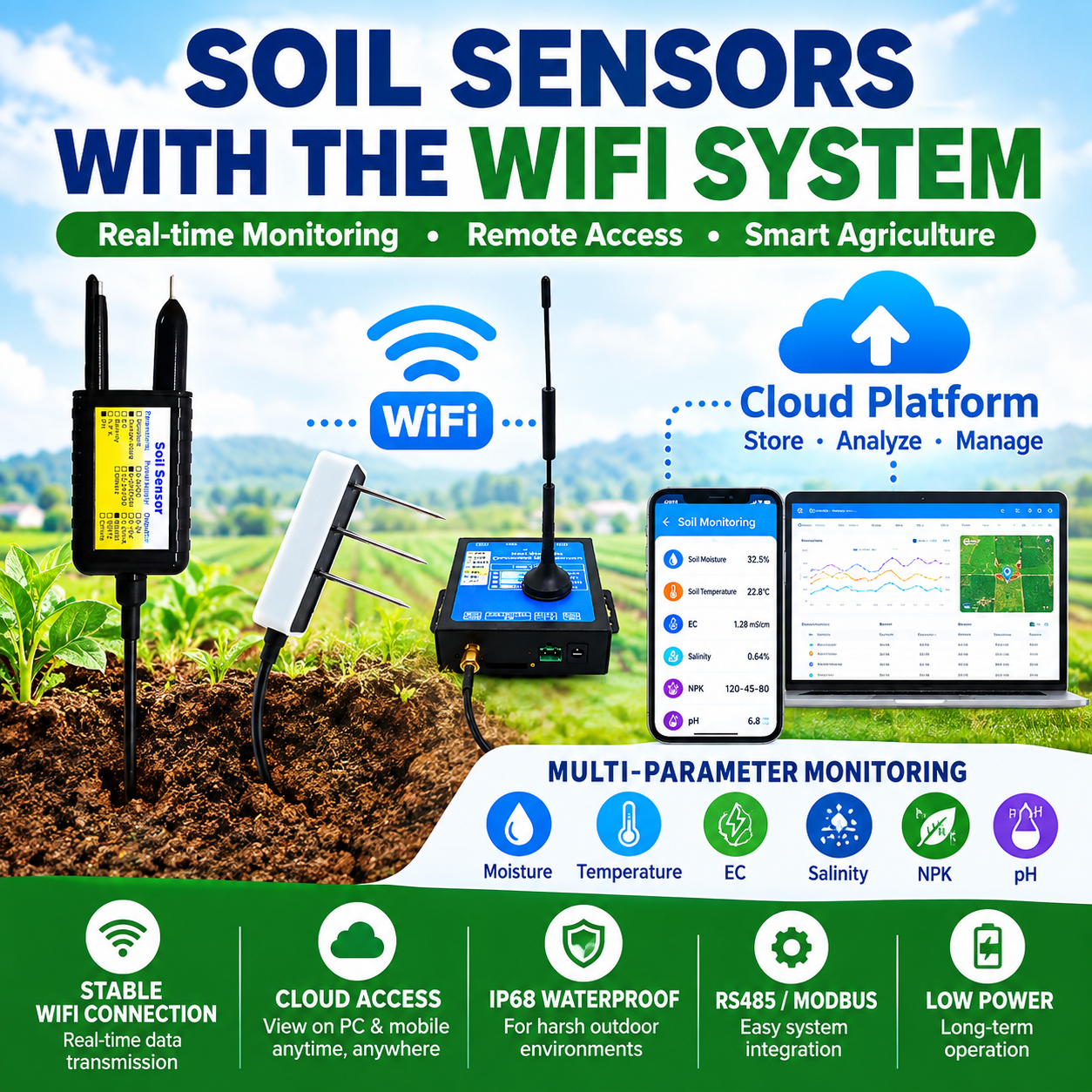
A WiFi soil sensor is a smart agricultural monitoring device that measures soil conditions and transmits the collected data wirelessly to a computer, mobile device or cloud platform. Depending on the sensor configuration, it can monitor soil moisture, temperature, electrical conductivity (EC), salinity, NPK, pH and other parameters.
Compared with traditional manual soil sampling, a wireless soil monitoring system provides continuous digital data that can be accessed remotely.
A typical system architecture is:
Honde Technology provides soil sensors that can integrate RS485, WiFi, LoRa, LoRaWAN, GPRS and 4G communication, together with matched server and software solutions for remote data monitoring.
This makes a WiFi soil sensor particularly useful for greenhouses, farms, nurseries, research stations and other locations where a reliable local WiFi network is available.
Why Use WiFi for Soil Monitoring?
The main advantage of WiFi soil monitoring is simple:
Traditional monitoring often requires workers to manually collect soil samples and transfer the information into spreadsheets.
A WiFi-enabled system can automate much of this process.
Key Benefits of WiFi Soil Monitoring
- Real-time soil data transmission
- Remote access through PC or mobile devices
- Reduced manual sampling
- Continuous monitoring
- Easier data storage and analysis
- Simple integration with cloud software
- Suitable for greenhouse and farm IoT systems
- Flexible connection with RS485/Modbus sensors
Honde’s soil sensor products can be configured with WiFi communication and matched server/software systems, allowing users to view real-time data remotely.
How Does a WiFi Soil Sensor System Work?
A professional wireless soil monitoring system normally contains several functional layers.
1. Soil Measurement
The sensor is inserted into the soil and measures the required parameters.
Depending on the model, this can include:
- Soil moisture
- Soil temperature
- EC
- Salinity
- NPK
- pH
Honde offers both single-purpose and multi-parameter configurations. For example, its 4-in-1 soil sensor measures soil moisture, temperature, EC and salinity simultaneously.
2. RS485 Data Communication
Many industrial soil sensors use RS485 with Modbus-RTU as their wired communication interface.
This is important for B2B projects because RS485 makes it easier to connect the sensor with:
- Data loggers
- PLCs
- IoT gateways
- Industrial controllers
- WiFi modules
- 4G modules
- LoRa gateways
Honde’s multi-parameter soil sensors specify RS485 with the standard Modbus-RTU protocol.
3. WiFi Wireless Transmission
The WiFi module receives the sensor data and transmits it through the available local network.
This removes the need for long communication cables between every sensor and the monitoring computer.
4. Cloud or Local Software
The data can then be displayed through software.
Depending on the project architecture, users can access:
- Real-time data
- Historical data
- Data curves
- Monitoring records
- Exported data
- Alarm information
Honde states that matched server and software can be supplied for viewing real-time data on PC or mobile devices.
WiFi Soil Sensor vs RS485 Soil Sensor
One important point is often misunderstood by buyers:
RS485 is generally the local wired communication interface, while WiFi provides the wireless network connection.
They can work together.
| Feature | RS485 Soil Sensor | WiFi Soil Sensor |
|---|---|---|
| Soil measurement | ✓ | ✓ |
| Modbus-RTU | ✓ | Usually supported through sensor interface |
| Wireless transmission | No | ✓ |
| Long cable installation | Possible | Reduced |
| Local industrial integration | Excellent | Good |
| Remote monitoring | Requires gateway/logger | ✓ |
| Cloud integration | Through external equipment | ✓ |
| Best application | Industrial wired systems | Smart wireless monitoring |
Therefore, a common architecture is:
rather than choosing between RS485 and WiFi.
What Soil Parameters Can a WiFi Soil Sensor Measure?
The correct sensor should be selected according to the actual application.
Soil Moisture
Soil moisture is essential for irrigation management.
Real-time moisture data can help determine:
- When irrigation is needed
- Whether irrigation is sufficient
- How quickly the soil dries
- Differences between irrigation zones
Honde’s 4-in-1 sensor specifies a moisture measurement range of 0–100% V/V and accuracy of ±2% V/V.
Soil Temperature
Soil temperature influences:
- Root development
- Seed germination
- Microbial activity
- Crop growth
Combining temperature and moisture provides a more complete picture of root-zone conditions.
Electrical Conductivity
EC provides useful information about the electrical conductivity of soil and nutrient solutions.
The Honde 4-in-1 sensor supports an EC measurement range up to 20,000 μS/cm, with model-specific accuracy specifications.
Soil Salinity
Salinity monitoring is particularly useful for:
- Greenhouses
- Irrigated farmland
- Arid regions
- Fertilized crops
- Coastal agriculture
NPK
For precision agriculture and soil fertility monitoring, NPK sensors can provide information about:
- Nitrogen
- Phosphorus
- Potassium
Honde also offers dedicated NPK sensors and integrated multi-parameter models.
Soil pH
pH is important for evaluating soil acidity and alkalinity.
For applications requiring a broader soil profile, Honde’s 8-in-1 soil sensor combines moisture, temperature, EC, salinity, NPK and pH measurements.
4-in-1 vs 8-in-1 WiFi Soil Sensor
A common purchasing question is whether a project needs a simple multi-parameter sensor or a more comprehensive 8-in-1 configuration.
| Feature | 4-in-1 Soil Sensor | 8-in-1 Soil Sensor |
|---|---|---|
| Moisture | ✓ | ✓ |
| Temperature | ✓ | ✓ |
| EC | ✓ | ✓ |
| Salinity | ✓ | ✓ |
| Nitrogen | — | ✓ |
| Phosphorus | — | ✓ |
| Potassium | — | ✓ |
| pH | — | ✓ |
| WiFi option | ✓ | ✓ |
| RS485 | ✓ | ✓ |
| Cloud software | Available | Available |
| Recommended for | Irrigation & basic monitoring | Comprehensive soil analysis |
The 4-in-1 configuration is often sufficient for irrigation and basic soil-condition monitoring.
The 8-in-1 configuration is more appropriate when the project requires soil fertility and nutrient information in addition to moisture and temperature. Honde’s published specifications confirm both configurations can be integrated with wireless communication and matched software.
What Makes a Good WiFi Soil Monitoring System?
Buying a soil sensor alone is not enough for a professional agricultural IoT project.
A complete solution should consider five key components.
1. Sensor Accuracy
Check:
- Measurement range
- Accuracy
- Resolution
- Measurement principle
- Calibration requirements
2. Communication Interface
For system integration, confirm whether the sensor supports:
This makes integration with third-party equipment easier.
3. Wireless Connectivity
WiFi is ideal when the monitoring site already has stable network coverage.
For remote farms without WiFi, other technologies may be more appropriate:
- LoRa
- LoRaWAN
- 4G
- GPRS
Honde supports multiple wireless options, allowing the communication method to be selected according to the project environment.
4. Waterproof Protection
Outdoor soil sensors operate in an extremely demanding environment.
The sensor may be exposed to:
- Water
- Mud
- Fertilizer
- Temperature changes
- Long-term burial
Honde’s soil sensor configurations include IP68 waterproof designs for continuous field installation.
5. Cloud Software
A sensor becomes much more useful when the data can be viewed remotely.
For B2B projects, ask whether the supplier can provide:
- Cloud server
- PC software
- Mobile access
- Historical data
- Data export
- Alarm functions
- API/MQTT integration where required
Honde states that matched server and software can be supplied for viewing real-time data on PC or mobile devices.
WiFi Soil Sensor Applications
Smart Agriculture
A WiFi soil sensor can continuously monitor soil conditions and provide data for precision irrigation and crop management.
Greenhouse Monitoring
Greenhouses are especially suitable for WiFi because network infrastructure is often already available.
Sensors can monitor:
- Moisture
- Temperature
- EC
- Salinity
- Nutrient conditions
This allows growers to adjust irrigation and fertilization based on measured data.
Nursery and Plant Production
WiFi monitoring can reduce the need for manual inspection of multiple growing areas.
Scientific Research
Researchers can use continuous soil measurements to create long-term datasets for:
- Soil-water studies
- Plant growth experiments
- Irrigation research
- Fertilizer studies
- Environmental monitoring
Precision Irrigation
One of the most practical applications is irrigation management.
Instead of irrigating according to a fixed schedule, growers can use real-time soil moisture information to make more informed decisions.
WiFi vs LoRa vs 4G for Soil Monitoring
The best communication technology depends on the installation environment.
| Communication | Best For | Main Advantage | Main Limitation |
|---|---|---|---|
| WiFi | Greenhouses, facilities | Existing network infrastructure | Requires WiFi coverage |
| LoRa | Large local areas | Long range and low power | Usually needs gateway/network planning |
| LoRaWAN | Large IoT networks | Scalable multi-node architecture | Requires LoRaWAN infrastructure |
| 4G | Remote farms | Direct cellular connectivity | Requires cellular coverage and SIM/data |
| RS485 | Local wired systems | Stable industrial communication | Requires cabling |
Honde’s product ecosystem supports these communication options, allowing system integrators to select the appropriate architecture rather than using one wireless technology for every project.
Common Mistakes When Buying a WiFi Soil Sensor
Mistake 1: Choosing Only by Price
A low-cost sensor may not provide the communication, waterproofing or software required by a commercial monitoring system.
Mistake 2: Ignoring WiFi Coverage
A WiFi sensor cannot solve a network coverage problem.
Before deployment, check:
- WiFi signal strength
- Access point location
- Distance between sensor and router
- Outdoor interference
- Network stability
Mistake 3: Buying Too Many Parameters
If the project only requires irrigation management, an 8-in-1 sensor may be unnecessary.
Mistake 4: Ignoring Data Integration
Always confirm:
For industrial projects, RS485 Modbus compatibility is particularly important.
Mistake 5: Forgetting Long-Term Installation
A sensor intended for permanent field installation should have appropriate sealing and environmental protection.
Honde Technology WiFi Soil Sensor Solution
Honde Technology Co., Ltd. develops soil monitoring equipment for agriculture, irrigation, greenhouse management, scientific research and environmental applications.
Its soil sensor portfolio includes:
- Soil moisture sensors
- Soil temperature sensors
- EC sensors
- Salinity sensors
- NPK sensors
- pH sensors
- 4-in-1 soil sensors
- 8-in-1 soil sensors
- Multi-layer soil sensors
Wireless communication can be customized using WiFi, LoRa, LoRaWAN, GPRS or 4G, while RS485/Modbus can be used for local communication and system integration.
Honde also provides matched server and software solutions for real-time monitoring through PC or mobile devices.
The company’s video library specifically includes demonstrations of “Soil sensors with the WIFI system”, alongside LoRaWAN, 4G, mobile APP and other soil monitoring configurations.
This demonstrates an important B2B advantage: the project can be built around the required application and communication architecture, rather than being limited to a single fixed sensor configuration.
Example: WiFi Soil Monitoring System for a Greenhouse
Consider a commercial greenhouse with several irrigation zones.
A practical architecture could be:
↓
RS485 / Modbus-RTU
↓
WiFi Communication Module
↓
Local WiFi Network
↓
Cloud Server / Software
↓
PC + Mobile Phone
The system can continuously collect soil moisture, temperature, EC and other selected parameters.
The grower can then monitor the greenhouse remotely instead of manually checking every sensor.
For a larger farm without reliable WiFi coverage, the same sensor concept can be adapted to LoRaWAN or 4G.
This modular architecture is particularly useful for system integrators who need to deploy the same basic sensor technology across different project environments.
How to Choose the Right WiFi Soil Sensor
Before sending an RFQ to a manufacturer, prepare the following information.
| Requirement | Information to Provide |
|---|---|
| Application | Farm / greenhouse / research / irrigation |
| Parameters | Moisture / temperature / EC / salinity / NPK / pH |
| Quantity | Number of sensors |
| Installation | Surface / buried |
| Communication | WiFi / RS485 / other |
| Power | Battery / DC / solar |
| Cable | Required cable length |
| Data platform | PC / mobile / cloud |
| Protocol | Modbus / MQTT / JSON / API |
| Environment | Indoor / outdoor |
| Customization | OEM / ODM / logo / housing |
Providing these details allows the manufacturer to recommend the correct sensor configuration instead of simply quoting a generic product.
FAQ About WiFi Soil Sensors
Can a WiFi soil sensor measure multiple parameters?
Yes. Depending on the model, one sensor can measure multiple soil parameters such as moisture, temperature, EC, salinity, NPK and pH.
Does a WiFi soil sensor support RS485?
Many Honde configurations support RS485 with Modbus-RTU, allowing the sensor to connect to data loggers, gateways and industrial controllers.
Can I view the soil data on my phone?
Yes. Honde states that matched server and software can be supplied for viewing real-time data on PC or mobile devices.
Is WiFi suitable for large farms?
It depends on network coverage. WiFi is usually most convenient where reliable WiFi infrastructure already exists. For large remote farms, LoRaWAN or 4G may be more suitable.
Can the communication method be customized?
Yes. Honde’s soil sensors can be configured with different wireless communication options, including WiFi, LoRa, LoRaWAN, GPRS and 4G, depending on the model.
Are Honde soil sensors suitable for long-term outdoor monitoring?
Selected models use IP68 waterproof construction and are designed for continuous soil installation and monitoring.
Conclusion: WiFi Soil Sensors Turn Soil Data Into Actionable Information
A modern WiFi soil sensor is more than a device that measures soil moisture.
The real value comes from combining:
For greenhouse operators, agricultural companies, researchers and IoT system integrators, the most important selection criteria are:
- Required soil parameters
- Measurement accuracy
- RS485/Modbus compatibility
- WiFi network coverage
- Waterproof protection
- Power supply
- Data logging
- Cloud/software compatibility
- Remote monitoring
- OEM/ODM customization
Honde Technology can provide configurable soil sensors and wireless monitoring solutions according to different agricultural IoT requirements, including WiFi, LoRa, LoRaWAN, 4G and GPRS communication options.
Build Your Wireless Soil Monitoring System With Honde
If you are looking for a WiFi Soil Sensor, Wireless Soil Monitoring System, RS485 Soil Sensor, or customized smart agriculture IoT solution, contact Honde Technology with your project requirements.
When sending an inquiry, provide:
- Required soil parameters
- Number of monitoring points
- WiFi coverage
- Communication protocol
- Power supply
- Installation method
- Cable length
- Cloud/software requirements
- Target quantity
- Destination country
Honde Technology can help you configure the soil sensor, wireless communication module, data logger and software system for your specific application.
Post time: Aug-25-2026