

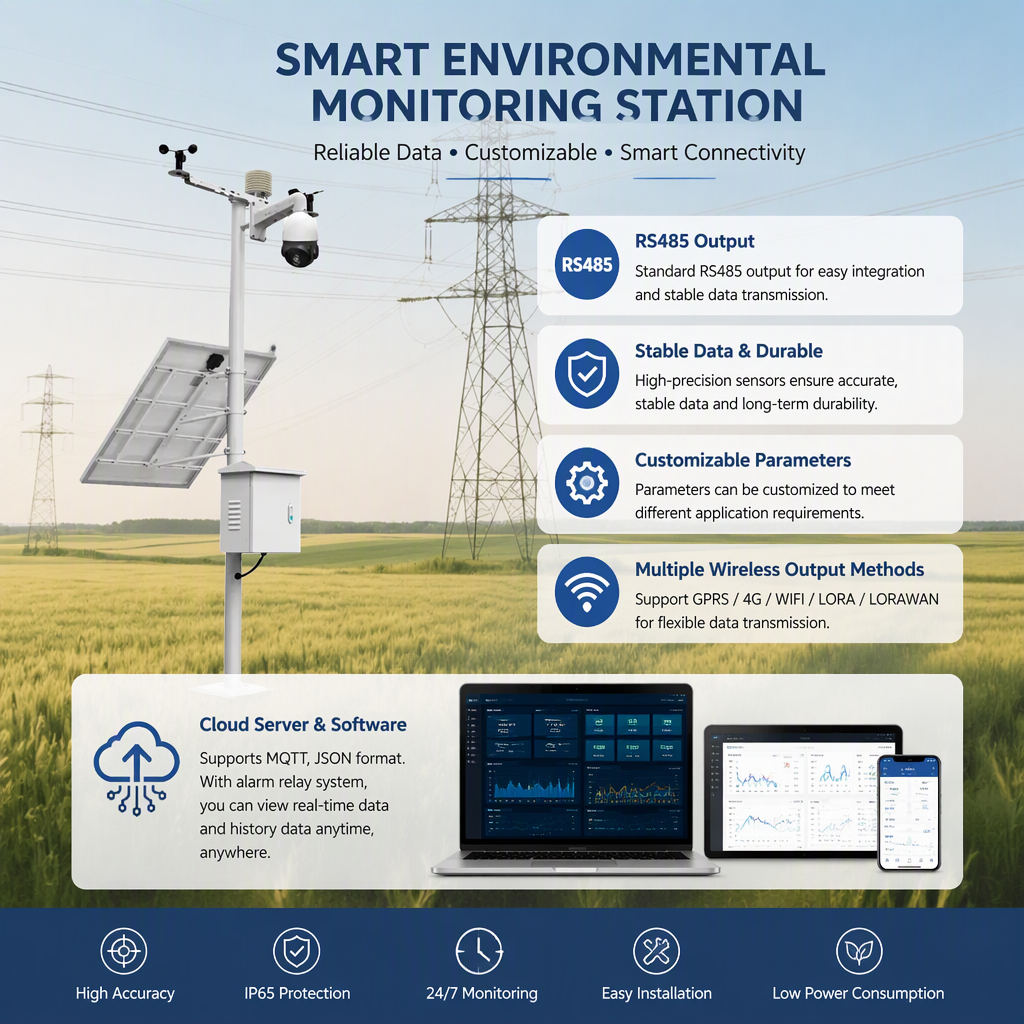
Introduction: What Is a 4G GSM Agricultural Weather Monitoring Station?
A 4G GSM agricultural weather monitoring station is a connected environmental monitoring solution that collects field weather data and transmits it through a cellular network to a remote monitoring platform. Depending on the selected sensor configuration, it can support measurements such as air temperature, relative humidity, wind speed, wind direction, rainfall, solar radiation, and atmospheric pressure.
For farms, orchards, greenhouses, and agricultural research projects, the main value is straightforward: users can access environmental data remotely, identify changing field conditions, and make more informed decisions about irrigation, crop protection, and farm operations.
When selecting a system, buyers should evaluate more than the sensor itself. Measurement parameters, accuracy, cellular coverage, power supply, data transmission protocols, software compatibility, and customization options all affect long-term project performance.
Honde Technology Co., Ltd. provides weather monitoring equipment and IoT solutions for agricultural and environmental applications. This guide explains the key selection criteria for buyers evaluating a cellular agricultural weather monitoring system.
1. Why Use a Cellular Weather Monitoring Station in Agriculture?
Traditional agricultural weather monitoring often requires personnel to visit the measurement site and manually record readings. This approach can be inefficient for large farms, remote orchards, and geographically dispersed monitoring locations.
A cellular weather station can help simplify this process by connecting field measurements with a remote data platform.
Key benefits of 4G GSM connectivity
- Remote data access: Check available monitoring data without visiting each station.
- Flexible deployment: Cellular communication can reduce the need for long communication cables between the field and the monitoring center.
- Timely environmental information: Receive updated measurements according to the configured sampling and transmission intervals.
- Multi-site management: Combine data from multiple monitoring locations when the software platform supports centralized management.
- Data-driven farm operations: Use environmental records to support irrigation planning, crop protection, and agricultural research.
Important selection tip: 4G and GSM are related but not interchangeable terms. Confirm whether the device supports the cellular technologies and frequency bands used by your local mobile operator. Also verify whether the selected model supports the required SIM card, network bands, and data transmission method.
2. Which Weather Parameters Should an Agricultural Monitoring System Measure?
The appropriate sensor configuration depends on the crop, climate, monitoring objective, and project budget.
| Monitoring Parameter | Agricultural Application | What Buyers Should Check |
|---|---|---|
| Air temperature | Frost risk assessment and crop growth analysis | Measurement range and accuracy |
| Relative humidity | Humidity management and disease-risk assessment | Operating range and accuracy |
| Wind speed | Spraying decisions and wind-risk monitoring | Measuring range and response |
| Wind direction | Understanding wind patterns around crops | Direction range and accuracy |
| Rainfall | Rainfall tracking and irrigation planning | Rain gauge type and resolution |
| Solar radiation | Crop energy balance and solar exposure analysis | Radiation range and accuracy |
| Atmospheric pressure | Weather trend analysis | Pressure range and resolution |
| Soil moisture and temperature | Root-zone monitoring and irrigation management | Soil sensor type and installation depth |
Not every agricultural weather station includes all these parameters. Buyers should confirm the standard configuration and optional sensors before placing an order.
For precision agriculture, combining above-ground weather monitoring with soil measurements can provide a more complete picture of crop growing conditions.
For example, rainfall data alone cannot show how much water remains available in the crop root zone. A soil moisture sensor can provide additional information to help farmers determine whether irrigation is necessary.
3. How Does a 4G Agricultural Weather Monitoring System Work?
A typical cellular monitoring architecture consists of four functional layers.
Weather Sensors → Data Acquisition Unit → 4G Cellular Network → Cloud Platform or Monitoring Software
Step 1: Environmental data collection
The station collects measurements from its configured meteorological sensors. Depending on the system, the readings may be sampled at predefined intervals.
Step 2: Data processing and acquisition
The acquisition unit receives and organizes sensor readings for transmission. Supported interfaces and communication methods depend on the selected hardware.
Step 3: Cellular data transmission
The device sends monitoring data through a supported cellular connection. Before deployment, confirm local network availability, signal strength, data plan requirements, and the communication protocol.
Step 4: Remote visualization and analysis
A compatible server, cloud platform, or monitoring application can display current readings and historical records. Additional functions such as alarms, data exports, and third-party integration depend on the software configuration.
For projects that require integration with an existing IoT platform, buyers should confirm whether the equipment supports protocols such as MQTT, Modbus, or another required interface. These capabilities should be verified against the specific model rather than assumed from the presence of 4G connectivity alone.
4. 4G GSM Weather Station vs. LoRaWAN Weather Monitoring
Both cellular and LoRaWAN technologies can be used in agricultural monitoring. The best option depends on the deployment layout, available infrastructure, and operating requirements.
| Selection Factor | 4G GSM Cellular | LoRaWAN |
|---|---|---|
| Communication architecture | Connects through a compatible cellular network | Typically communicates through a LoRaWAN gateway |
| Network dependency | Requires supported cellular coverage | Requires suitable LoRaWAN coverage and gateway infrastructure |
| Multi-node deployment | Suitable for individual cellular-connected stations and supported multi-site systems | Often attractive for networks of low-power sensor nodes |
| Infrastructure planning | Check mobile operator coverage and SIM requirements | Check gateway placement, coverage, and network configuration |
| Power considerations | Depends on modem, transmission frequency, and power design | Depends on node design, reporting frequency, and gateway architecture |
| Best-fit scenario | Remote sites with suitable cellular service | Projects where a managed low-power sensor network is advantageous |
A cellular station may be simpler when each monitoring site needs an independent connection to a remote server. LoRaWAN can be attractive when many low-power sensors need to communicate with a shared gateway.
Neither option is universally better. For some projects, a hybrid architecture using LoRa or LoRaWAN for field sensors and 4G for gateway backhaul can also be considered.
Explore Honde’s 4G Weather Station Solutions for more information about cellular weather monitoring equipment.
5. How to Choose the Right Station for Your Agricultural Project
Before purchasing an agricultural weather station, evaluate the following six factors.
1. Define the monitoring objective
Decide whether the project focuses on general weather observation, irrigation management, frost monitoring, greenhouse control, agricultural research, or a combination of these applications.
Your objective determines which sensors are essential and which are optional.
2. Verify measurement accuracy
Compare the specified accuracy, resolution, measurement range, and operating conditions for every required parameter.
Do not compare products solely by the number of integrated sensors. A station with fewer, well-matched parameters may be more suitable than a larger configuration containing measurements that the project does not need.
3. Check cellular compatibility
Confirm the supported cellular technology, regional frequency bands, SIM requirements, antenna configuration, and data plan.
For remote agricultural sites, check the actual signal conditions at the proposed installation location before finalizing the communication design.
4. Evaluate power supply
Determine whether the station uses mains power, a battery, solar power, or a combination of these options.
For solar-powered installations, assess local sunlight conditions, seasonal variation, battery capacity, and expected energy consumption. Cellular transmission frequency can influence the overall power budget.
5. Confirm software and data integration
Ask whether the equipment can connect to the required cloud platform or farm management software. Confirm supported protocols, data formats, API availability, and historical data access where applicable.
This step is especially important for system integrators building a centralized agricultural monitoring platform.
6. Consider customization and maintenance
For commercial projects, check whether the manufacturer can support the required sensor combination, installation method, communication configuration, enclosure protection, and data interface.
Also clarify calibration requirements, spare parts availability, warranty terms, and technical support arrangements.
6. Applications of Cellular Agricultural Weather Monitoring
Precision irrigation
Weather observations help agricultural teams understand environmental conditions affecting crop water demand. When combined with soil moisture measurements and an appropriate irrigation model, the data can support better irrigation scheduling.
Orchard and vineyard monitoring
Distributed monitoring stations can help growers compare microclimates across different blocks or elevations. Temperature, humidity, rainfall, and wind observations can support decisions about crop protection and field operations.
Greenhouse management
Outdoor weather measurements provide useful context for greenhouse management. When connected to compatible indoor sensors and control equipment, they can support more informed decisions about ventilation, humidity, and temperature management.
Agricultural research and demonstration farms
Weather stations provide environmental records for crop trials, field experiments, and agricultural research. Consistent data collection helps researchers compare growing conditions and interpret experimental results.
Remote and large-scale farms
Cellular connectivity can reduce the need for frequent on-site data collection where mobile network coverage is available. A centralized platform can help managers review data from multiple sites, subject to the system’s software and networking capabilities.
7. Why Integrate Weather Monitoring with Soil Sensors?
Weather data describes conditions above the ground, while soil sensors provide information about the crop root zone. Combining these data sources can help agricultural teams make decisions based on both atmospheric conditions and soil conditions.
| Data Source | Example Measurements | Decision Support |
|---|---|---|
| Agricultural weather station | Temperature, humidity, rainfall, wind, radiation | Weather assessment and field operation planning |
| Soil sensor | Soil moisture, temperature, electrical conductivity, depending on model | Root-zone monitoring and irrigation assessment |
| Cellular data collector | Acquired sensor readings and transmission status, depending on configuration | Remote data collection and connectivity |
| Monitoring platform | Current readings, historical trends, configured alarms | Centralized monitoring and reporting |
For example, a farm may combine rainfall measurements with soil moisture readings to determine whether recent precipitation has sufficiently replenished the root zone. Solar radiation, air temperature, and wind data can provide additional inputs for estimating crop water demand.
Where supported by the selected weather station and software, evapotranspiration-related calculations can further assist irrigation planning. Buyers should confirm which meteorological inputs and calculation methods are available.
Learn more about Honde’s Agriculture Weather Station and Soil Sensor System with 4G MQTT.
8. Frequently Asked Questions
Q1: What is the difference between a 4G weather station and a traditional weather station?
A traditional weather station may require local data retrieval or a separate communication system. A 4G weather station incorporates or connects to cellular communication equipment, enabling remote transmission when compatible network coverage and software are available.
Q2: Can a 4G agricultural weather station operate in a remote farm?
Yes, provided that the selected cellular network covers the installation site and the station has a suitable power supply. For areas without cellular coverage, consider a different communication technology or a hybrid network architecture.
Q3: Can the weather station connect to a cloud platform?
This depends on the device’s communication interface, supported protocol, and software configuration. Before ordering, confirm compatibility with the intended platform, including MQTT, Modbus, APIs, or other required interfaces.
Q4: Which sensors are essential for precision agriculture?
Air temperature, relative humidity, rainfall, and wind measurements are common starting points. Solar radiation and soil moisture may be important additions for crop water management, agricultural research, and more advanced monitoring applications.
The final configuration should be selected according to the crop, local climate, management goals, and budget.
Q5: Is a solar-powered 4G weather station suitable for off-grid agriculture?
It can be suitable if the solar panel and battery are sized for the equipment’s energy requirements and local sunlight conditions. Buyers should request information about power consumption, battery capacity, charging performance, and operation during extended periods of low sunlight.
Q6: Can the monitoring parameters be customized?
Customization depends on the product model and sensor interfaces. Buyers should provide a list of required parameters, measurement ranges, communication requirements, and installation conditions so the supplier can confirm a suitable configuration.
9. Conclusion: Select a Weather Monitoring System Based on the Project
A 4G GSM agricultural weather monitoring station can help farms collect environmental data remotely and improve access to information for irrigation planning, crop management, and agricultural research.
The most suitable system is not necessarily the one with the largest number of sensors or the most communication options. It is the one that matches the project’s measurement requirements, cellular coverage, power budget, software architecture, and long-term maintenance plan.
Before purchasing, prepare a clear technical specification covering the required parameters, accuracy, sampling interval, transmission method, power supply, data interface, and installation environment.
Looking for a cellular agricultural weather monitoring solution for your project?
Contact Honde Technology Co., Ltd. to discuss your required sensor configuration, communication method, and application scenario.
Company Information
- Company Name: Honde Technology Co., Ltd.
- Website: www.hondetechco.com
- Email: info@hondetech.com
- Product Reference: Smart Cellular 4G GSM Ambient Agriculture Monitoring Product
Request product specifications and a customized quotation for your agricultural monitoring project.
Post time: Oct-21-2026