

1. Introduction: The “Position Zero” Summary
Modern agriculture requires a holistic approach to data collection to maximize resource efficiency and crop health. To truly optimize smart irrigation, growers must bridge the gap between subterranean soil chemistry and atmospheric conditions. An integrated system combining 4G and WiFi connectivity with a high-precision sensor suite—specifically monitoring soil moisture, NPK levels, pH, and local weather patterns—is essential for success. This configuration enables real-time decision-making, ensuring water and nutrients are applied only when necessary. By leveraging Honde Technology’s robust IoT solutions, agriculturalists can achieve superior yields while significantly reducing resource waste through data-driven precision.
2. The Architecture of a Modern Agricultural Monitoring System
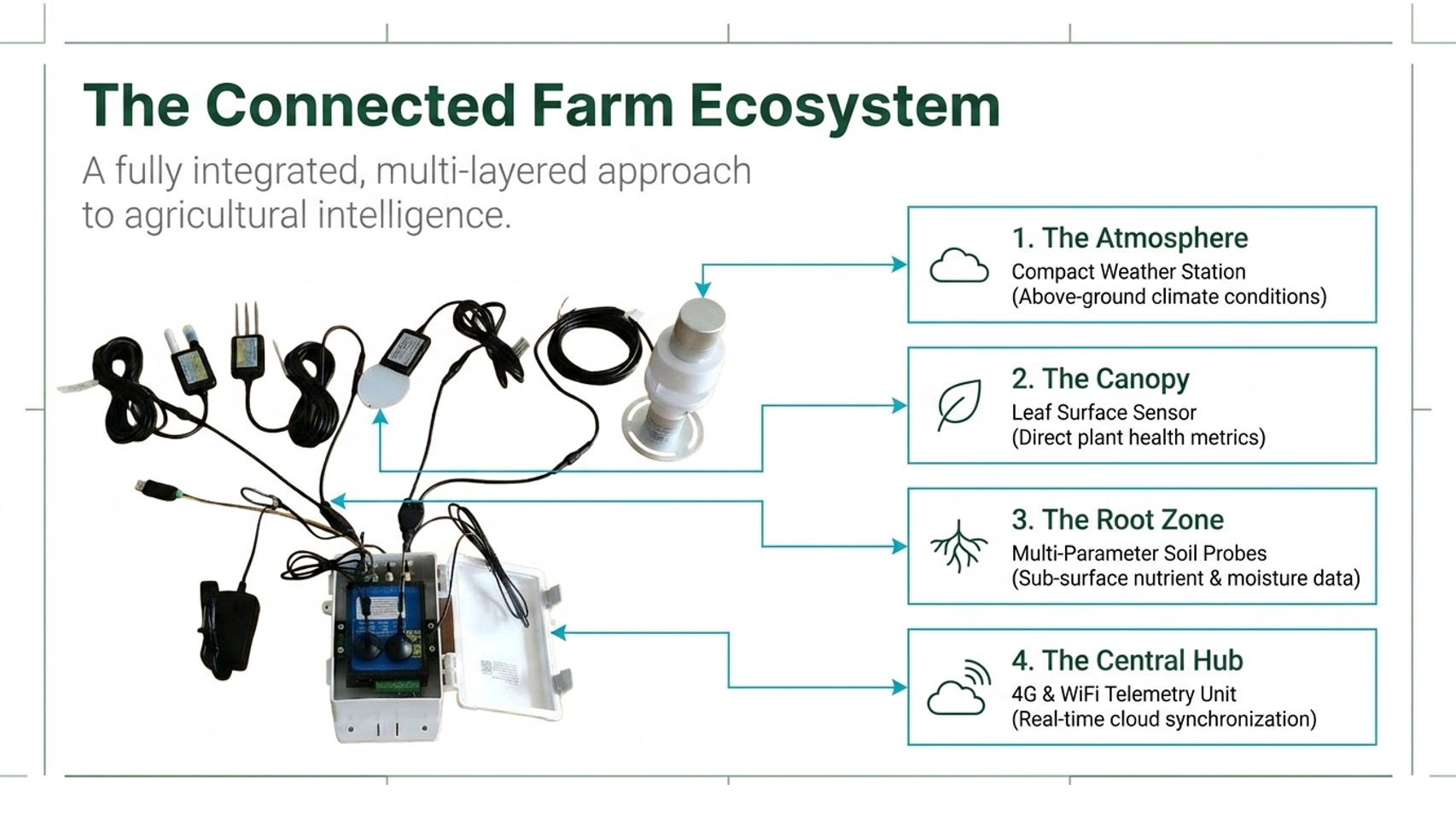
Precision Agriculture depends on the seamless integration of diverse data points to create a comprehensive view of the field. By combining the Honde Technology Compact Weather Station with the 7-in-1 Soil Sensor, users establish a powerful Environmental Monitoring network. This architecture utilizes Real-time Data Transmission via a centralized wireless hub.
Technical depth is found in the communication hierarchy: the individual sensors operate as Modbus-RTU slaves via RS485 Output, while the 4G/WiFi hub acts as the Master Gateway, aggregating data for cloud upload. This creates a functional “Entity Graph” of the farm’s ecosystem. Above-ground data, such as total radiation and wind speed, is synthesized with below-ground metrics like salinity and nutrient levels. Furthermore, the inclusion of a Leaf Sensor provides the “Plant Stress” variable, the final critical piece of the evapotranspiration puzzle. This synergy allows for precise irrigation; for instance, understanding that high solar radiation and leaf moisture loss necessitate immediate action even if soil moisture remains at a nominal threshold.
3. Deep Dive: Technical Specifications and Sensor Capabilities
The Honde Technology suite is designed to provide a high-resolution view of both the growing medium and the local climate.
| Component Name | Parameters Measured | Communication Interface |
|---|---|---|
| 7-in-1 Soil Sensor | Soil Moisture, Temperature, EC (Electrical Conductivity), Salinity, Nitrogen, Phosphorus, and Potassium (NPK) | RS485 (Modbus-RTU) |
| Soil pH Sensor | Soil pH levels (Glass electrode-based measurement) | RS485 (Modbus-RTU) |
| Leaf Sensor | Leaf surface temperature and humidity (Plant stress indicators) | RS485 (Modbus-RTU) |
| Compact Weather Station | Air temperature, humidity, pressure, ultrasonic wind speed, wind direction, and total radiation | RS485 (Modbus-RTU) |
| 4G/WiFi Wireless Hub | Connectivity Gateway (Dual antennas: 4G and 2.4G WiFi), SIM slot, RJ45 config port | 4G LTE / 2.4G WiFi / RJ45 |
4. Expert Experience: Installation and Setup Best Practices
As engineers at Honde Technology, we have refined the setup process to ensure long-term reliability in harsh field environments. To maximize the lifespan and accuracy of your system, we recommend the following professional best practices:
-
Differentiating Soil Sensors: It is vital to distinguish between the two soil probes. The 7-in-1 Soil Sensor is a robust multi-parameter probe that you can simply insert into the soil. However, the Soil pH Sensor is our largest and most delicate component. It is very fragile and easily broken; never “insert it roughly.” Instead, you must dig a hole and bury the sensor carefully to protect the glass electrode.
-
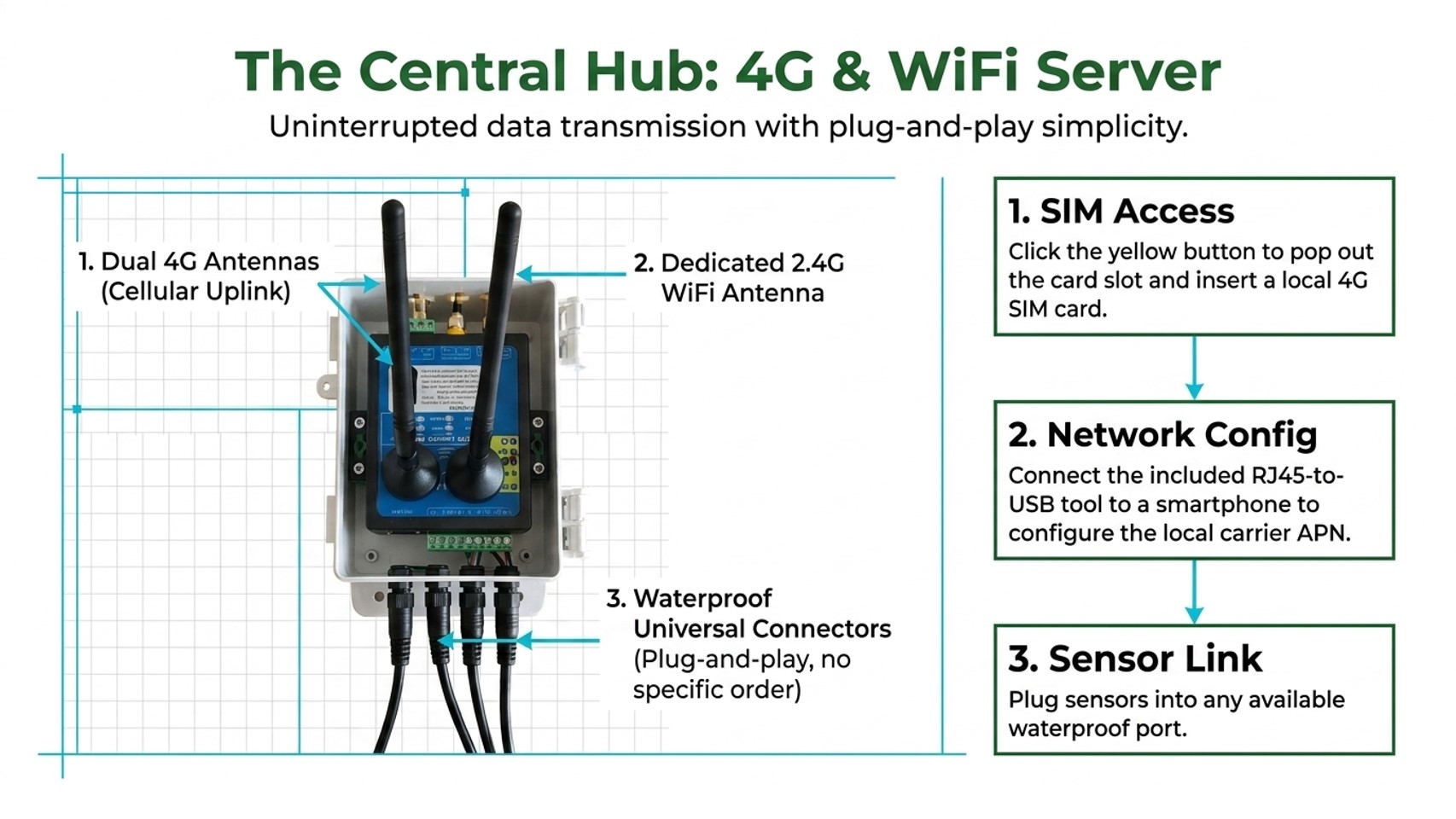
Antenna Precision: Our wireless hub features a dual-antenna system (one for 4G and one for 2.4G WiFi). These must be connected to their specific labeled ports in the correct order. These antennas are tuned for specific impedance matching; swapping them or failing to secure them will lead to significant signal loss, transmission failure, or hardware strain.
-
SIM and APN Configuration: To install the 4G SIM card, use the provided matching tool to click the yellow button on the hub to eject the card slot. It is critical that your APN (Access Point Name) settings on the device match the specific settings provided by your cellular carrier to enable data flow.
-
Local Configuration Tools: We include an RJ45-to-USB connector as a spare tool. This is used for local configuration via a laptop or mobile device. This is particularly useful for setting up WiFi instructions or updating APN settings in areas where a 4G signal has not yet been established.
-
Deployment and Power: The hub includes an install pallet designed for rain-proof mounting. While we provide a standard power adapter, our systems are fully compatible with custom solar panels and battery setups for off-grid operations.
5. Why Choose Honde Technology for Your IoT Agriculture Project?
Honde Technology Co., Ltd. focuses on providing fully integrated, field-ready solutions that remove the complexity from agricultural IoT. Our primary value proposition is a true “plug-and-play” experience. Every sensor in the suite uses high-quality, waterproof connectors that are standardized across the platform.
Because our sensors utilize the same RS485 Modbus protocol, there is no special order required for connection. The hub’s firmware is designed to auto-detect the sensor array regardless of which port is used. This eliminates the need for complex field wiring or specialized programming knowledge, allowing growers to transition from unboxing to data collection in minutes.
6. Conclusion and Actionable Next Steps
By integrating 4G/WiFi soil sensors and compact weather stations, you close the loop between raw environmental data and actionable field management. This technology provides the transparency needed to manage soil health, nutrient delivery, and atmospheric stress in real-time, leading to more sustainable and profitable farming operations.
Post time: Apr-23-2026