

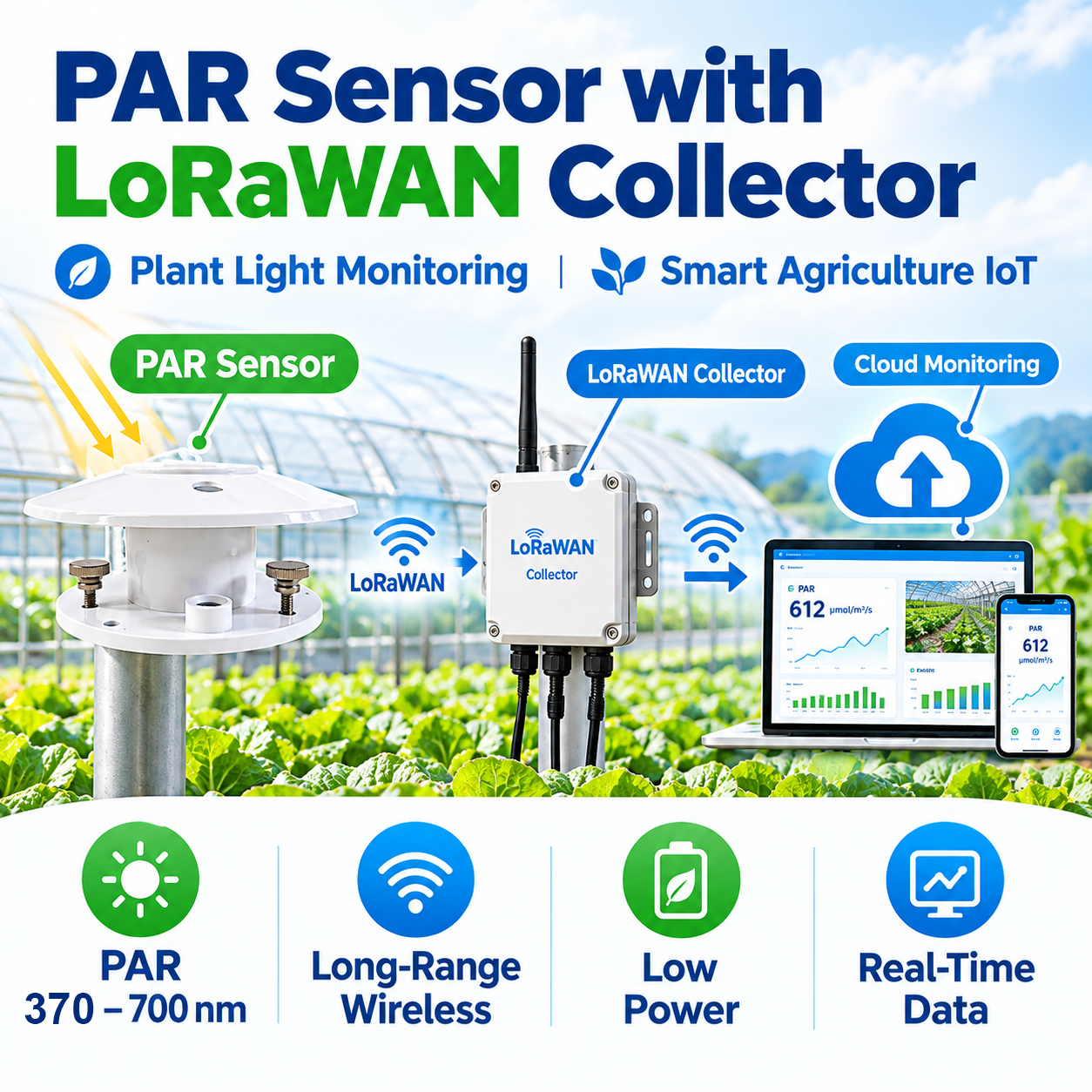
PAR Sensor with LoRaWAN Collector: A Practical Guide to Smart Agriculture Light Monitoring
A PAR sensor with a LoRaWAN collector provides a practical answer by combining plant-oriented light measurement with long-range, low-power IoT communication. PAR, or Photosynthetically Active Radiation, describes the portion of solar radiation that plants use for photosynthesis, commonly defined as the 400–700 nm wavelength range. PAR-related measurements are particularly important in greenhouse production, crop research, precision agriculture, vertical farming and other environments where light availability directly affects crop development.
Honde Technology Co., Ltd. integrates agricultural sensing and IoT communication technologies to help customers move from isolated sensor readings to connected environmental monitoring systems. The company’s product portfolio covers smart agriculture, soil monitoring, agricultural meteorological monitoring and IoT-based environmental solutions.
This article explains how a PAR sensor and LoRaWAN collector work together, what PAR data means for crop management, and how the technology can become part of a larger precision agriculture monitoring network.
What Is a PAR Sensor and Why Does PAR Matter in Agriculture?
PAR stands for Photosynthetically Active Radiation.
Unlike conventional light sensors designed primarily around human visual perception, a PAR sensor focuses on the portion of radiation relevant to plant photosynthesis. The commonly used PAR range is 400–700 nm. For agricultural applications, this distinction is important because a high lux reading does not necessarily mean that plants are receiving an equivalent amount of photosynthetically useful light.
For crop production, PAR data can help growers understand:
- How much usable light reaches the crop canopy
- How sunlight changes throughout the day
- Differences in light conditions between growing areas
- Whether greenhouse shading is reducing available light
- Whether supplemental lighting is sufficient
- How seasonal weather affects crop light exposure
- How microclimate conditions influence crop growth
For this reason, PAR monitoring is not simply “measuring brightness.” It is measuring a variable that can be directly connected to the biological environment in which crops grow.
PAR vs. Lux: What Is the Difference?
This is one of the most common points of confusion when selecting an agricultural light sensor.
| Measurement | Main Purpose | Typical Application |
|---|---|---|
| Lux | Measures visible light according to human visual sensitivity | Buildings, workplaces, general lighting |
| PAR | Describes radiation relevant to plant photosynthesis | Agriculture, greenhouse, horticulture |
| PPFD | Quantifies photosynthetic photon flux density received by a surface | Crop research, greenhouse lighting, controlled cultivation |
| Solar Radiation | Measures broader solar energy input | Weather stations, solar-energy and environmental monitoring |
For plant-focused applications, PAR and PPFD-related measurements provide a more relevant perspective than relying on conventional illuminance measurements alone.
How Does a PAR Sensor with a LoRaWAN Collector Work?
A connected agricultural light-monitoring system can be understood as a simple three-stage architecture:
The PAR sensor is installed at the location where light conditions need to be monitored. It measures the relevant radiation conditions and sends the collected data to the LoRaWAN network.
The collector or gateway then acts as the communication bridge between field sensors and the monitoring platform.
A typical workflow is:
- Measure — The PAR sensor continuously or periodically measures plant-relevant light conditions.
- Collect — The LoRaWAN collector receives sensor data.
- Transmit — Data is transmitted wirelessly through the LoRaWAN network.
- Store — Measurements can be transferred to a cloud or software platform.
- Analyze — Users compare light conditions with crop growth, irrigation, temperature and other environmental variables.
- Decide — Farmers or agronomists use the information to adjust production strategies.
This architecture is particularly useful when sensors are distributed across large fields, orchards, greenhouses or research plots.
Why Use LoRaWAN for Agricultural PAR Monitoring?
Agricultural environments present a special connectivity challenge. Sensors may be distributed over large areas, while reliable power and wired network infrastructure may not be available at every measurement point.
The LoRa Alliance identifies long range, low power consumption, easy deployment and suitability for remote locations as important characteristics of LoRaWAN for smart agriculture. Its current agriculture resources also highlight applications such as environmental monitoring, irrigation management, soil health and crop management.
For a PAR monitoring network, these characteristics can provide several practical advantages.
1. Wireless Deployment
A wireless architecture reduces the need for long communication cables between individual sensors and a central monitoring location.
This can be especially useful for:
- Large agricultural fields
- Greenhouses
- Orchards
- Experimental farms
- Agricultural research stations
- Remote crop-monitoring locations
2. Low-Power Operation
Many agricultural IoT sensors need to operate for long periods without frequent maintenance. LoRaWAN is designed for low-power wide-area IoT deployments, making it suitable for distributed agricultural sensing.
3. Large-Area Monitoring
Instead of relying on a single light measurement point, farmers can deploy multiple sensors to understand spatial differences across the growing area.
This is particularly valuable because light is not necessarily uniform throughout a farm or greenhouse.
4. Scalable IoT Architecture
PAR does not have to operate as an isolated measurement.
A LoRaWAN agricultural network can also connect other types of environmental sensors, creating a broader monitoring architecture.
For example:
This changes the role of the PAR sensor from a standalone instrument into one part of a complete agricultural IoT system.
PAR Monitoring for Greenhouses
For greenhouse applications, an Agricultural Greenhouse Light Sensor can provide continuous PAR and light-condition monitoring for crop management.
Greenhouse operators often need to balance natural sunlight, shading and supplemental lighting.
A PAR monitoring system can provide objective data for understanding the light environment inside different sections of a greenhouse.
For example, a grower may discover that:
- Plants near the greenhouse edge receive stronger natural light.
- Plants underneath structural components receive less light.
- Shade cloth significantly changes the available light.
- Seasonal sunlight creates large differences between morning and afternoon.
- Different greenhouse sections require different lighting strategies.
Instead of making decisions only from visual observation, growers can use sensor data to identify these differences.
A connected PAR sensor can therefore become part of a greenhouse environmental monitoring system together with temperature, humidity, CO₂ and soil or substrate sensors.
PAR Monitoring for Precision Agriculture
The value of agricultural sensing increases when different environmental variables are analyzed together.
For example:
can provide a more complete picture of the crop environment than any individual sensor.
Consider a simple scenario:
| Parameter | What It Tells the Grower |
|---|---|
| PAR | Available photosynthetically relevant light |
| Air Temperature | Thermal conditions around the crop |
| Air Humidity | Atmospheric moisture conditions |
| Soil Moisture | Water availability in the root zone |
| Rainfall | Natural water input |
| Wind Speed | Atmospheric movement and field conditions |
When these measurements are collected continuously, growers can begin to identify relationships between environmental conditions and crop performance.
This is the foundation of data-driven precision agriculture.
The LoRa Alliance also describes smart agriculture applications in which environmental, soil and weather data are remotely collected to support more efficient farm management and resource optimization.
From a PAR Sensor to a Complete Smart Agriculture Monitoring System
The same LoRaWAN architecture can also connect soil sensors for monitoring moisture, temperature, EC, salinity, pH and NPK, as described in our guide to LoRaWAN Soil Sensor With Collector.
A PAR sensor should not necessarily be viewed as an isolated product.
For commercial agriculture projects, a more useful architecture is often:
→ Soil Moisture Sensor
→ Soil Temperature Sensor
→ Air Temperature & Humidity Sensor
→ Weather Station
→ LoRaWAN Collector / Gateway
→ Database
→ Dashboard
→ Historical Data
→ Alerts
→ Greenhouse Lighting
→ Crop Management
→ Environmental Warning
→ Production Optimization
This architecture allows the customer to start with one measurement parameter and gradually expand the monitoring network.
What Should Buyers Check When Choosing a PAR Sensor?
For B2B buyers, selecting a PAR sensor is more than comparing the sensor price.
We recommend evaluating the following points.
1. Measurement Definition
Confirm exactly what the sensor measures.
Is it PAR, PPFD, solar radiation or illuminance?
These parameters are related but should not be treated as interchangeable.
2. Installation Environment
Consider whether the sensor will be installed:
- Outdoors
- Inside a greenhouse
- Above the crop canopy
- Under artificial lighting
- In agricultural research plots
The installation environment affects the sensor design and long-term measurement reliability.
3. Communication Method
For distributed agricultural projects, consider whether the sensor supports:
- LoRa
- LoRaWAN
- 4G
- Wi-Fi
- RS485
- Other industrial interfaces
For remote multi-point monitoring, LoRaWAN can be particularly attractive because it is designed for long-range, low-power IoT connectivity.
4. Data Integration
A professional agricultural monitoring project should not stop at displaying the current value.
Buyers should consider whether the system supports:
- Real-time data
- Historical data
- Cloud storage
- Remote monitoring
- Alarm functions
- Data export
- API or standard communication protocols
- Integration with other agricultural sensors
5. System Scalability
If the customer plans to add soil sensors, weather stations or other environmental sensors later, the communication architecture should be capable of supporting expansion.
This is one reason a network-based solution can be more valuable than purchasing independent sensors from multiple suppliers.
Honde’s Approach to Connected Agricultural Monitoring
Honde Technology Co., Ltd. was founded in 2011 and focuses on IoT-based smart water equipment, smart agriculture, smart environmental protection and related solutions. Its application areas include agricultural meteorological monitoring, soil data monitoring, greenhouse monitoring and other environmental IoT applications.
Based on Honde’s existing agricultural IoT architecture, a PAR sensor can be integrated into a broader monitoring network rather than operating independently.
Honde’s existing agricultural solutions already cover combinations of weather stations, soil sensors, wireless communication and cloud-based monitoring. For example, its LoRa/LoRaWAN smart agriculture architecture combines distributed soil sensors and agricultural weather stations with LoRa collectors and gateways.
This approach is important for B2B customers because the real requirement is often not simply:
“I need a PAR sensor.”
The actual requirement may be:
“I need to monitor light, soil and weather conditions across my farm and send the data to a central platform.”
That is a much larger IoT solution.
PAR + LoRaWAN: Typical Application Scenarios
The combination of PAR sensing and LoRaWAN connectivity can be considered for several agricultural applications.
Greenhouse Monitoring
Monitor light availability in different greenhouse zones and combine PAR data with temperature, humidity and CO₂ measurements.
Precision Horticulture
Track the light environment around high-value crops such as vegetables, flowers, fruits and nursery plants.
Agricultural Research
Collect continuous environmental data from experimental plots and compare light conditions with crop growth and production results.
Vertical Farming
In controlled-environment agriculture, PAR/PPFD information can help evaluate artificial lighting conditions and differences between cultivation zones.
Orchard Monitoring
Combine light measurements with weather and soil information to study microclimate conditions around fruit trees.
Smart Farm IoT Networks
Deploy multiple environmental sensors across a large farm and use LoRaWAN connectivity to centralize the collected data.
A Practical Example of a Connected PAR Monitoring Network
Imagine a commercial greenhouse with several growing zones.
Instead of installing only one light sensor, the operator deploys several PAR sensors at representative locations.
Each sensor measures local light conditions.
The data is transmitted through the LoRaWAN network to a collector or gateway.
The cloud platform then provides:
- Current PAR data
- Historical trends
- Daily light changes
- Comparison between different zones
- Environmental alerts
- Combined analysis with soil and weather data
The grower can then determine whether a specific area is receiving sufficient natural or supplemental light.
This approach turns light from a visual observation into a measurable agricultural dataset.
Why Connected PAR Monitoring Matters for the Future of Smart Agriculture
The next stage of precision agriculture is not simply adding more sensors.
It is connecting the sensors and turning measurements into decisions.
A PAR sensor provides information about the crop’s light environment.
A soil sensor provides information about the root zone.
A weather station provides information about atmospheric conditions.
A LoRaWAN network provides the communication infrastructure.
A cloud platform turns these measurements into accessible data.
Together, they create a digital representation of the agricultural environment.
This is consistent with the broader direction of LoRaWAN smart agriculture, where distributed sensors are used to monitor environmental and production conditions across large and remote agricultural areas.
PAR monitoring can also be integrated with weather stations and soil sensors to create a Weather-Soil Integrated Smart Agriculture System based on LoRa/LoRaWAN.
Conclusion: PAR Sensor + LoRaWAN Is More Than Light Monitoring
A PAR sensor with a LoRaWAN collector provides a practical way to connect plant-light monitoring with modern agricultural IoT.
The key value is not simply measuring PAR. It is the ability to:
- Measure plant-relevant light conditions.
- Collect data wirelessly.
- Monitor multiple locations.
- Store and analyze historical information.
- Combine PAR with soil and weather parameters.
- Build a scalable smart agriculture monitoring network.
For farms, greenhouses, agricultural research facilities and precision horticulture projects, this architecture can provide a stronger data foundation for understanding crop environments.
Honde Technology Co., Ltd. provides IoT sensing products and agricultural monitoring solutions for customers looking to connect sensors, wireless communication, cloud platforms and agricultural applications.
Company Name: Honde Technology Co., Ltd.
Website: www.hondetechco.com
Email: info@hondetech.com
For customers planning a PAR sensor, LoRaWAN agricultural sensor network or complete smart agriculture monitoring project, contact Honde Technology to discuss the required sensor parameters, communication method and system architecture.
FAQ
What is a PAR sensor?
A PAR sensor measures photosynthetically active radiation, the portion of radiation commonly associated with plant photosynthesis in the 400–700 nm range.
What is the difference between PAR and lux?
Lux measures visible light according to human visual sensitivity, while PAR focuses on radiation relevant to plant photosynthesis.
Why use LoRaWAN for agricultural sensors?
LoRaWAN is designed for long-range, low-power IoT connectivity and is well suited to distributed agricultural sensors deployed across remote or large areas.
Can a PAR sensor be integrated with other agricultural sensors?
Yes. A PAR sensor can be combined with soil moisture, soil temperature, air temperature, humidity, rainfall, wind and other sensors to create a broader agricultural monitoring network.
Where can PAR sensors be used?
Typical applications include greenhouses, precision agriculture, horticulture, agricultural research, orchards and controlled-environment agriculture.
Post time: Sep-18-2026