

Quick Answer
A weather station and soil sensor system with a 4G wireless module and solar power is an IoT-based agricultural monitoring solution that combines above-ground weather data, root-zone soil information, wireless communication, and autonomous power supply. It can collect environmental data such as air temperature, humidity, wind, rainfall, and soil conditions, then transmit the data remotely through a 4G network to a cloud platform.
This architecture is particularly useful for smart agriculture, precision irrigation, greenhouse monitoring, orchards, farms, agricultural research, and remote environmental monitoring, where wired infrastructure or continuous grid power may be difficult to deploy.
The basic architecture is:
Weather Station + Soil Sensors → Data Logger → 4G Wireless Module → Cloud Server → Remote Monitoring
With a solar panel and battery system, the monitoring station can operate in remote agricultural areas without depending on permanent grid power.
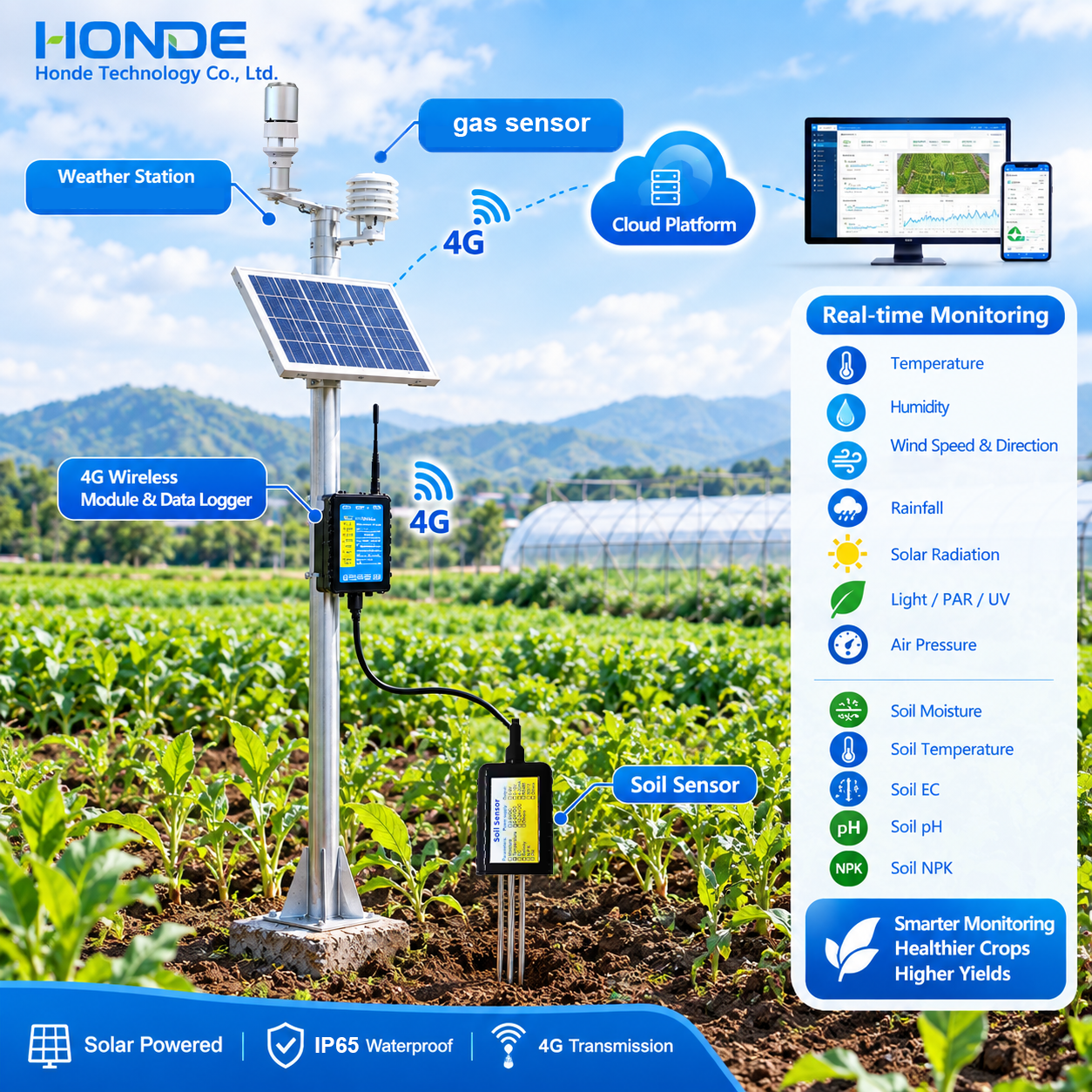
What Is a 4G Agricultural Weather and Soil Monitoring System?
Traditional agricultural monitoring often requires workers to visit the field and manually record weather and soil conditions. This approach can create gaps between measurements and makes it difficult to understand rapid environmental changes.
A 4G agricultural monitoring system changes this workflow by connecting field sensors directly to an IoT communication network.
The system shown in the Honde solution combines several functional layers:
- Weather monitoring layer
- Soil monitoring layer
- Data acquisition layer
- 4G wireless communication layer
- Solar power supply layer
- Cloud monitoring and data management layer
The result is a sensor-to-cloud architecture that allows agricultural managers to monitor field conditions remotely.
Honde has also developed related agricultural monitoring architectures integrating weather stations, multi-parameter soil sensors, 4G communication and MQTT data transmission.
Weather Station and Soil Sensors: Why Combine Them?
A weather station measures what is happening above the ground, while soil sensors measure conditions inside the root zone.
Using only one type of sensor provides an incomplete picture of the crop environment.
Weather Station Data
Depending on the selected configuration, an agricultural weather station can monitor:
- Air temperature
- Air humidity
- Atmospheric pressure
- Wind speed
- Wind direction
- Rainfall
- Light intensity
- Solar radiation
- PAR
- UV radiation
- Other agricultural environmental parameters
Soil Sensor Data
The soil monitoring section can be configured for different agricultural requirements, including:
- Soil moisture
- Soil temperature
- Soil EC
- Soil salinity
- Soil pH
- Nitrogen
- Phosphorus
- Potassium
- Multi-depth soil moisture
- Other soil parameters
The exact sensor combination should be selected according to the crop, soil type, monitoring depth, and project objective.
This combined architecture provides a more complete picture of the relationship between weather conditions, soil conditions, irrigation requirements, and crop growth.
How Does the 4G Wireless Agricultural Monitoring System Work?
The system can be understood as a five-step data flow.
Step 1: Sensors Collect Field Data
The weather station continuously measures environmental conditions around the crop.
At the same time, soil sensors collect information from the root-zone environment.
For example, a farm may monitor:
Air Temperature → Air Humidity → Rainfall → Wind → Soil Moisture → Soil Temperature → Soil EC
These parameters can be collected at configurable intervals according to the application.
Step 2: Data Logger Collects Sensor Information
The data logger acts as the local data acquisition unit.
It receives measurements from connected sensors and organizes the information into a structured dataset.
Depending on the project configuration, interfaces such as RS485 and Modbus can be used for industrial sensor communication.
Step 3: 4G Module Sends Data Remotely
The 4G wireless module provides long-distance communication between the field monitoring station and the remote server.
Instead of requiring a physical network cable from the farm to a monitoring center, the device can use the cellular network to transmit data.
This is especially useful for:
- Large farms
- Remote agricultural fields
- Orchards
- Greenhouses
- Agricultural research stations
- Environmental monitoring sites
Honde’s existing 4G agricultural IoT architecture similarly combines professional weather monitoring, multi-layer soil monitoring and MQTT communication to create a sensor-to-cloud system.
Step 4: Cloud Server Stores the Data
After transmission, the monitoring data can be sent to a cloud server.
The software platform can provide access to:
- Real-time data
- Historical data
- Data records
- Parameter trends
- Alarm information
- Remote monitoring
Users can therefore monitor agricultural conditions without physically visiting every monitoring point.
Step 5: Users Make Data-Based Decisions
The final purpose of the system is not simply collecting numbers.
The collected information can support decisions related to:
- Irrigation
- Fertilization
- Crop management
- Greenhouse ventilation
- Weather risk monitoring
- Soil condition management
- Agricultural research
- Environmental analysis
This is the key transition from manual observation to data-driven agricultural management.
Why Is Solar Power Important for Remote Agricultural Monitoring?
Many agricultural monitoring locations do not have convenient access to grid electricity.
Installing a permanent power cable may increase:
- Installation cost
- Construction difficulty
- Maintenance requirements
- Infrastructure complexity
A solar-powered monitoring station provides an alternative architecture.
Solar-Powered System Architecture
Solar Panel → Solar Controller → Battery → Sensors + Data Logger + 4G Module
During daylight hours, the solar panel supplies energy and charges the battery.
The battery can then provide power to the monitoring equipment when solar radiation is unavailable.
This architecture is particularly suitable for outdoor monitoring points where grid electricity is limited.
Honde’s agricultural monitoring solutions also use solar-powered field equipment together with low-power wireless technologies for remote agricultural deployments.
Key Advantages of 4G + Solar Agricultural Monitoring
| Feature | Traditional Manual Monitoring | 4G Solar IoT Monitoring |
|---|---|---|
| Data collection | Manual | Automatic |
| Remote access | Limited | Yes |
| Real-time monitoring | Difficult | Supported |
| Field visits | Frequent | Reduced |
| Grid electricity | Often required | Solar-powered option |
| Historical records | Manual recording | Digital storage |
| Large-area deployment | Difficult | Easier to scale |
| Weather + soil integration | Usually separated | Integrated architecture |
| Cloud connection | Limited | 4G wireless connection |
The biggest difference is the transition from periodic manual measurement to continuous connected monitoring.
What Agricultural Problems Can This System Help Solve?
1. Precision Irrigation
Soil moisture data can help agricultural managers understand the water condition around crop roots.
When soil data is combined with rainfall and weather information, irrigation decisions can be based on multiple environmental parameters rather than a fixed schedule.
2. Greenhouse Environmental Monitoring
Greenhouses can experience rapid changes in temperature, humidity and radiation.
A weather and soil monitoring system can provide continuous environmental information to support greenhouse management.
For more information about integrated agricultural monitoring, see Honde’s related guide on Agriculture Weather Station and Soil Sensor System with 4G MQTT.
3. Orchard Monitoring
Orchards may cover large areas where manual monitoring of every location is inefficient.
Distributed weather stations and soil sensors can provide localized environmental data.
4. Agricultural Research
Research projects often require long-term environmental datasets.
Automatic data collection can help create continuous records for:
- Crop growth research
- Irrigation experiments
- Soil research
- Microclimate analysis
- Agricultural environmental studies
5. Remote Farm Management
When the farm is far away from the management center, 4G communication makes remote monitoring possible.
Managers can access field information without being physically present at the monitoring point.
How to Choose the Right Weather Station and Soil Sensors?
There is no single sensor configuration suitable for every agricultural project.
Before purchasing an IoT agricultural monitoring system, buyers should define several key requirements.
1. Determine the Weather Parameters
Ask:
- Do you need rainfall?
- Is wind speed important?
- Is wind direction required?
- Do you need solar radiation?
- Is PAR measurement required?
- Do you need atmospheric pressure?
- Do you need air temperature and humidity?
2. Determine the Soil Parameters
For soil monitoring, identify whether the project requires:
- Soil moisture
- Soil temperature
- EC
- Salinity
- pH
- NPK
- Multiple measurement depths
Multi-parameter and multi-depth configurations can be useful when the project needs more detailed root-zone information.
3. Select the Communication Method
Communication should be selected according to the infrastructure and distance.
Common options include:
- 4G
- GPRS
- Wi-Fi
- LoRa
- LoRaWAN
- RS485
- Ethernet
For locations with cellular coverage and no convenient wired network, 4G is a practical option.
For large distributed agricultural sensor networks, LoRa/LoRaWAN can also be considered. Honde’s related LoRa/LoRaWAN architecture connects distributed soil sensors and weather stations through data collectors and gateways.
4. Consider Power Supply
For remote outdoor locations, evaluate:
- Solar panel size
- Battery capacity
- Sensor power consumption
- 4G transmission frequency
- Local solar conditions
- Expected autonomous operating time
Power design should be considered together with communication and sensor selection rather than separately.
4G vs LoRaWAN for Agricultural Monitoring
Both 4G and LoRaWAN can be used in smart agriculture, but their architectures are different.
| Factor | 4G | LoRaWAN |
|---|---|---|
| Communication architecture | Cellular network | LPWAN gateway network |
| SIM/network dependency | Usually required | Gateway required |
| Individual sensor connection | Direct cellular connection possible | Typically connects through gateway |
| Large sensor networks | Suitable depending on deployment | Well suited |
| Infrastructure | Mobile network | Gateway + network |
| Remote monitoring | Yes | Yes |
| Power optimization | Depends on device design | Often suitable for low-power nodes |
For a single integrated weather station with several sensors, 4G can simplify the connection from the field to the cloud.
For many low-power sensor nodes distributed across a large farm, LoRaWAN can provide a different network architecture.
The correct choice depends on number of monitoring points, distance, available infrastructure, power budget, and project requirements.
From Sensor Data to Smart Agriculture
A modern agricultural monitoring system should not be viewed simply as a collection of sensors.
The complete system can be represented as:
Sensors
↓
Data Acquisition
↓
Wireless Communication
↓
Cloud Server
↓
Data Visualization
↓
Alarm / Analysis
↓
Agricultural Decision
This architecture creates an information chain from the physical field to the management platform.
Honde’s agricultural monitoring solutions similarly emphasize the integration of sensors, wireless communication and cloud-based data management rather than treating each sensor as an isolated device.
Honde Technology: IoT Solutions for Agricultural Monitoring
Honde Technology Co., Ltd. was founded in 2011 with the business philosophy “Technology Making Our Life Better.”
The company focuses on the R&D, production and sales of smart water equipment, smart agriculture equipment, smart environmental equipment and related IoT solutions.
Honde products and solutions are supplied to customers in more than 70 countries and can be configured for different agricultural and environmental monitoring requirements.
The company provides sensor and monitoring solutions covering areas such as:
- Agricultural weather stations
- Soil sensors
- Environmental sensors
- Water monitoring equipment
- 4G IoT systems
- LoRa/LoRaWAN systems
- Data loggers
- Cloud monitoring platforms
- Customized agricultural monitoring solutions
Honde’s existing agricultural weather station solutions emphasize configurable environmental parameters and remote access through wireless communication and cloud software.
Frequently Asked Questions
Can a weather station and soil sensors work in the same system?
Yes. A weather station and soil sensors can be connected through a common data acquisition and communication architecture. This allows above-ground and below-ground environmental data to be monitored together.
Can the system work without grid electricity?
A solar-powered architecture can be used for remote installations. The actual power design should be matched to sensor consumption, communication frequency, battery capacity and local solar conditions.
Can 4G transmit agricultural data to a cloud server?
Yes. A 4G IoT module can transmit sensor data through a cellular network to a remote server. MQTT or other supported communication protocols can be used depending on the system architecture.
What soil parameters can be monitored?
Depending on the sensor configuration, the system can monitor soil moisture, soil temperature, EC, salinity, pH and other parameters. Multi-parameter and multi-depth sensors can also be selected for more advanced applications.
Is this system suitable for greenhouses?
Yes. Weather, soil and environmental sensors can be configured for greenhouse monitoring. The selected parameters should match the crop and greenhouse control requirements.
Can the system be customized?
Yes. For B2B agricultural projects, sensor combinations, communication modules, measurement parameters, installation structures and software interfaces can be customized according to project requirements.
Conclusion: Building a Connected Agricultural Monitoring Network
A weather station and soil sensor system with 4G wireless communication and solar power combines four important technologies:
Environmental Sensing + Soil Monitoring + Wireless IoT + Autonomous Power
This architecture enables agricultural managers to collect environmental information automatically and access the data remotely.
For farms, greenhouses, orchards and agricultural research projects, the key value is not simply measuring temperature, humidity or soil moisture. The larger objective is to create a connected monitoring infrastructure that transforms field conditions into usable digital information.
As agricultural operations become increasingly data-driven, the combination of weather stations, soil sensors, 4G communication, solar power and cloud monitoring provides a flexible foundation for precision agriculture.
Get a Customized Agricultural IoT Monitoring Solution
If you are planning an agricultural weather monitoring, soil monitoring, greenhouse monitoring or remote IoT project, the sensor configuration should be designed according to your crop, measurement parameters, communication environment and power requirements.
Honde Technology Co., Ltd.
Company Name: Honde Technology Co., Ltd.
Website: www.hondetechco.com
Email: info@hondetech.com
Contact Honde Technology for a customized weather station and soil sensor solution with 4G, LoRa/LoRaWAN, solar power and cloud monitoring.
Related Honde resources:
- Weather-Soil-Network Integrated Smart Agriculture System
- All-in-One Agricultural Weather Station Guide
Post time: Sep-24-2026