

When Winter Weather Changes in Minutes, Rain Detection Cannot Wait
For Nordic road maintenance teams, precipitation is not simply a weather measurement.
It can be the first signal of a dangerous road condition.
Rain begins.
The road temperature drops below freezing.
The surface becomes wet.
Ice begins to form.
A maintenance vehicle needs to be dispatched.
The entire decision chain can happen within minutes.
This is why real-time precipitation detection has become an increasingly important part of Road Weather Information Systems (RWIS).
Sweden’s Trafikverket currently operates around 750 road weather stations, providing real-time information including road-surface temperature, air temperature, precipitation, humidity and wind.
Finland’s Fintraffic operates more than 420 road weather stations, with road-weather measurements updated every minute and used extensively for winter road maintenance.
Norway’s road-weather measurement data is currently published at 10-minute intervals.
The operational requirement is clear:
The earlier a road-weather system detects precipitation, the earlier maintenance teams can evaluate the risk of snow, freezing rain and icy roads.
Traditional tipping-bucket rain gauges can provide reliable precipitation accumulation data, but their mechanical design introduces another consideration in winter:
There is a physical mechanism that must remain free to move.
For cold-climate networks, this has encouraged growing interest in solid-state optical precipitation sensors with no tipping bucket and no moving mechanism.
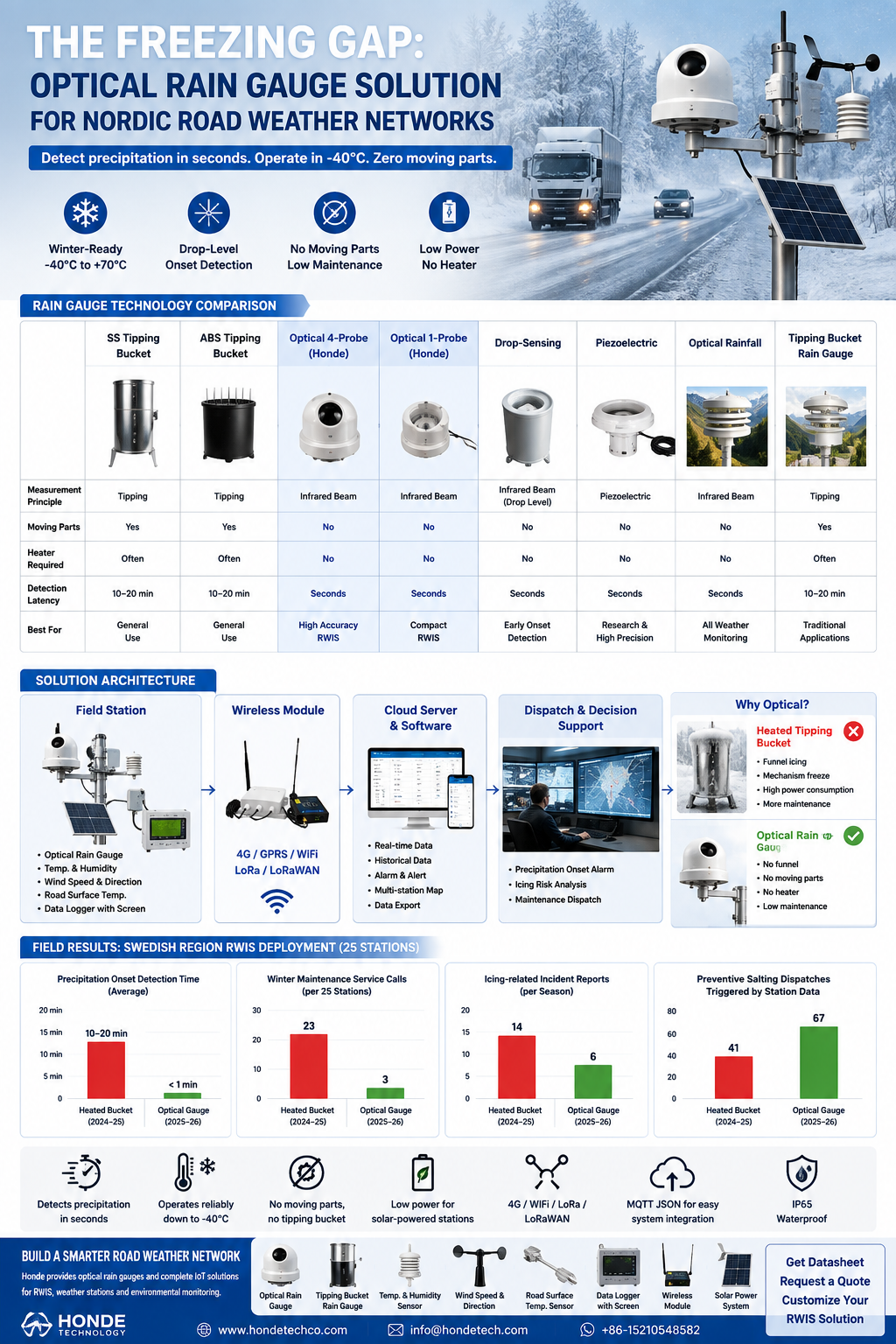
The Winter Problem: A Rain Gauge Has to Survive the Weather It Measures
A conventional tipping-bucket rain gauge works by collecting precipitation in a funnel.
Once a predefined amount of water accumulates, the bucket tips.
The tipping action generates a measurement pulse.
The cycle repeats.
Tipping-Bucket Measurement
Rain / Snow
     ↓
   Funnel
     ↓
 Collect Water
     ↓
 Bucket Fills
     ↓
   TIP
     ↓
Measurement Pulse
The mechanism is simple and proven.
But winter introduces additional challenges:
- ✕ Snow and ice can accumulate around the collection area.
- ✕ Moving components can become difficult to operate in freezing conditions.
- ✕ Heated versions require additional power.
- ✕ Mechanical components add another maintenance point.
- ✕ Very light precipitation may take time to accumulate enough water to trigger a tip.
For a conventional weather station, these may be manageable.
For a remote solar-powered RWIS station in a Nordic winter, they can become important system-level considerations.
Optical Precipitation Sensing: No Bucket. No Tipping Mechanism.
Honde’s optical rain gauge uses a different measurement principle.
Instead of waiting for precipitation to accumulate in a bucket, the sensor monitors an infrared sensing beam.
When precipitation particles pass through the sensing area, they interrupt the optical path.
The sensor detects the event and processes the precipitation signal.
Optical Measurement
        Rain / Snow
       ↓   ↓   ↓
    ●     ●     ●
       ↓   ↓
 ───────────────────
      IR Sensing
        Beam
 ───────────────────
       ↓
 Particle Detected
       ↓
Precipitation Data
The key difference is simple:
Tipping bucket = measure after accumulation
Optical sensor = detect precipitation as particles pass through the sensing zone
This makes optical technology particularly attractive when rapid precipitation onset detection and low mechanical maintenance are important.
Optical vs. Tipping Bucket: What Changes?
| Feature | Heated Tipping Bucket | Honde Optical Rain Gauge |
|---|---|---|
| Measurement principle | Mechanical tipping | Infrared optical sensing |
| Moving parts | Yes | None |
| Funnel / bucket | Yes | No |
| Heater | Often used for winter operation | No heating element required by design |
| Light precipitation onset | Accumulation-dependent | Particle-level detection |
| Snow detection | Collection/melting dependent | Direct precipitation detection |
| Freezing mechanical risk | Higher | No tipping mechanism to freeze |
| Power demand | Heater can increase demand | Low-power sensing architecture |
| Maintenance | Funnel/mechanism inspection | Low maintenance |
| Remote solar station | More power planning required | Well suited |
| RS485 | Available depending configuration | RS485 Modbus-RTU |
| Wireless IoT | Optional | 4G / WiFi / LoRa / LoRaWAN |
The Product Positioning
Not simply another rain gauge.
It is a:
Low-maintenance, solid-state precipitation sensor for automated weather and road-weather monitoring.
Why Winter Road Maintenance Needs Faster Precipitation Detection
The real value of precipitation detection is not the rainfall number itself.
It is what the data allows the road operator to do next.
Consider a simplified winter scenario:
TIME ───────────────────────────────────────────────→

00:00       00:05       00:10       00:15       00:20

Rain begins
   │
   ▼
Optical Detection
   │
   └──────► Operator evaluates road condition
                       │
                       ▼
                 Salt / Plow Decision
With a system that detects precipitation immediately, the operator has more time to combine:
- precipitation;
- road-surface temperature;
- air temperature;
- humidity;
- weather forecast;
- camera images;
- traffic conditions;
before deciding whether winter maintenance is required.
This is consistent with how Nordic road-weather networks are operated.
Fintraffic states that real-time road-weather information is used for allocating winter-maintenance resources, while Trafikverket uses its road-weather stations to continuously monitor conditions and support preventive winter-road operations.
The Real Value: From “Rain Detected” to “Road Risk Detected”
An optical rain gauge should not operate alone.
Its strongest value appears when precipitation data is combined with other weather measurements.
Example RWIS Decision Logic
                Precipitation
                     │
                     ▼
            ┌─────────────────┐
            │ Optical Rain    │
            │     Gauge       │
            └────────┬────────┘
                     │
                     ▼
          Precipitation Detected
                     │
          ┌──────────┴──────────┐
          ▼                     ▼
   Road Temperature       Air Temperature
          │                     │
          └──────────┬──────────┘
                     ▼
              Icing Risk Logic
                     │
                     ▼
              Alarm / Alert
                     │
                     ▼
          Winter Maintenance
          Decision / Dispatch
This changes the sensor’s role.
It is no longer simply measuring rainfall.
It becomes a trigger within a road-weather decision system.
Honde Optical Rain Gauge: Product Specifications
| Parameter | Honde Optical Rain Gauge |
|---|---|
| Measurement Principle | Infrared Beam Interruption |
| Detection | Drop / Particle Sensing |
| Precipitation Types | Rain, Snow, Sleet, Freezing Rain |
| Moving Parts | None |
| Heating Element | Not required by design |
| Detection Response | Rapid precipitation onset detection |
| Operating Temperature | -40°C to +70°C |
| Wired Output | RS485 Modbus-RTU |
| Wireless Options | GPRS / 4G / WiFi / LoRa / LoRaWAN |
| Housing | Weatherproof |
| Application | RWIS, Weather Stations, Hydrology, Agriculture, Flood Monitoring |
Three Product Advantages to Put on the Product Page
01 — No Moving Parts
Less mechanical complexity for long-term outdoor deployment.
02 — Winter-Ready Design
Designed for cold environments without relying on a continuously heated tipping mechanism.
03 — Fast Precipitation Detection
Detect precipitation particles directly instead of waiting for a bucket to accumulate enough water to tip.
The Nordic RWIS Opportunity
The scale of Nordic road-weather infrastructure demonstrates how important automated weather data has become.
Sweden
750
Road Weather Stations
Finland
420
Road Weather Stations
Norway
10 Min
Update Intervals
Market Signal
Nordic RWIS Data Requirement

Real-Time Data       ████████████████████
Winter Reliability   ███████████████████
Remote Monitoring    █████████████████
Low Maintenance      █████████████████
Low Power            ████████████████
Fast Detection       ███████████████████
The opportunity is therefore not limited to replacing one type of rain gauge.
It is about supplying more robust precipitation measurement for increasingly connected road-weather networks.
A Complete IoT Road Weather Monitoring Station
For independent websites, this is one of the most important sections for product conversion.
Don’t sell only the rain sensor.
Sell the complete monitoring solution.
Tier 1 — Weather Station
The optical rain gauge measures precipitation while other sensors monitor:
- Air temperature
- Relative humidity
- Wind speed
- Wind direction
- Atmospheric pressure
- Road-surface temperature
The system can therefore determine whether precipitation is occurring and whether the road environment is approaching an icing condition.
Tier 2 — Local Data Logger
A Data Logger with Screen provides on-site access to:
- Current precipitation
- Rainfall accumulation
- Communication status
- Sensor status
- Historical data
This is especially useful for installation, commissioning and maintenance teams.
Tier 3 — Wireless Transmission
Different communication methods can be selected according to site conditions:
4G / GPRS
For stations with cellular coverage.
LoRa / LoRaWAN
For low-power remote stations and distributed monitoring networks.
WiFi
For stations with local network infrastructure.
RS485 Modbus-RTU
For direct connection to industrial controllers and data loggers.
Tier 4 — Cloud Monitoring
The data can be transmitted to a cloud platform using MQTT JSON.
The cloud platform can display:
The Complete Architecture
      WEATHER / ROAD CONDITION
                │
     ┌──────────┼──────────┐
     ▼          ▼          ▼
 Rain Gauge   T/RH      Road Temp.
     │          │          │
     └──────────┼──────────┘
                ▼
        Data Logger
                │
       ┌────────┴────────┐
       ▼                 ▼
    4G/GPRS          LoRaWAN
       │                 │
       └────────┬────────┘
                ▼
          Cloud Platform
                │
       ┌────────┼────────┐
       ▼        ▼        ▼
    Dashboard  Alarm   History
                │
                ▼
      Winter Maintenance
          Decision
One Station → One Data Point
Multiple Stations → One Road-Weather Network
One Network → Centralized Winter-Maintenance Management
Why No Moving Parts Matters
For remote winter-weather equipment, mechanical simplicity is a practical advantage.
A tipping bucket contains:
Funnel + Bucket + Pivot + Moving Mechanism + Switch/Sensor
A solid-state optical precipitation sensor contains:
Emitter + Detector + Signal Processing
Complexity Comparison
Mechanical Tipping Bucket
████████████████
Moving mechanism
Funnel
Pivot
Switch
Possible heater
Ice management

Optical Sensor
████████
Optical sensing
Signal processing
No tipping mechanism
No moving parts
Fewer mechanical components can mean fewer mechanical failure modes and less maintenance attention.
This is especially valuable where a weather station is:
- on a remote highway;
- at a mountain pass;
- far from a maintenance depot;
- difficult to access during snowfall;
- powered by solar and battery.
Power Is Part of the Winter Engineering Equation
One of the most overlooked issues in remote weather stations is power.
A solar-powered station has to balance:
Sensor Power | Data Logger Power | Communication Power | Heating Power | Battery Capacity
During winter, solar generation can decrease precisely when precipitation and icing risks increase.
That makes power efficiency an important part of system design.
Simplified Energy Model
| System Component | Heated Tipping Bucket | Optical Sensor |
|---|---|---|
| Sensing electronics | ✓ | ✓ |
| Mechanical mechanism | ✓ | — |
| Heating system | Often required | Not required by design |
| Winter power demand | Higher | Lower potential system load |
| Battery sizing pressure | Higher | Reduced |
| Remote solar deployment | More challenging | Well suited |
For remote winter stations, eliminating an always-on heater can be as valuable as eliminating the moving bucket.
What Does Faster Detection Actually Change?
The sensor itself does not salt the road.
It gives the maintenance system an earlier signal.
That signal can then be combined with road temperature and other measurements.
Example Decision Timeline
| Event | Conventional Accumulation-Based Detection | Optical Detection |
|---|---|---|
| First precipitation | Begins | Detected |
| Precipitation signal | After accumulation | Immediate particle detection |
| Road-risk evaluation | Later | Earlier |
| Maintenance decision | Later | More decision time |
| Salt/plow dispatch | Later | Potentially earlier |
Important
The exact detection time depends on precipitation type, intensity, sensor configuration, installation and algorithm.
Therefore, the strongest marketing claim is not:
“Always 15 minutes faster.”
It is:
“Detect precipitation onset at the particle level instead of waiting for a tipping mechanism to accumulate enough water.”
That statement is both more technically defensible and more compelling to professional buyers.
From Rain Gauge to Smart Road Weather Sensor
The Honde optical rain gauge can be used in several markets beyond Nordic highways.
A Single Sensor Can Become Part of a Larger Water & Weather Solution
This is an important cross-selling opportunity for distributors.
This creates a broader product portfolio around:
Weather Monitoring + Hydrological Monitoring + Flood Warning
Buyer Checklist: Is an Optical Rain Gauge Right for Your RWIS?
| Requirement | Honde Optical Rain Gauge |
|---|---|
| Nordic / cold climate | ✓ -40°C operation |
| Snow detection | ✓ |
| Freezing rain monitoring | ✓ |
| No moving parts | ✓ |
| No tipping bucket | ✓ |
| No heater required by design | ✓ |
| Fast precipitation detection | ✓ |
| RS485 integration | ✓ |
| 4G communication | ✓ |
| LoRaWAN communication | ✓ |
| Solar-powered station | ✓ |
| Cloud monitoring | ✓ |
| MQTT JSON | ✓ |
| Multi-station network | ✓ |
| OEM customization | ✓ |
Why This Matters for System Integrators
For an equipment distributor or RWIS integrator, the opportunity is larger than selling a single precipitation sensor.
A typical project can include:
Optical Rain Gauge | Temperature & Humidity Sensor | Data Logger | 4G / LoRaWAN Communication | Solar Power | Cloud Platform | Alarm System
This creates a complete Road Weather Monitoring Station rather than a standalone rain gauge.
The New Product Positioning
The traditional question is:
“How much rain has fallen?”
The modern road-weather question is:
“Has precipitation started, and does the road now require action?”
That distinction is what makes optical precipitation sensing particularly interesting for automated winter-maintenance systems.
The future of RWIS is not just about collecting rainfall totals.
It is about:
Faster Detection | Lower Maintenance | Lower Mechanical Complexity | Remote Connectivity | Real-Time Decision Support | Reliable Winter Operation
The Bottom Line
Nordic road agencies already operate large, highly connected road-weather networks. Sweden’s Trafikverket reports approximately 750 weather stations, while Finland’s Fintraffic operates more than 420 road-weather stations and uses real-time weather information to support winter maintenance.
As these networks become increasingly data-driven, precipitation sensors need to provide more than a rainfall total.
They need to deliver:
Fast precipitation detection
Reliable cold-weather operation
Low mechanical maintenance
Low-power remote operation
Easy digital integration
Honde’s optical rain gauge is designed around these requirements.
No tipping bucket. | No moving parts. | No heater required by design. | RS485 Modbus-RTU. | 4G / GPRS / WiFi / LoRa / LoRaWAN. | MQTT JSON. | -40°C to +70°C operating range.
Detect precipitation earlier. Maintain less. Connect more.
Build a Smarter Road Weather Monitoring Station
Honde Technology provides optical precipitation sensors and complete IoT weather-monitoring solutions for:
Road Weather Information Systems | Winter Road Maintenance | Mountain Roads | Hydrological Monitoring | Flood Warning | Smart Agriculture
Available Solution Components
- Optical Rain Gauge
- Tipping Bucket Rain Gauge
- Temperature & Humidity Sensor
- Radar Water Level Sensor
- Radar Flow Meter
- Data Logger with Screen
- Handmeter
- 4G / GPRS / LoRaWAN Modules
- Cloud Server & Software
- Alarm Relay System
Request the Optical Rain Gauge Datasheet → Get a Complete RWIS Configuration → Ask for OEM / Project Customization
Honde Technology Co., Ltd.
Website: www.hondetechco.com
Email: info@hondetech.com
WhatsApp: +86-15210548582
SEO Optimization Data
SEO Title
Optical Rain Gauge for Road Weather Monitoring | No Moving Parts, -40°C, RS485 & LoRaWAN
Meta Description
Discover Honde optical rain gauges for RWIS, No moving parts, no heater required by design, -40°C operation, RS485, 4G and LoRaWAN.
Primary SEO Keywords
optical rain gauge | optical precipitation sensor | road weather sensor | RWIS precipitation sensor | winter rain gauge | snow rain sensor | freezing rain sensor | non-heated rain gauge | no moving parts rain gauge | RS485 rain gauge | LoRaWAN rain gauge | 4G rain gauge | smart rain gauge | automatic rain gauge | rainfall monitoring sensor | road weather monitoring system | winter road weather sensor | snow monitoring sensor | IoT weather station | remote rain gauge
Suggested Internal-Link CTA
Post time: Aug-19-2026