

To achieve long-term accuracy in soil carbon dioxide monitoring, sensors must feature IP68-rated corrosion resistance and NDIR (Non-Dispersive Infrared) technology with integrated temperature compensation. Underground environments are physically and chemically aggressive; without “diving suit” protection to block liquid moisture and “noise-canceling” internal logic to filter thermal fluctuations, sensor signals suffer from rapid data drift and hardware failure. These features ensure data integrity and a long service life in harsh, buried conditions.
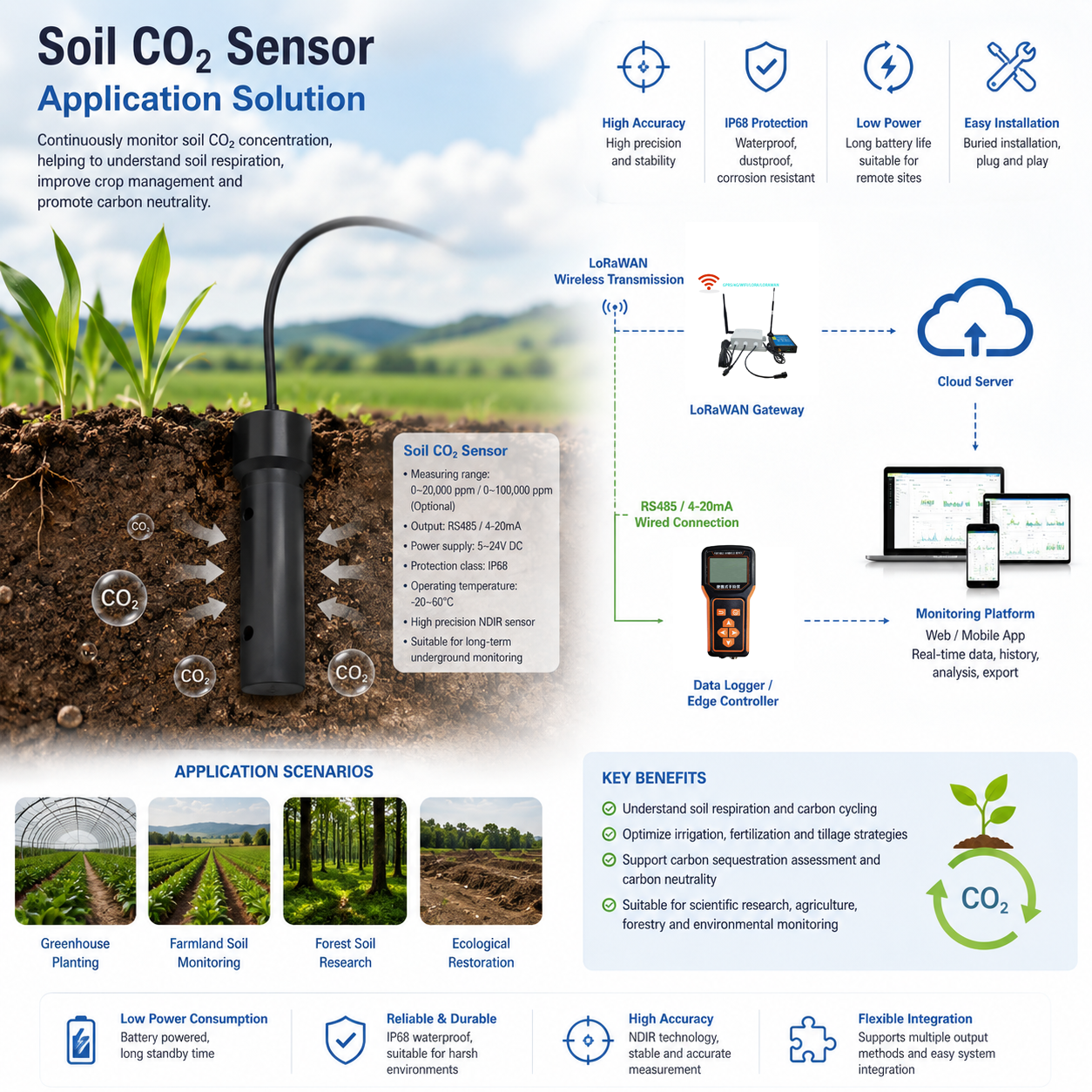
The “Diving Suit” Analogy: Why IP68 Corrosion Resistance is Non-Negotiable
In the world of IoT architecture, we view soil not as static dirt, but as a “hostile chemical soup.” It is a high-pressure environment of constant moisture, fluctuating acidity, and intense microbial activity. For a standard electronic component, a buried installation is a death sentence.
Honde’s soil CO2 sensors are engineered with a high-tech “diving suit”—an IP68-rated, anti-corrosive housing. This protection class ensures the device is completely waterproof and dustproof. Crucially, the sensor utilizes a specialized semi-permeable, breathable membrane. Just as a professional diving suit protects a diver while allowing them to breathe, this membrane protects the internal NDIR optical path and circuits from liquid water and corrosive salts while allowing CO2 gas molecules to pass through for measurement. Furthermore, the small size and “plug-and-play” design allow for installation in various soil layers with minimal soil disturbance, preserving the integrity of the very environment you are trying to measure.
Mastering Signal Stability: The “Noise-Canceling Headset” Advantage
In data science, temperature fluctuations and electrical interference are the “background chatter” of the soil. If your sensor cannot filter this noise, it cannot “hear” the true CO2 concentration.
We utilize the NDIR (Non-Dispersive Infrared) principle, which functions like a pair of premium noise-canceling headphones. By using specific infrared absorption gas detection, the sensor focuses exclusively on the “voice” of CO2 molecules. Because soil temperatures shift across seasons and depths, the built-in temperature sensor provides real-time temperature compensation. This filters out thermal “static,” ensuring high-precision signal stability and a stable linear output even when the ground is freezing or baking.
Technical Specifications: Honde Soil CO2 Sensor Reference
| Feature | Specification | Benefit |
| Measuring Range | 0–5000ppm | Flexible for agricultural monitoring or high-concentration research. |
| Technology | NDIR Principle | High selectivity, no oxygen dependence, and superior long-term stability. |
| Output Signal | RS485 (Modbus RTU) / 4-20mA | Industrial standard for long-distance cable runs and easy PLC/SCADA integration. |
| Power Supply | 7–24V DC | Low power consumption; ideal for solar or battery-powered remote sites. |
| Protection Class | IP68 | Waterproof and anti-corrosive for permanent buried online monitoring. |
| Operating Temp | -20°C to 50°C | Reliable performance across extreme seasonal temperature shifts. |
E-E-A-T Perspective: The Engineer’s Field Notes
In our laboratory testing at Honde, we have seen how frequently clients overlook the factor of oxygen dependence. While some older sensor technologies (like electrochemical versions) require oxygen to function—leading to massive errors in deep, anaerobic soil layers—our NDIR sensors have zero oxygen dependence. This makes them the only viable choice for deep-layer soil respiration and carbon sequestration studies where oxygen is depleted.
From an architectural standpoint, data integrity at the edge is paramount. We have engineered our sensors with a precise optical path design to prevent the physical misalignment that causes data drift over time. Additionally, the RS485 (Modbus RTU) output allows for cable runs of up to 1200 meters without signal degradation, making it easy to bridge the gap between buried sensors and a LoRaWAN Gateway or a central data logger for cloud-based analysis.
Key Benefits for Multi-Sector Applications
- Greenhouse Planting: Automate CO2 enrichment and ventilation to maximize photosynthetic efficiency and crop yields.
- Farmland Soil Monitoring: Gain real-time insights into soil respiration to optimize irrigation, fertilization, and tillage strategies.
- Forest Soil Research: Capture high-precision data for long-term scientific studies regarding carbon cycling and climate impact.
- Ecological Restoration: Provide the verified data required for carbon sequestration assessments and “Carbon Neutrality” audits.
Conclusion: Securing Your Monitoring ROI
Durability and accuracy are the twin pillars of a successful IoT deployment. By selecting sensors with IP68 “diving suits” and NDIR “noise-canceling” capabilities, you ensure that your hardware survives the environment and your data remains trustworthy for years. At Honde Technology, we focus on the small details—like breathable anti-corrosive membranes and stable optical paths—so your large-scale projects can succeed.
Ready to enhance your soil monitoring capabilities?
- [Download the full technical datasheet]
- [Consult with our engineering team for custom carbon sequestration projects]
Company Information:
- Company Name: Honde Technology Co., Ltd.
- Website: www.hondetechco.com
- Email: info@hondetech.com
Post time: Jun-01-2026