

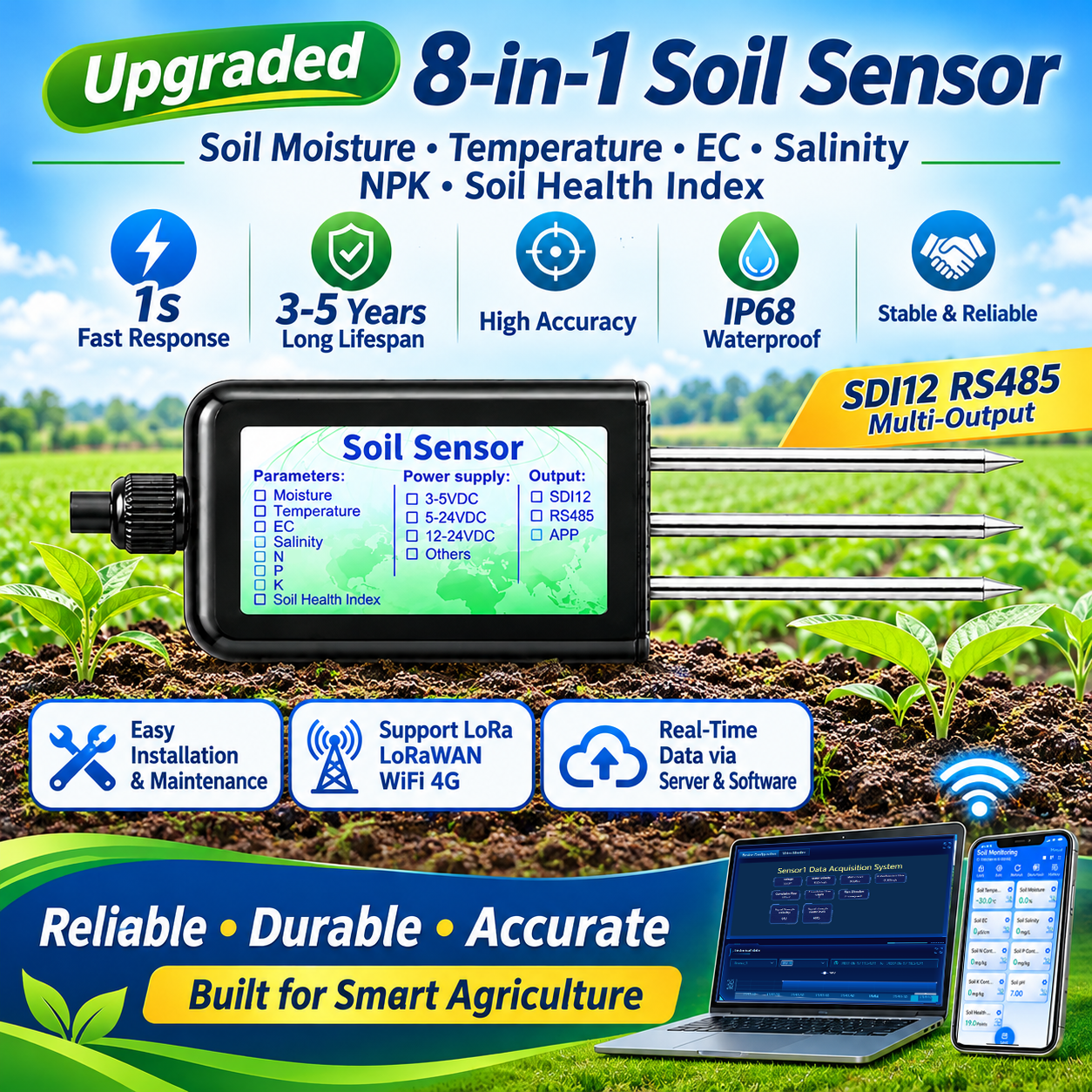
Quick Answer: What Is an Upgraded 8-in-1 Soil Sensor?
An upgraded 8-in-1 soil sensor is a multi-parameter agricultural monitoring device designed to measure eight important soil indicators: soil moisture, soil temperature, electrical conductivity (EC), salinity, nitrogen (N), phosphorus (P), potassium (K), and Soil Health Index (SHI). Honde’s upgraded model features a 1-second fast response, high-accuracy measurement, IP68 waterproof protection, and an expected service life of 3–5 years under specified operating conditions.
With SDI-12 and RS485 output options, the sensor can be integrated into different agricultural data acquisition systems. Optional LoRa, LoRaWAN, WiFi, and 4G wireless communication modules enable remote data transmission. Combined with server and software solutions, users can view real-time soil monitoring data through a computer or mobile device.
For agricultural equipment distributors, greenhouse operators, smart farming solution providers, and IoT system integrators, this sensor provides a practical way to collect multiple soil measurements through one integrated device.
1. Why Choose an Upgraded 8-in-1 Soil Sensor for Smart Agriculture?
Traditional soil monitoring often requires several individual instruments to measure moisture, temperature, salinity, and nutrient conditions.
This approach can increase equipment costs, installation complexity, wiring requirements, and maintenance workload.
An 8-in-1 soil sensor integrates multiple measurement functions into one device, helping agricultural projects simplify their soil monitoring infrastructure.
The upgraded Honde soil sensor focuses on five important advantages:
- Fast Response: 1-second response for efficient soil data acquisition.
- Long Service Life: Designed for an expected 3–5 years of operation under appropriate conditions.
- High Accuracy: Provides precise soil measurements for agricultural monitoring.
- Waterproof Protection: IP68-rated protection for demanding soil environments.
- Flexible Connectivity: Supports SDI-12, RS485 and optional wireless communication solutions.
Instead of purchasing multiple separate sensors, project developers can use one integrated device to collect a broader range of soil information.
2. Eight Soil Parameters: What Can the Sensor Measure?
The main advantage of an 8-in-1 soil monitoring sensor is its ability to collect physical, chemical, and nutrient-related soil information in one monitoring point.
The eight parameters provide complementary information for understanding soil conditions.
| Parameter | Full Name | Agricultural Application |
|---|---|---|
| 1. Moisture | Soil Moisture | Monitors soil water conditions and supports irrigation management |
| 2. Temperature | Soil Temperature | Tracks root-zone temperature changes |
| 3. EC | Electrical Conductivity | Helps evaluate soil conductivity and dissolved-ion conditions |
| 4. Salinity | Soil Salinity | Supports monitoring of salt accumulation |
| 5. N | Nitrogen | Provides information about soil nitrogen levels |
| 6. P | Phosphorus | Provides information about soil phosphorus levels |
| 7. K | Potassium | Provides information about soil potassium levels |
| 8. SHI | Soil Health Index | Provides an additional indicator for soil health assessment |
2.1 Soil Moisture Monitoring
Soil moisture is one of the most important indicators in agricultural production.
Insufficient soil moisture can affect crop growth, while excessive moisture can contribute to poor soil aeration and root-zone problems.
Real-time soil moisture monitoring helps growers:
- Evaluate soil water conditions.
- Identify differences between irrigation zones.
- Monitor moisture changes after irrigation or rainfall.
- Make more informed irrigation decisions.
- Reduce unnecessary manual soil inspections.
For precision irrigation projects, soil moisture data can be integrated with weather stations, irrigation controllers, and agricultural management software.
2.2 Soil Temperature Monitoring
Soil temperature affects seed germination, root development, nutrient availability, and microbial activity.
Continuous temperature monitoring helps agricultural managers understand changes in the root-zone environment.
Combining soil temperature and moisture measurements provides a more complete picture of soil conditions.
2.3 Soil EC and Salinity Monitoring
Electrical conductivity (EC) is an important indicator of the ability of soil to conduct electrical current.
Soil EC measurements can help evaluate changes in dissolved-ion conditions, while salinity monitoring provides information relevant to salt accumulation and soil management.
These measurements are particularly useful for:
- Greenhouse cultivation.
- Irrigated farmland.
- Fertigation systems.
- Coastal agricultural areas.
- Arid and semi-arid regions.
Monitoring EC and salinity together can help agricultural professionals identify changes in soil conditions and evaluate management strategies.
2.4 NPK Soil Nutrient Monitoring
Nitrogen, phosphorus, and potassium are three essential nutrients for plant growth.
An integrated NPK monitoring function provides additional information about soil nutrient conditions.
| Nutrient | Symbol | Importance in Agriculture |
|---|---|---|
| Nitrogen | N | Supports vegetative growth and leaf development |
| Phosphorus | P | Supports root development and energy transfer |
| Potassium | K | Supports plant metabolism and stress resistance |
NPK measurements can provide useful reference data for soil fertility monitoring and nutrient management.
For commercial projects, buyers should confirm the measurement ranges, accuracy, calibration requirements, and applicable soil conditions for each nutrient parameter.
2.5 Soil Health Index (SHI)
Soil Health Index (SHI) adds another dimension to multi-parameter soil monitoring.
Rather than examining only one soil measurement, an SHI-related indicator can help users evaluate soil conditions from a broader perspective.
For agricultural projects, soil health information can be considered together with moisture, temperature, EC, salinity, and NPK measurements.
This is particularly relevant to precision agriculture, soil improvement projects, agricultural research, and long-term soil monitoring.
Note: The SHI calculation method, reference scale, and interpretation should be confirmed against the selected sensor specification.
3. Key Technical Advantages of the Upgraded Soil Sensor
3.1 1-Second Fast Response
<bold>1s Fast Response</bold>
In agricultural IoT systems, timely data acquisition is important for monitoring changing soil conditions.
The upgraded sensor features a 1-second response specification, helping reduce the waiting time for measurement response.
This is beneficial for monitoring systems that require efficient data collection, including:
- Automatic soil monitoring stations.
- Greenhouse monitoring networks.
- Precision irrigation projects.
- Agricultural research installations.
- Multi-point soil monitoring systems.
A fast response specification should be distinguished from the complete system’s reporting interval, which also depends on the data logger, wireless module, and software settings.
3.2 3–5 Years Expected Service Life
<bold>3–5 Years Long Service Life</bold>
Long-term reliability is an important consideration when installing soil sensors across large agricultural areas.
Frequent replacement can increase labor expenses, maintenance costs, and project downtime.
Honde’s upgraded soil sensor is designed for an expected service life of 3–5 years under appropriate operating conditions.
Its durable construction supports long-term agricultural monitoring and helps reduce the frequency of equipment replacement.
Actual service life depends on installation conditions, soil characteristics, operating environment, and maintenance practices.
3.3 High-Accuracy Measurement
<bold>High Accuracy for Reliable Soil Data</bold>
Accurate soil measurements help agricultural managers make better-informed decisions.
For B2B buyers and system integrators, it is important to evaluate not only the number of measurement parameters but also the accuracy, measurement range, resolution, and calibration requirements.
The upgraded 8-in-1 sensor combines multiple measurement functions in one integrated device, providing a convenient option for projects that need comprehensive soil information.
3.4 IP68 Waterproof Protection
<bold>IP68 Waterproof Design</bold>
Soil sensors operate in environments that may involve moisture, mud, irrigation water, and prolonged contact with wet soil.
IP68 waterproof protection is an important feature for equipment designed for outdoor soil monitoring.
It helps protect the sensor against water and dust ingress when used within the specified protection conditions.
For installation projects, buyers should confirm the applicable IP68 test conditions and installation limitations with the manufacturer.
3.5 Stable and Reliable Operation
<bold>Reliable · Durable · Accurate</bold>
A professional soil monitoring system requires stable measurements and dependable communication.
The upgraded Honde sensor combines multi-parameter measurement, waterproof protection, and flexible communication interfaces to support different agricultural monitoring requirements.
4. SDI-12 and RS485: Flexible Data Output Interfaces
Different agricultural projects use different data acquisition architectures.
Some systems require a standardized digital sensor interface, while others use industrial communication protocols for integration with controllers, data loggers, and IoT gateways.
The upgraded 8-in-1 soil sensor supports SDI-12 and RS485 output options.
| Output Interface | Main Characteristics | Typical Applications |
|---|---|---|
| SDI-12 | Digital sensor communication interface | Environmental monitoring and agricultural data loggers |
| RS485 | Industrial serial communication interface | PLCs, IoT gateways, data acquisition systems and monitoring networks |
Why Is RS485 Important for Agricultural IoT?
RS485 is widely used in industrial monitoring because it supports communication between field sensors and compatible data acquisition equipment.
For smart agriculture projects, an RS485 soil sensor can be connected to:
- Data loggers.
- Industrial controllers.
- PLC systems.
- IoT wireless modules.
- Agricultural monitoring gateways.
- Customer-developed software platforms.
The actual protocol, wiring, register mapping, and data format should be confirmed for the selected configuration.
5. LoRa, LoRaWAN, WiFi and 4G: Wireless Soil Monitoring Options
A soil sensor becomes more useful when its measurements can be transmitted to a remote monitoring platform.
Different agricultural environments require different communication technologies.
Honde provides optional wireless communication solutions to help customers select a suitable connection method.
5.1 LoRa Wireless Communication
LoRa is suitable for agricultural projects that require low-power wireless data transmission across relatively large field areas.
It can be used to connect soil sensors with compatible data collectors and gateways.
Typical applications include:
- Large farms.
- Orchards.
- Remote agricultural fields.
- Distributed soil monitoring stations.
5.2 LoRaWAN Wireless Communication
LoRaWAN is suitable for projects that need a structured wireless monitoring network with multiple sensor nodes.
A typical architecture is:
Soil Sensor → LoRa Data Collector → LoRaWAN Gateway → Cloud Server → PC / Mobile Monitoring
This approach is useful for agricultural projects with multiple monitoring locations.
For additional information, see our article:
LoRaWAN Smart Agriculture Monitoring Network: Weather and Soil Sensors
5.3 WiFi Wireless Communication
WiFi is a convenient option for agricultural monitoring locations where a stable wireless network is already available.
Typical applications include:
- Greenhouses.
- Nurseries.
- Indoor agricultural facilities.
- Research laboratories.
- Farms with existing WiFi coverage.
5.4 4G Wireless Communication
For remote agricultural fields without convenient WiFi infrastructure, 4G provides another option for connecting field monitoring equipment to a remote server.
A typical system architecture is:
8-in-1 Soil Sensor → 4G Wireless Module → Cellular Network → Server → Remote Monitoring
This is useful for distributed agricultural monitoring projects where remote access is important.
Wireless Communication Comparison
| Communication | Suitable Environment | Main Advantage |
|---|---|---|
| LoRa | Large agricultural areas | Low-power wireless transmission |
| LoRaWAN | Multi-node monitoring networks | Scalable IoT network architecture |
| WiFi | Greenhouses and facilities | Uses existing WiFi infrastructure |
| 4G | Remote farms and outdoor sites | Cellular network connectivity |
The communication module is selected according to the project requirements. Wireless communication options may require additional modules, gateways, network services, or power arrangements.
6. Server and Software: Real-Time Soil Data Monitoring
Collecting soil data is only the first step.
For professional agricultural monitoring projects, users also need a convenient way to access, store, and analyze measurement results.
Honde can provide matched server and software solutions for remote monitoring.
With a compatible wireless module and monitoring platform, users can view soil data through a PC or mobile device.
Main Monitoring Functions
- Real-time soil data viewing.
- Historical data records.
- Soil parameter trend analysis.
- Remote monitoring through the internet.
- Centralized management of monitoring points.
- Optional alarm and data integration functions according to the selected system configuration.
Typical Sensor-to-Cloud Architecture
Step 1: Soil Measurement
The 8-in-1 soil sensor collects the selected soil parameters.
Step 2: Data Acquisition
The sensor transmits measurement data through the selected SDI-12 or RS485 interface.
Step 3: Wireless Transmission
A compatible LoRa, LoRaWAN, WiFi, or 4G communication module transfers data to the monitoring network.
Step 4: Server Processing
The server receives and processes the incoming monitoring data.
Step 5: Remote Monitoring
Users access real-time and historical data through the monitoring software.
This architecture helps agricultural operators move from manual soil inspections to connected digital soil monitoring.
For more information about connected soil monitoring and software architecture, read our guide:
WiFi Soil Sensor: Wireless Soil Monitoring with Cloud Software
7. Applications of the 8-in-1 Soil Sensor
7.1 Precision Agriculture
Large agricultural areas often contain different soil conditions, irrigation zones, and nutrient distributions.
By deploying multi-parameter soil sensors at representative locations, agricultural managers can collect continuous soil data and better understand field variations.
The measurements can support irrigation planning, nutrient management, and agricultural research.
7.2 Smart Greenhouse Monitoring
Greenhouse crops require careful management of root-zone conditions.
The 8-in-1 soil sensor can monitor moisture, temperature, EC, salinity, and nutrient-related parameters.
This information helps greenhouse operators evaluate soil conditions and adjust cultivation practices.
7.3 Precision Irrigation and Fertigation
Soil moisture and EC are important monitoring parameters in irrigation and fertigation projects.
By combining soil measurements with irrigation system data, operators can better evaluate water conditions and changes in soil conductivity.
When connected to suitable controllers, the sensor data can also serve as an input for automated irrigation management.
7.4 Orchard and Fruit Farm Monitoring
Orchards often cover large areas, making frequent manual soil inspections inconvenient.
Wireless soil monitoring provides a practical way to collect information from different planting zones.
LoRa and LoRaWAN communication can help connect distributed monitoring points through a compatible gateway.
7.5 Soil Research and Agricultural Experiments
For agricultural research institutions, multi-parameter soil monitoring can support long-term data collection.
Researchers can evaluate changes in moisture, temperature, EC, salinity, NPK, and SHI-related indicators under different cultivation and soil management conditions.
8. How to Choose the Right 8-in-1 Soil Monitoring Configuration
Before purchasing a multi-parameter soil sensor, B2B buyers should evaluate the complete monitoring requirements rather than focusing only on the number of parameters.
Here are seven important questions to consider.
- Which soil parameters are required? Confirm that moisture, temperature, EC, salinity, NPK, and SHI meet the project requirements.
- Which output interface is needed? Select SDI-12 or RS485 according to the data acquisition equipment.
- Which wireless communication method is suitable? Choose LoRa, LoRaWAN, WiFi, or 4G according to network coverage and deployment conditions.
- Is waterproof protection sufficient? Confirm the IP68 rating and applicable operating conditions.
- What is the required response time? Check the 1-second response specification and the complete system’s data reporting interval.
- Is remote monitoring required? Confirm whether a server, software, gateway, or communication module is needed.
- Does the project require customization? Discuss the required parameters, power supply, output interface, and wireless communication configuration with the manufacturer.
For projects combining weather stations, soil sensors, and wireless gateways, see our related guide:
Agriculture Weather Station and Soil Sensor System with 4G MQTT
9. Frequently Asked Questions (FAQ)
Q1. What are the eight parameters measured by the upgraded soil sensor?
The upgraded 8-in-1 configuration covers soil moisture, soil temperature, electrical conductivity (EC), salinity, nitrogen, phosphorus, potassium, and Soil Health Index (SHI).
Q2. How fast does the soil sensor respond?
The sensor features a 1-second response specification. The actual system reporting frequency also depends on the connected data acquisition and communication equipment.
Q3. How long is the expected service life?
The expected service life is 3–5 years under appropriate operating conditions. Actual service life depends on the installation environment and maintenance practices.
Q4. Is the soil sensor waterproof?
Yes. The sensor features IP68 waterproof protection. Buyers should confirm the applicable test conditions and installation limitations for their projects.
Q5. Does the sensor support both SDI-12 and RS485?
Yes. SDI-12 and RS485 are supported output options. Please confirm the selected interface and communication configuration when ordering.
Q6. Can the soil sensor transmit data wirelessly?
Yes. Compatible wireless solutions can support LoRa, LoRaWAN, WiFi, and 4G transmission through the corresponding modules and system configuration.
Q7. Can I view soil data remotely?
Yes. With a compatible wireless communication module and server/software solution, users can view real-time soil monitoring data remotely through a computer or mobile device.
Q8. Can the sensor be used in greenhouses and open fields?
Yes. It is designed for agricultural soil monitoring applications, including greenhouses, open farmland, orchards, nurseries, and agricultural research projects. The installation and communication configuration should match the specific environment.
Q9. Can Honde provide a complete wireless monitoring solution?
Honde can provide soil sensors, compatible wireless communication equipment, and server/software solutions. The complete configuration can be discussed according to the number of monitoring points, communication requirements, and project conditions.
10. Conclusion: A Reliable 8-in-1 Soil Sensor for Smarter Agriculture
The upgraded 8-in-1 soil sensor provides an integrated approach to agricultural soil monitoring by combining moisture, temperature, EC, salinity, NPK, and Soil Health Index measurements in one device.
With its 1-second response, 3–5 years expected service life, high-accuracy measurement, and IP68 waterproof protection, it is designed for demanding agricultural monitoring applications.
More importantly, SDI-12 and RS485 output options, together with LoRa, LoRaWAN, WiFi, and 4G wireless solutions, make it possible to connect field measurements with remote server and software platforms.
Whether you are developing a precision irrigation project, building a greenhouse monitoring system, supplying agricultural equipment, or integrating an IoT-based smart farming solution, Honde can help you select a suitable soil monitoring configuration.
Looking for an upgraded 8-in-1 soil sensor for your agricultural project?
Contact Honde Technology today to discuss your required parameters, communication options, and customized monitoring solutions.
Product Link:
Upgraded 8-in-1 Soil Sensor – Honde Technology
About Honde Technology Co., Ltd.
Honde Technology Co., Ltd. is an IoT technology company specializing in the research, development, production, and sales of smart water equipment, smart agriculture equipment, smart environmental monitoring equipment, and integrated IoT solutions.
With a focus on reliable sensing technology and wireless data communication, Honde provides monitoring products and customized solutions for customers worldwide.
Company Name: Honde Technology Co., Ltd.
Website: https://www.hondetechco.com/
Email: info@hondetech.com
Reliable Sensing · Intelligent Connectivity · Smarter Agriculture
Post time: Nov-17-2026